

International shipping remains central to global commerce, but the market is becoming more volatile. Geopolitical disruptions, changing trade routes, freight-rate movements, fleet expansion, port congestion, and carrier strategies are reshaping how goods move between markets.
Maritime transport carries more than 80% of the world’s goods traded by volume, making shipping performance closely connected to global trade and supply-chain competitiveness. Freight rates have also remained volatile.
For shipping companies, ports, freight forwarders, exporters, importers, logistics providers, investors and financial institutions, understanding this market requires information to routes, ports, carriers, and capacity developments which will shape international shipping competitiveness in the future.
An International shipping market analysis helps evaluate shipping routes, freight rates, port performance, trade flows, and future market opportunities to help stakeholders understand market dynamics and make more informed shipping, infrastructure, and investment decisions.
Why Shipping Routes Are Changing
International shipping routes are evolving due to geopolitical developments, changing trade patterns, supply chain diversification, and shifts in global manufacturing activity. As companies seek more resilient and flexible supply chains, cargo flows are increasingly moving through alternative corridors, ports, and transshipment hubs.
These changes are influencing shipping capacity, freight rates, transit times, and infrastructure requirements, making route selection a critical factor in international trade competitiveness.
The Evolving International Shipping Market
The international shipping market is shaped by a combination of global trade activity, economic conditions, transportation capacity, infrastructure development, and changing supply chain requirements.
As trade flows shift and market conditions evolve, shipping networks must adapt to new sourcing patterns, customer expectations, and operational challenges.
Understanding these dynamics is essential for organizations seeking to improve supply chain efficiency, manage transportation costs, and identify emerging opportunities across global shipping and logistics networks.
Nexdigm’s View on International Shipping Trends
Global shipping trends are increasingly shaped by changing trade routes, evolving freight economics, capacity realignments, port performance, and shifting supply chain strategies. As these factors continue to influence international trade flows, organizations need a deeper understanding of how market dynamics may affect shipping costs, service reliability, and logistics competitiveness.
Nexdigm evaluates these interconnected trends to identify emerging opportunities, potential risks, and the implications for shipping networks, infrastructure planning, and investment decisions. These insights form the foundation of Nexdigm’s International Shipping Market Analysis Framework.
Nexdigm’s International Shipping Market Analysis Framework
Nexdigm conducts International shipping market analysis through its structured framework which evaluates five important dimensions. Together, these dimensions provide a structured view of shipping-market attractiveness, operational risk, and future commercial potential.
- Shipping Routes: Nexdigm maps major trade lanes, cargo flows, transit distances, chokepoints, and alternative routes to identify changing patterns and emerging corridor opportunities.
- Freight Rates: The assessment examines spot rates, contract pricing, fuel costs, surcharges, and historical movements to understand route economics and shipping-cost pressures.
- Vessel Capacity: Nexdigm evaluates fleet size, vessel deployment, orderbooks, utilization, vessel types, and capacity growth to identify supply-demand imbalances across shipping markets.
- Port Performance: The framework assesses throughput, congestion, turnaround times, connectivity, handling efficiency, infrastructure, and expansion plans to evaluate gateway competitiveness and capacity constraints.
- Carrier Competition: Nexdigm compares carrier networks, alliances, service frequency, fleet strength, pricing, market share, and customer offerings to assess competitive dynamics.
The analysis connects these dimensions to help organizations evaluate shipping markets and identify opportunities, risks, and strategic priorities.
Value Delivered by Nexdigm’s International Shipping Analysis Framework
Nexdigm’s framework provides a structured view of shipping market dynamics, enabling organizations to evaluate route competitiveness, capacity availability, freight economics, and infrastructure requirements. The assessment supports organizations with the following benefits:
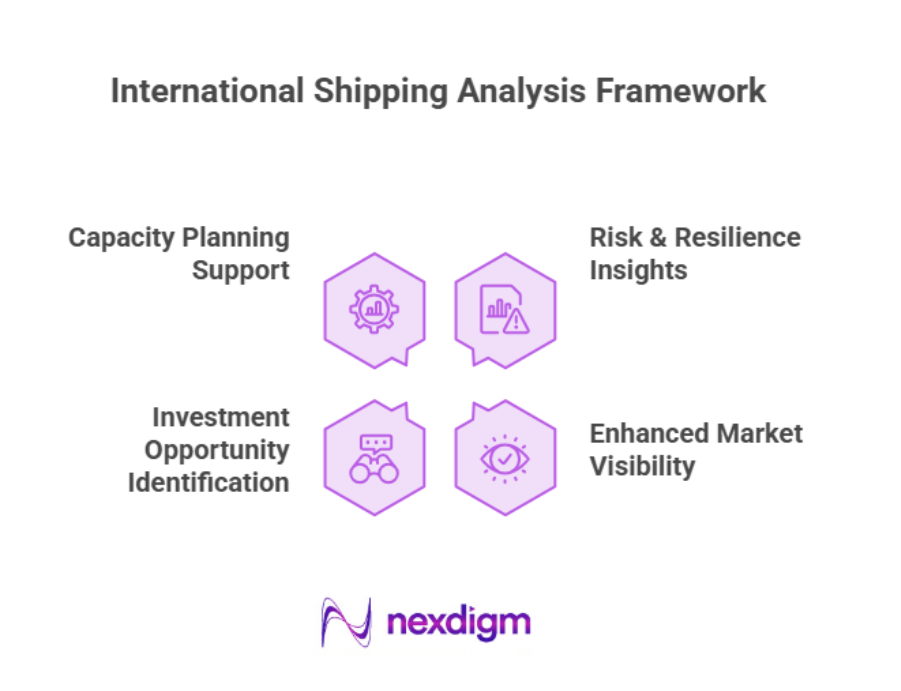
- Enhanced Market Visibility: Provides a comprehensive understanding of trade flows, freight rates, carrier activity, and port performance to support better strategic planning and market positioning.
- Capacity Planning Support: Evaluates shipping and port capacity against projected demand to identify potential constraints and areas requiring operational or infrastructure enhancements.
- Investment Opportunity Identification: Highlights locations and logistics assets where growing trade activity may create opportunities for infrastructure investment and network expansion.
- Risk & Resilience Insights: Assessment of factors affecting service reliability, capacity utilization, and supply chain continuity, helping organizations strengthen operational resilience.
By combining insights from the analysis, the framework enables organizations to make more informed shipping, network, and investment decisions while improving competitiveness in a rapidly evolving global trade environment.
Nexdigm’s Strategic Investment Decision Support
Using the findings from the assessment framework, Nexdigm helps organizations evaluate investment opportunities across ports, shipping networks, logistics infrastructure, carrier partnerships, and trade corridors. This supports the prioritization of investments that enhance connectivity, improve operational efficiency, and create long-term value in international shipping markets.
Nexdigm’s Case
A shipping company engaged Nexdigm to assess routes, freight rates, port capacity, and carrier competition. The analysis helped reduce shipping costs by 13%, improve route reliability by 21%, and increase capacity utilization by 18%. The impact included stronger cost control, improved service reliability, and more resilient shipping operations.
To take the next step, simply visit our Request a Consultation page and share your requirements with us.
Harsh Mittal
+91-8422857704