

A shipping route becomes more commercially important when cargo demand, connectivity and service reliability make it a practical link between producers and buyers. Routes can gain importance as manufacturing locations change, regional trade expands or disruptions make traditional corridors less dependable. Tracking these shifts helps exporters, freight forwarders and shipping businesses understand where services, capacity and infrastructure may be needed.
Read The Movement Behind Trade Growth
Shipping data should be analysed by origin, destination, cargo type, volume and frequency. A rise in total cargo may reflect stronger demand, a change in product mix or the diversion of existing shipments from another route. These situations have different implications for long-term capacity planning.
UN Trade and Development reported that global maritime trade grew by 2.2% in 2024, while growth was expected to slow to 0.5% in 2025. Rerouting around disrupted corridors pushed maritime ton-miles up by approximately 6% in 2024, meaning ships travelled farther even though cargo volume grew much more slowly.
This distinction matters. A route may experience increased vessel demand without a corresponding increase in the quantity of goods being traded. Businesses should therefore examine cargo volumes alongside sailing distance, vessel availability and schedule changes.
Identify Routes Gaining Strategic Relevance
Effective international shipping trade analysis combines cargo movement, port connectivity, service frequency and transit performance to distinguish durable route growth from temporary diversion.
Several indicators help establish whether a corridor deserves closer attention:
- Sustained Cargo Growth: Volumes and shipment frequency increase across multiple reporting periods.
- Improved Connectivity: More direct services or stronger links connect the origin and destination markets.
- Changing Trade Relationships: Importers and exporters develop new or expanding commercial connections.
- Route Substitution: Cargo shifts from a congested or disrupted corridor to an alternative route.
- Reliable Transit: The route offers predictable delivery times and practical onward transport.
UNCTAD’s liner shipping connectivity data identifies China as a leading maritime connectivity centre in Asia and highlights Singapore, Malaysia, Viet Nam, India and other Asian economies among the region’s strongly connected economies. It also tracks the role of strategically positioned ports in other regions. Connectivity is an important indicator, but it does not by itself prove that a route is commercially attractive for every cargo type.
Separate Temporary Diversions From Structural Change
A route gaining traffic during a disruption may lose that volume when normal services resume. Before committing capacity, companies should compare current activity with longer-term trends and examine the reasons behind the shift.
Check port calls, available vessel capacity, freight costs, transshipment requirements, customs processes and inland access. For time-sensitive or specialised cargo, service frequency and reliability may matter more than the shortest distance.
Route analysis should also consider alternative scenarios. If a corridor becomes unavailable or costs rise sharply, can the shipment move through another port without undermining delivery commitments or product economics?
The Shipping Route Opportunity Framework
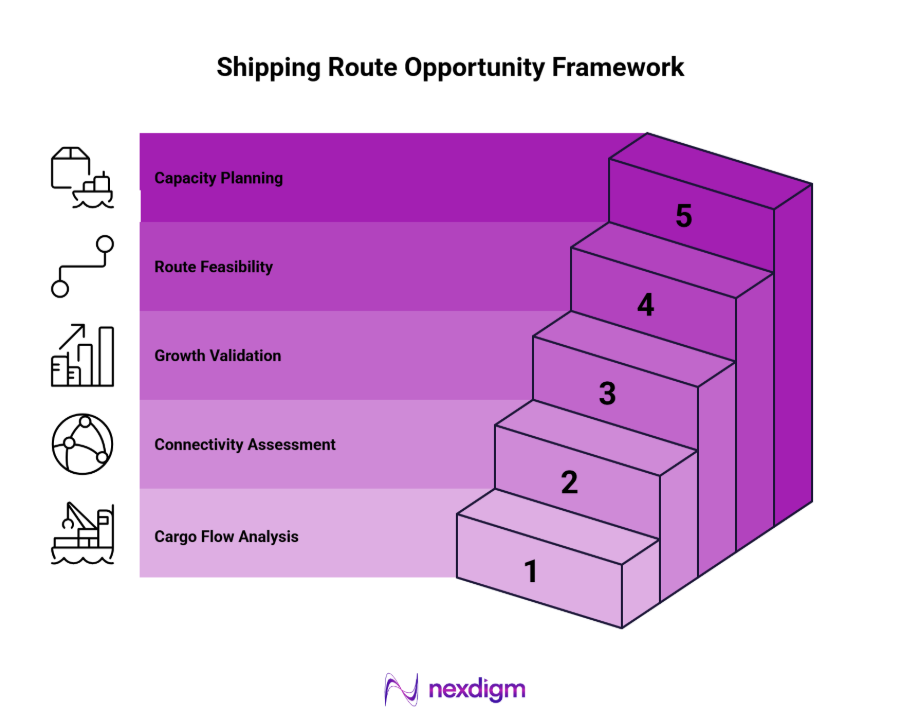
- Cargo Flow Analysis: Track origin-destination volumes, shipment frequency and cargo composition.
- Connectivity Assessment: Compare port links, direct services and available alternatives.
- Growth Validation: Distinguish sustained trade expansion from temporary diversion.
- Route Feasibility: Evaluate transit time, reliability, cost and inland connections.
- Capacity Planning: Prioritise corridors where demand and service conditions justify commercial investment.
Case Study: Evaluating An Alternative Corridor
A freight operator reviewed monthly cargo flows across six Asia-Europe and regional routes. Two alternative corridors showed sustained shipment growth, but only one offered suitable sailing frequency and inland connections for the target cargo. The operator prioritised carrier discussions for that corridor and retained a second route as a contingency.
To take the next step, simply visit our Request a Consultation page and share your requirements with us.
Harsh Mittal
+91-8422857704