

International student mobility is becoming increasingly important to universities competing for global talent. The OECD’s 2026 data shows that international students accounted for 11% of new bachelor’s entrants, 24% of master’s entrants, and 34% of doctoral entrants across OECD countries in 2024. International students are also more concentrated in STEM, with 30% of international graduates completing STEM degrees compared with 23% of national graduates.
At the country level, mobility remains concentrated around established destinations, but regional hubs and emerging study markets are gaining relevance. The five largest OECD destinations Australia, Canada, Germany, the United Kingdom, and the United States collectively receive almost 60% of international students moving to OECD countries. At the same time, India and China remain major sources of international students, while destination preferences increasingly reflect programme availability, affordability, career prospects, language, and post-study opportunities.
For institutions, the opportunity is therefore not simply to attract more international students, but to understand which countries, programmes, and student segments offer the strongest sustainable growth potential.
What Is Changing in International Student Demand?
International demand is becoming more differentiated across academic levels and fields of study. Students increasingly evaluate destinations based on the combination of programme quality, affordability, employability, immigration pathways, lifestyle, and institutional reputation. Two areas deserve particular attention:
- Destination Shifts: Emerging regional hubs and established destinations are competing through programme availability, tuition structures, English-taught courses, scholarships, infrastructure, and post-study opportunities.
- Programme Preferences: STEM, business, health, technology, and career-oriented programmes can attract strong international interest, particularly where graduates have access to employment and skills-development opportunities.
These differences make country- and programme-level analysis more useful than relying on overall international enrollment figures.
From Global Mobility to Institutional Opportunity
The international student market is influenced by several interconnected factors. A destination may attract substantial student volumes but still offer limited opportunity for a particular institution because of intense competition, high tuition, restrictive admissions, or weak programme alignment. Conversely, a smaller market can become attractive when student demand is growing, competition is manageable, and institutional offerings match local preferences.
Nexdigm brings an industry-focused expertise, combining market intelligence, education-sector research, student demand assessment, competitive analysis, and strategic advisory to help institutions understand where international growth opportunities are emerging.
Nexdigm’s Role in Supporting International Education Markets
Nexdigm supports education institutions in understanding evolving international student markets through market intelligence, sector research, demand assessment, and strategic advisory. Its expertise helps institutions evaluate source countries, programme preferences, competitive landscapes, affordability, and mobility drivers, enabling them to identify emerging opportunities and make more informed decisions around international recruitment, programme positioning, partnerships, and geographic growth.
Nexdigm’s International Student Market Opportunity Analysis
Nexdigm’s International student market opportunity analysis can help universities assess potential source countries and programme categories through a structured evaluation of demand, competition, affordability, mobility, and institutional fit. The assessment can examine:
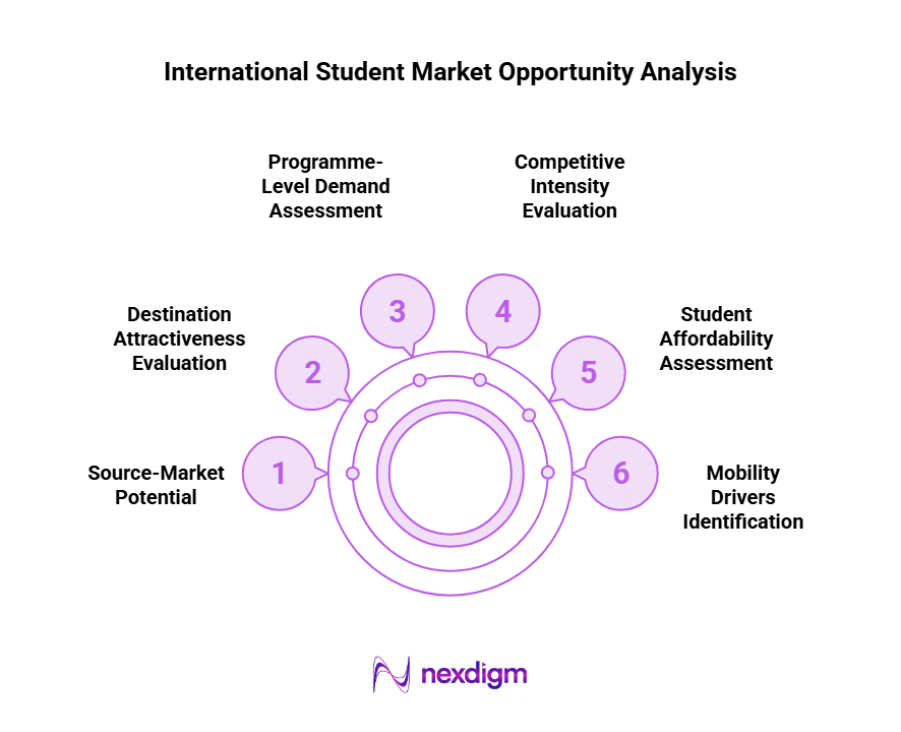
- Source-Market Potential: Analyze student populations, outbound mobility, income levels, education participation, and historical enrollment flows to identify promising origin markets.
- Destination Attractiveness: Evaluate competing destinations based on tuition, living costs, visa conditions, language, employability, institutional reputation, and post-study opportunities.
- Programme-Level Demand: Identify academic disciplines where international student interest aligns with workforce requirements and institutional capabilities.
- Competitive Intensity: Compare universities, programme availability, pricing, rankings, scholarships, capacity, and recruitment presence across target destinations.
- Student Affordability: Assess tuition sensitivity, financing requirements, scholarship expectations, and broader cost-of-study considerations.
- Mobility Drivers: Examine proximity, language, diaspora networks, employment opportunities, migration policies, and destination reputation that influence student decisions.
This enables institutions to move from broad international recruitment ambitions toward specific markets and programmes with identifiable demand potential.
Nexdigm’s Analytical Insights Supporting International Market Prioritization
Once international student markets have been assessed, the next step is determining where institutions should concentrate their resources. Nexdigm helps translate market findings into clear priorities by:
- Prioritizing Source Markets: Identify countries where student mobility and institutional offerings show stronger alignment.
- Matching Markets With Programs: Connect source-market demand with programmes that have relevant academic and career appeal.
- Identifying Market Gaps: Highlight underserved student segments or programme areas where competitive intensity may be lower.
- Guide Recruitment Investment: Help institutions focus recruitment resources, partnerships, and outreach efforts on priority opportunities.
This creates a practical bridge between market analysis and international enrollment strategy, helping institutions determine where their next growth opportunities may lie.
Nexdigm’s Case Study
Nexdigm supported a university assessing international student growth across multiple source markets and programmes. The engagement evaluated 16 source countries, compared 28 programme-market combinations, and identified 6 priority opportunities, helping narrow recruitment priorities by 37% and focus international growth planning on markets with stronger demand and programme fit.
To take the next step, simply visit our Request a Consultation page and share your requirements with us.
Harsh Mittal
+91-8422857704