
Export expansion often begins with a list of countries that import a company’s product. That list is useful, but it does not establish which market offers the strongest commercial return. Import demand may be large while tariffs, technical requirements, established suppliers or distribution costs make entry difficult. A smaller market can be more attractive if the company has a cost advantage and a credible route to customers.
International expansion requires trade-flow analysis to be connected with market access, competitor positioning, and the economics of serving each destination.
Establish Where Demand Is Real and Accessible
The first stage is to identify products and destinations where import demand is meaningful. Product-level trade data can reveal market size, growth, supplier shares, and changes in sourcing. The analysis should use the most detailed appropriate product classification, because broad commodity groups can combine products with different prices, applications, and regulatory requirements.
The International Trade Centre’s Export Potential Map uses import and export values, tariff data, economic indicators, and other variables to estimate potential export opportunities. Its methodology draws on trade data for 2020 to 2024 and tariff information available as of April 2026 for relevant inputs. Such tools help create an initial market shortlist, but their estimates should be treated as screening evidence rather than guaranteed sales forecasts.
A commercially useful shortlist also accounts for customer structure. A market dominated by a few large industrial buyers may require direct account development and lengthy qualification. A fragmented market may need local distributors, inventory, and a larger sales network.
Market Access Extends Beyond Tariffs
Tariffs directly affect the landed cost of imported goods, but formal duties are only one part of market access. Product registration, conformity assessment, labelling, testing, customs documentation, local certification and restrictions on particular materials can determine whether a product can be sold at all.
The World Trade Organization’s 2026 World Trade Report emphasised that non-tariff measures and behind-the-border regulations can have a greater effect on trade costs than tariffs in many markets. This matters for products subject to technical standards, safety requirements or sector-specific approvals. A low tariff does not guarantee an easy entry route if compliance demands significant time, expense or local expertise.
Companies should identify mandatory requirements early and distinguish them from optional commercial advantages. Regulatory barriers that can be addressed through testing or documentation may be manageable; requirements that demand major product redesign or a local operating presence may change the investment case.
Assess Competitive Position Before Choosing a Destination
Trade flows reveal which countries supply a market and how their positions are changing. A supplier gaining share may benefit from lower production costs, a trade agreement, geographic proximity, stronger product quality or established customer relationships. Understanding the cause matters more than observing the share movement alone.
Competitive analysis should compare the company’s proposed product with alternatives on landed price, specifications, reliability, service, and switching costs. It should also examine whether competitors have local stock, technical support, exclusive distributors, or long-term customer contracts.
For some exporters, the best entry strategy is to compete directly with established suppliers. Others may be better served by targeting a product niche, a specific customer segment, or a region where incumbent coverage is weak.
Convert Trade Evidence into a Market Entry Decision
A structured international trade analysis combines four perspectives: demand, market access, competition and execution economics. The purpose is to determine not simply whether a country imports the product, but whether the company can win enough business at acceptable returns.
The financial model should estimate net sales after duties, freight, insurance, distributor margins, compliance costs, and customer acquisition expenses. It should also include payment terms, currency exposure, and the cost of holding inventory. These factors can change the ranking of markets that appear similar in trade statistics.
Companies should test a range of scenarios for selling price, shipment volumes, exchange rates, and competitor response. Where evidence is weak, a limited export pilot or distributor-led launch can validate assumptions before the company commits to a larger fixed investment.
Evidence Required Before a Market Advances
- Product-level import demand is sustained across several periods and supported by relevant customer segments.
- Tariffs, standards, and product-specific regulations are understood and commercially manageable.
- The company has a defensible position against existing suppliers on price, quality, service or availability.
- Freight, channel costs and payment terms support acceptable net realisation.
- Qualified buyers, distribution partners or a realistic direct-sales route can be identified.
A Market Access and Expansion Framework
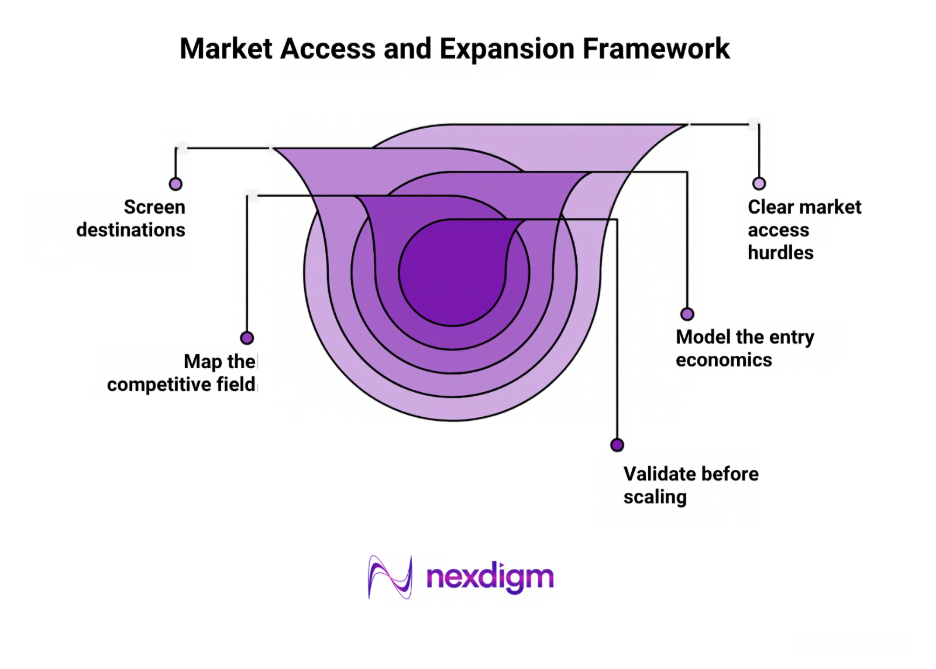
- Screen destinations: Rank countries by product-level imports, demand trends and customer relevance.
- Clear market access hurdles: Verify tariffs, product standards, registration, customs requirements and restrictions.
- Map the competitive field: Compare supplier shares, landed prices, product alternatives and channel strength.
- Model the entry economics: Calculate net realisation, customer acquisition costs, working capital and downside exposure.
- Validate before scaling: Use buyer discussions, samples, distributor checks or pilot shipments to confirm assumptions.
Nexdigm Case Study
A manufacturer compared seven export markets for an industrial product range. Trade analysis identified four plausible destinations, but regulatory and landed-cost screening reduced the shortlist to two. Management prioritised the market with stronger buyer access and more resilient projected margins, subject to customer and distributor validation.
To take the next step, simply visit our Request a Consultation page and share your requirements with us.
Harsh Mittal
+91-8422857704