
A product can have strong demand in a foreign market and still be difficult to supply competitively. Inland transport, border procedures, port connectivity, handling costs and documentation requirements all affect whether goods reach buyers on time and at a viable cost. Understanding these connections requires looking at trade flows and logistics infrastructure as parts of the same system.
Map The Full Cargo Journey
Start with the movement of goods from production location to destination buyer. This includes inland transport, terminals, ports, border crossings, customs procedures and final distribution.
Trade data can show which countries exchange a product and how those flows change. Logistics data helps explain the practical conditions under which the product moves. Comparing the two can reveal where trade is expanding despite constraints or where weak connectivity may limit a supplier’s ability to serve a market.
The World Bank’s 2025 Logistics Performance Indicators 2.0 use operational shipment data from maritime, aviation and postal networks. The indicators examine connectivity and movement times, including port dwell and import performance. The findings highlight time penalties associated with transshipment and border procedures, alongside unpredictability at ports and inland checkpoints.
Evaluate Cost and Market Access Together
A meaningful comparison includes more than the international freight quotation. The total cost of supplying a market may include:
- Inland haulage and terminal handling.
- International freight and insurance.
- Customs clearance, duties and documentation.
- Storage, transshipment and delay-related charges.
- Warehousing and final-mile distribution.
These costs should be compared with the market’s commercial requirements. A low-cost route may be unsuitable if it cannot meet delivery deadlines, preserve product quality or provide sufficient shipment frequency.
Market access also depends on regulatory and administrative conditions. Import licences, product standards, certificates of origin, sanitary controls and customs requirements can add time and cost. These requirements vary by product and destination, so they should be verified against the relevant authorities rather than inferred from trade volumes.
Interpret Trade and Logistics Together
Effective international trade and logistics analysis links cargo flows with infrastructure, transport costs, border performance and the requirements for entering a destination market. It helps companies distinguish a market with attractive trade activity from one that is operationally difficult to serve.
For example, rising imports may signal demand, but the opportunity can be constrained by high inland transport costs or unreliable border clearance. Alternatively, a market with moderate trade volumes may be accessible through regular services and efficient customs procedures, making it a practical candidate for expansion.
The International Maritime Organization’s Maritime Single Window requirement, effective from 1 January 2024, is one example of trade facilitation through digital information exchange. It requires member states to use a single digital platform for exchanging information needed for ship arrival, stay and departure, helping reduce duplicate submissions across port authorities.
Nexdigm’s Trade and Logistics Feasibility Framework
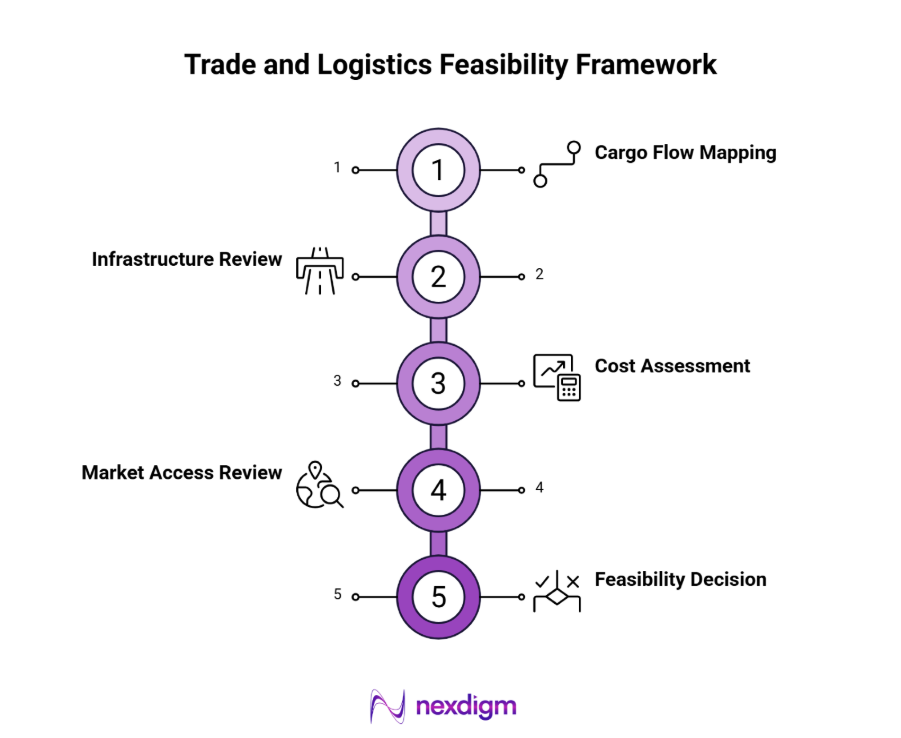
- Cargo Flow Mapping: Identify origin, destination, volume, trading partners and transport routes.
- Infrastructure Review: Assess ports, inland links, transshipment points and service availability.
- Cost Assessment: Calculate transport, border, handling, storage and distribution costs.
- Market Access Review: Confirm documentation, customs procedures and product-specific requirements.
- Feasibility Decision: Compare landed cost, delivery reliability and market requirements before committing resources.
Nexdigm’s Case Study: Testing an Export Corridor
An exporter assessed two destination markets using trade volumes, port connectivity, inland transport charges and customs requirements. One market showed higher imports but required expensive inland delivery. The company prioritised the second market for a controlled export trial while seeking alternative logistics arrangements for the first.
To take the next step, simply visit our Request a Consultation page and share your requirements with us.
Harsh Mittal
+91-8422857704