

Emerging opportunities are not always found in countries reporting the highest import growth. They can appear in a product category gaining importance within a mature market, an industrial cluster attracting new investment or a supplier relationship being reorganised across borders. International trade data helps companies identify these changes early, but understanding the commercial opportunity requires examining what is driving the movement.
The objective is to identify where demand is becoming more relevant to a company’s products, rather than simply where trade totals are increasing.
Look for Changes in the Composition of Trade
Aggregate trade growth can conceal important differences between sectors. UN Trade and Development reported that global trade reached approximately US$35 trillion in 2025, increasing by around 7.5%. Trade in goods grew by about 7%, while services expanded by around 8%. Growth was particularly strong in developing economies in East Asia and Africa.
These figures describe the scale of international commerce, but they do not reveal which individual products offer the best opportunities. A company must examine the categories responsible for growth, the destinations importing them and the supplier countries gaining ground. It should also establish whether rising trade values reflect higher prices, greater quantities, or a shift towards more specialised products.
Product-level analysis can reveal opportunities that broad economic indicators miss. An industrial supplier may find stronger prospects in a particular component category than in the overall machinery market. A chemicals exporter may discover that demand is shifting towards a higher-purity grade even when total imports of the wider category remain relatively stable.
Emerging Markets Are Often Linked to New Industrial Activity
Trade data becomes particularly useful when it is connected to changes in production and investment. A country importing more machinery, components and industrial inputs may be expanding manufacturing capacity. Rising imports of construction materials may correspond with infrastructure development, while greater imports of specialised equipment can indicate investment in a new industrial application.
The relationship must be tested rather than assumed. Imports may rise because domestic supply has weakened, because companies are building inventory or because a country is acting as an intermediary for goods destined elsewhere.
The OECD’s July 2026 report on global value chains found that international production remained highly interconnected and that recent shifts reflected changes in sourcing structures and sectoral patterns. For businesses, this means emerging demand may be linked to a new production location rather than a simple increase in final consumption.
Companies should examine related trade categories, domestic investment announcements, production statistics, and customer activity to understand what is driving the pattern.
Find Opportunities Before They Become Obvious
A useful international trade data assessment looks for several signals that reinforce one another. The most promising opportunities often emerge when trade changes coincide with identifiable customer needs and a plausible route to market.
Consider a destination where imports of industrial components are increasing. If related machinery imports and local manufacturing investment are also rising, the pattern may indicate an expanding industrial base. If component imports rise while final-product exports remain unchanged, the explanation may instead involve inventory accumulation or a change in sourcing.
Three types of opportunity deserve particular attention:
- Product specialisation: Demand is shifting towards a grade, specification or application that the company can supply more effectively than generalist competitors.
- Geographic expansion: A new industrial cluster or regional distribution hub is creating a customer base that existing sales coverage does not adequately serve.
- Supplier diversification: Buyers are adding alternative sources because of concentration risk, delivery uncertainty, or changing cost structures.
Each opportunity needs commercial validation. Trade data can identify where to investigate, but customer interviews and competitive analysis are needed to establish whether a company can win business.
Separate Early Signals from Temporary Disturbances
An emerging opportunity should be supported by more than one unusual data point. Analysts should compare several years of trade flows, review recent monthly or quarterly movements where available, and investigate changes in supplier shares. They should also account for differences in reporting coverage and revisions.
Price movements require particular care. The World Bank’s October 2026 commodity update reported that the energy price index rose 25.7% in September, while the non-energy index increased by 1.3%. In markets where traded products are closely linked to energy costs, higher trade values may reflect input-price pressure rather than stronger physical demand.
A company should therefore test whether the opportunity remains attractive under different price assumptions. If it depends entirely on a temporary shortage or unusually high prices, the appropriate response may be short-term sales rather than a long-term investment.
Decide Which Opportunities Deserve Further Investment
The final assessment should estimate the reachable customer base, the likely competitive response, the cost of serving the market, and the time required to generate revenue. It should also identify the evidence still missing, such as product certification, distributor capability, or confirmation of customer demand.
Management can then distinguish opportunities ready for commercial development from those requiring additional research. This makes the process more disciplined than ranking countries by growth rate and allocating sales resources accordingly.
Nexdigm’s Emerging-Demand Discovery Framework
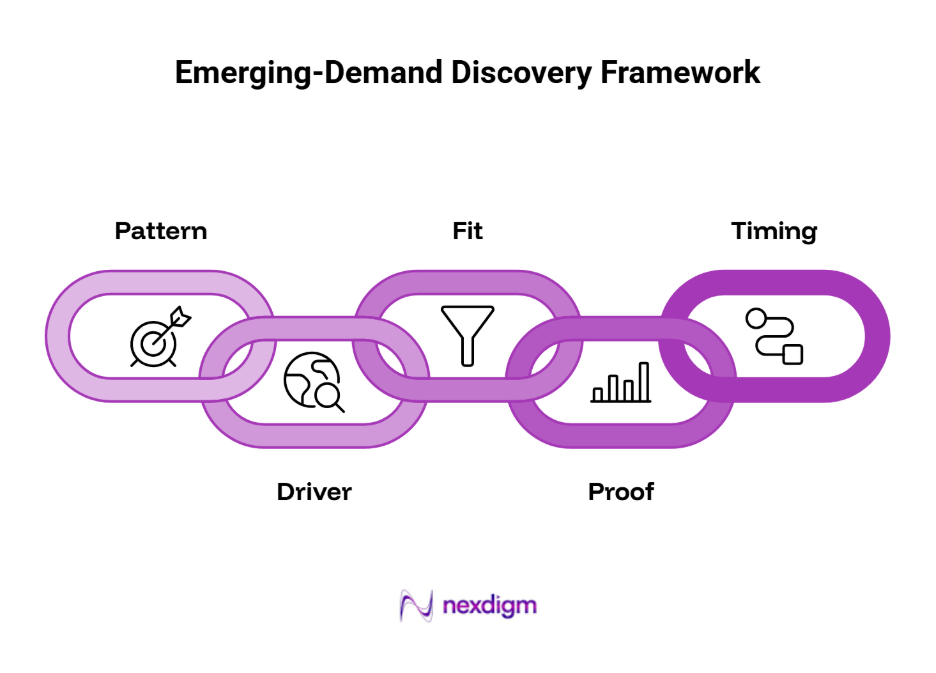
- Pattern: Identify products and destinations showing meaningful changes in trade.
- Driver: Connect those changes to industrial investment, consumption, sourcing, or price movements.
- Fit: Determine whether the demand aligns with the company’s products and capabilities.
- Proof: Validate the opportunity through customer evidence, competitive research, and realistic cost estimates.
- Timing: Decide whether to enter now, run a pilot or wait for stronger evidence of sustained demand.
Nexdigm’s Case Study
A supplier of water-treatment components assessed 6 potential export markets after trade data revealed that imports of selected treatment equipment had grown by an average of 12% annually over 3 years.
Sector-level analysis indicated that demand was concentrated in industries facing stricter water-treatment requirements and expanding water-reuse initiatives. Rather than targeting the broader market, the company prioritised 2 economies and 3 industrial sectors for customer outreach. Before committing to expansion, it reviewed product certification requirements, local service expectations and distributor capabilities to determine whether the opportunity was commercially viable.
To take the next step, simply visit our Request a Consultation page and share your requirements with us.
Harsh Mittal
+91-8422857704