

For companies seeking international growth, trade intelligence can narrow a large universe of potential customers and suppliers into a more focused set of commercial opportunities. Import patterns show which markets purchase a product, supplier shares reveal the competitive landscape, and changes in sourcing can indicate where relationships or production networks are shifting.
However, country-level trade statistics do not identify every company involved in a transaction. Effective trade intelligence combines these statistics with company research, industry knowledge and direct validation to build a realistic picture of the market.
Start With Product Flows, Not Broad Market Labels
The first task is to define the product precisely. A broad category such as machinery, chemicals or electrical equipment may include products with different end uses, price points and customer groups. Analysts should identify the relevant customs classification and verify its scope before interpreting trade values.
UN Comtrade provides official merchandise trade statistics submitted by national statistical authorities. These data can be used to examine import and export values, trading partners and product-level patterns across countries. Analysts can compare several years of data to distinguish sustained sourcing relationships from one-off shipments or temporary disruptions.
The classification itself matters. If a customs code includes products outside the company’s offering, the estimated market may be overstated. Conversely, a narrow code may miss relevant substitutes or adjacent product categories. Product mapping should therefore be checked against technical specifications and the way buyers actually purchase the product.
Use Import Patterns to Identify Potential Buyer Markets
A destination importing substantial quantities of a product may offer a useful starting point for prospecting. The next step is to identify the industries that use the product, the size and location of relevant industrial clusters, and the likely procurement channels.
For example, imports of specialised components may be associated with manufacturers, contract assemblers, maintenance providers or distributors. Imports of a finished consumer product may point toward retailers, wholesalers and national distributors. The trade data help determine where to search, while company and industry research identifies which organisations are relevant.
Market selection should also consider supplier concentration. A market dependent on a small number of exporting countries may offer an opportunity for alternative suppliers, but it may also reflect technical barriers, scale economies or established contracts that make entry difficult.
Map Suppliers and Competitors to Understand Market Structure
Supplier-country shares can show which countries are gaining or losing position. A company can use this information to identify established sources of competition, potential manufacturing partners and markets where sourcing is becoming more diversified.
The analysis should investigate why a supplier is gaining share. Possible explanations include lower production costs, stronger product capabilities, trade preferences, geographic proximity or changes in buyer procurement strategy. Export growth alone cannot establish which explanation applies.
Trade intelligence can also help identify potential suppliers for sourcing diversification. Companies can compare the exporting countries already serving their target market, then assess the supplier base for capacity, quality, reliability, lead times and regulatory compliance. A new source should not be selected solely because its exports are growing.
From Trade Signals to Company-Level Intelligence
A key limitation is that international trade intelligence built from official trade statistics does not automatically reveal named buyers, supplier contacts, individual shipment dates or transaction-level prices. UN Comtrade explicitly states that its database does not provide company names or buyer and supplier contact details.
The practical implication is that trade data should be treated as a market-mapping layer, not a complete prospect database. Company websites, annual reports, industry directories, procurement notices, exhibition lists, regulatory records and direct outreach can help identify relevant organisations. Where legally available and appropriately licensed, shipment-level commercial databases may provide additional evidence, although their coverage and accuracy should be checked.
A robust prospecting process links each identified company to a clear rationale: the product it may purchase, the evidence of demand, the likely decision-making function and the reason the company’s offering could be relevant.
Separate Market Signals From Verified Commercial Leads
Not every company operating in an importing country is a qualified buyer. A prospect may manufacture a product but purchase through a parent company, use a substitute material or have an exclusive supply agreement. Qualification requires evidence of product fit, purchasing authority, expected volumes, technical requirements and a plausible route to contact.
The same discipline applies to supplier identification. An exporter may be a manufacturer, trading company or intermediary. Before approaching it as a strategic supply partner, the company should verify production capability, certifications, financial standing and export experience.
A Trade Intelligence-to-Prospect Framework
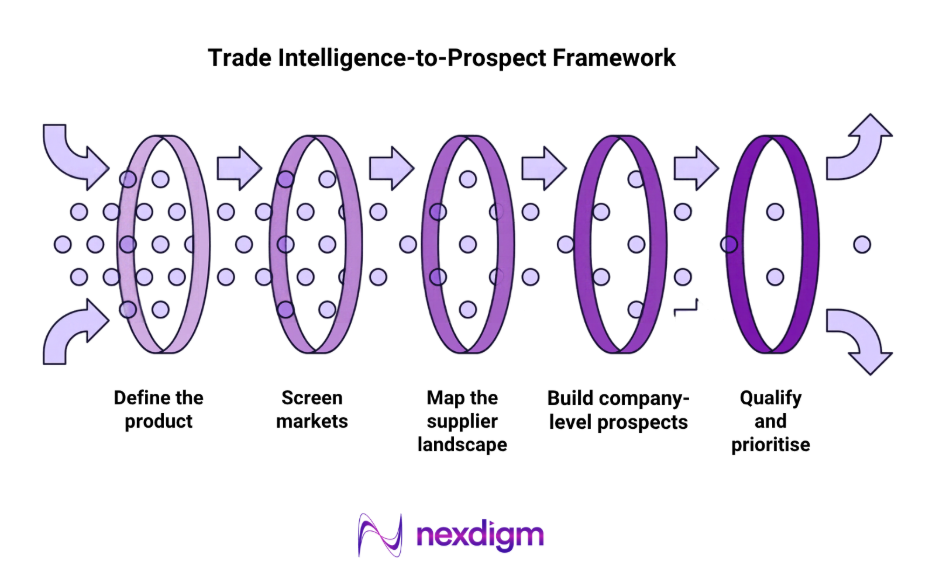
- Define the product: Confirm customs codes, specifications, end uses and relevant substitutes.
- Screen markets: Identify importing countries with meaningful demand and relevant customer industries.
- Map the supplier landscape: Compare source-country shares, emerging exporters and concentration risks.
- Build company-level prospects: Combine trade signals with corporate records, industry directories and procurement evidence.
- Qualify and prioritise: Validate product fit, purchasing authority, commercial potential and the next actionable contact.
Nexdigm Case Study
An industrial supplier used product-level trade flows to screen eight destination markets and identify the most relevant customer industries. Company research and qualification reduced the initial prospect universe to 30 organisations, which were prioritised by product fit, purchasing relevance and evidence of import demand before outreach began.
To take the next step, simply visit our Request a Consultation page and share your requirements with us.
Harsh Mittal
+91-8422857704