

Inventory is essential for keeping products available, but excessive stock can tie up capital, consume warehouse space, increase handling costs, and create obsolescence risks.
On the other side, insufficient inventory can cause stockouts, delayed production, lost sales, and weaker customer satisfaction. The challenge is finding the right balance as businesses manage wider product ranges, shorter delivery expectations, volatile demand, and complex supplier networks.
An Inventory management market analysis helps organizations understand changing stock requirements, optimization models, technology adoption, demand patterns, and operational economics.
Nexdigm connects these factors to identify where inventory can be optimized, which technologies can improve visibility, and how businesses can balance availability with working-capital efficiency.
Understanding the Inventory Challenge
Inventory management is a critical balance between product availability and cost efficiency. Different industries face unique inventory challenges based on demand patterns, supply chain complexity, customer expectations, and operational requirements.
Nexdigm evaluates these differences to identify inventory inefficiencies, supply risks, and opportunities to improve stock performance while maintaining service levels and profitability.
- Demand Variability: Nexdigm analyzes fluctuations in customer demand across products and regions to determine optimal inventory levels, helping businesses reduce stock imbalances while maintaining product availability.
- Product Lifecycle Management: The assessment evaluates how inventory requirements change throughout a product’s lifecycle, from introduction to decline, enabling businesses to minimize obsolescence and improve inventory turnover.
- Supplier Reliability and Lead Times: Nexdigm examines supplier performance, sourcing risks, and replenishment timelines to identify vulnerabilities that can lead to delays, stock shortages, or excessive safety stock requirements.
How Nexdigm Helps with the Challenges
Rapid changes in customer demand, supply chain disruptions, and evolving market conditions require businesses to monitor inventory in real time. Digital technologies are transforming inventory management by providing greater visibility, faster decision-making, and improved operational efficiency.
Nexdigm focuses on the underlying business challenge rather than the technology itself, ensuring that investments deliver measurable operational and commercial benefits. Such as:
- Warehouse Management Systems (WMS): Evaluate whether warehouse management systems can improve inventory visibility, streamline operations, optimize storage utilization, and provide real-time data that enhances planning and fulfillment performance.
- Internet of Things (IoT) and Connected Devices: Assess the value of connected sensors and monitoring systems that provide real-time inventory insights, track asset conditions, and enable proactive operational responses.
Nexdigm helps organizations move beyond technology trends to focus on tangible operational outcomes. By assessing the business impact of inventory technologies, the analysis identifies solutions that improve visibility, efficiency, and resilience.
Nexdigm’s Inventory Optimization Framework
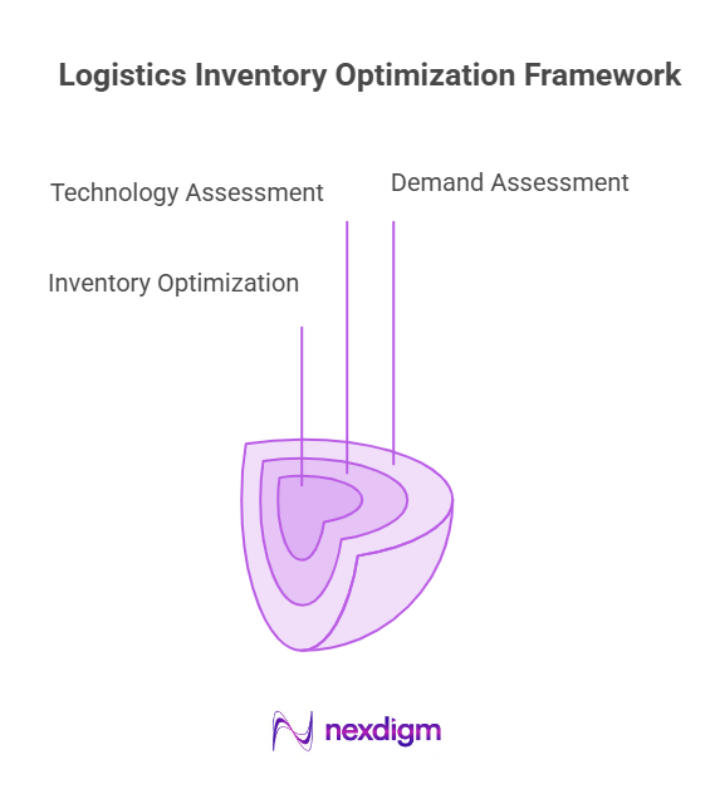
The Inventory management market analysis brings the assessment together through major areas. Each area helps explain how organizations can achieve better inventory availability without carrying unnecessary stock.
Demand
- Demand forecasting: Nexdigm analyzes historical sales, seasonality, customer behavior, market growth, and external signals to estimate future inventory requirements more effectively.
- Demand variability: Understanding fluctuations helps businesses establish appropriate safety-stock levels without unnecessarily increasing inventory across the entire product portfolio.
- Product segmentation: Nexdigm groups products by value, demand frequency, profitability, criticality, and lifecycle to create differentiated inventory policies.
- Seasonal demand: Identifying recurring peaks allows companies to prepare inventory in advance while reducing excess stock after seasonal demand declines.
- Customer behavior: Purchasing frequency, basket size, preferences, and fulfillment expectations provide additional signals for determining future inventory requirements.
Inventory Visibility
- Real-time tracking: Nexdigm evaluates technologies that provide timely information about inventory location, movement, availability, and status throughout the supply chain.
- Inventory accuracy: Better alignment between physical and digital inventory reduces fulfillment errors, unnecessary replenishment, stock discrepancies, and operational disruption.
- Supply-chain visibility: Greater transparency across suppliers and logistics partners helps companies identify potential shortages, delays, and inventory risks earlier.
Technology
- Warehouse management systems: Integrated platforms connect inventory, orders, receiving, picking, storage, and dispatch while creating stronger operational visibility.
- AI analytics: Predictive models can identify demand changes, excess inventory, potential shortages, and unusual stock movements earlier.
- Digital twins: Virtual supply-chain models allow organizations to test inventory policies and network changes before making expensive operational commitments.
- Automation: Robotics and automated storage systems can improve handling speed, storage density, retrieval efficiency, and fulfillment productivity.
Nexdigm in Connecting Inventory Across the Network
Inventory decisions are closely connected to the wider supply chain.
Nexdigm examines suppliers, factories, warehouses, distribution centers, stores, fulfillment facilities, transportation networks, and customers as one connected system.
For example, a business may hold excessive stock because supplier lead times are unpredictable. Another may experience shortages because inventory is concentrated in the wrong locations.
Understanding these relationships allows Nexdigm to address structural inventory problems rather than focusing only on individual warehouses.
Nexdigm’s Case
A retail distributor used Nexdigm’s Inventory management market analysis to identify excess stock and improve replenishment planning. Within 11 months, inventory carrying costs declined, stock availability improved 18%, inventory turnover increased 26%, and stockouts fell 24%, strengthening working-capital efficiency and customer fulfillment.
To take the next step, simply visit our Request a Consultation page and share your requirements with us.
Harsh Mittal
+91-8422857704