

IoT device markets are expanding rapidly as connected technologies become essential across industrial, consumer, and enterprise applications. From smart manufacturing sensors and connected healthcare devices to home automation systems, asset tracking tools, and enterprise monitoring platforms, IoT is transforming how organizations collect data, improve efficiency, and deliver intelligent services.
IoT device competitor analysis plays a key role in competitive intelligence by helping businesses track product innovation, pricing strategies, connectivity standards, partnerships, and market positioning. These insights enable companies to identify growth opportunities, evaluate competitor strengths, and build stronger strategies in the evolving connected device ecosystem.
The global IoT devices market is expected to reach USD 83.33 billion in 2025 and grow to USD 181.17 billion by 2030, at a 16.8% CAGR. Connected IoT devices are also projected to rise from 21.1 billion in 2025 to 39 billion by 2030, reinforcing the need for IoT device competitor analysis.
Leveraging Competitive Intelligence to Identify Emerging IoT Technology Trends
Competitive intelligence helps identify emerging IoT technology trends by tracking competitor innovations, connectivity standards, AI integration, edge computing, security features, partnerships, and adoption patterns across industrial, consumer, and enterprise applications.
-
Tracking Competitor Innovation
Competitive intelligence monitors IoT product upgrades, patents, launches, and feature enhancements to identify emerging technology directions.
-
Monitoring Connectivity Standards
Tracking 5G, Wi-Fi, Bluetooth, Zigbee, and LPWAN adoption reveals how competitors improve device performance and interoperability.
-
Analyzing Edge Computing Adoption
Competitor analysis shows how IoT players use edge computing for faster processing, lower latency, and real-time decision-making.
-
Evaluating AI Integration
Monitoring AI-enabled IoT devices helps identify trends in automation, predictive analytics, remote monitoring, and intelligent device management.
-
Assessing Security Features
Competitive intelligence compares encryption, authentication, compliance, and cybersecurity features to understand evolving IoT security expectations.
Nexdigm’s Market Entry Strategy for IoT Expansion Planning
Nexdigm’s market entry strategy for IoT expansion planning helps businesses evaluate new geographies, customer segments, competitive intensity, regulatory factors, pricing expectations, and distribution channels. By combining market assessment, competitor analysis, and demand insights.
Nexdigm supports companies in identifying viable IoT opportunities, reducing entry risks, prioritizing target markets, and building stronger expansion plans across industrial, consumer, and enterprise applications.
Nexdigm’s Market Assessment to Identify IoT Growth Opportunities across different segments
Nexdigm’s market assessment helps identify IoT growth opportunities across industrial, consumer, and enterprise segments by analyzing demand trends, competitor activity, customer needs, adoption barriers, pricing dynamics, and market readiness:
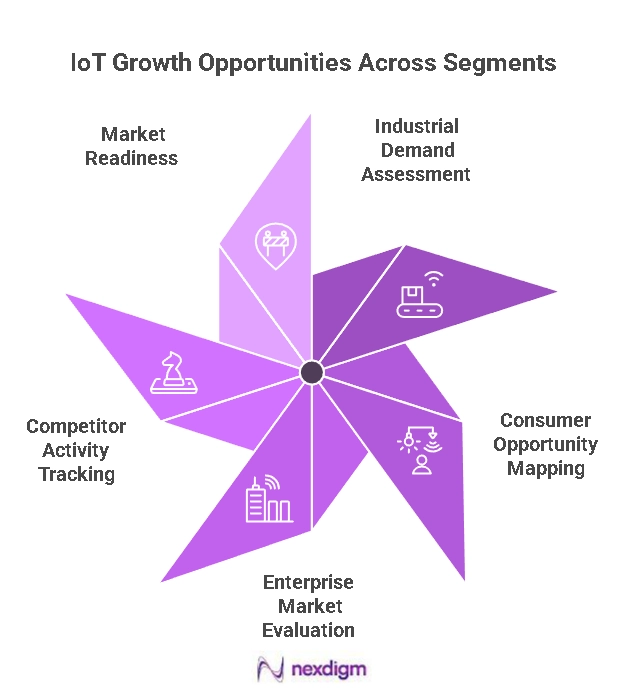
-
Industrial Demand Assessment
Nexdigm analyzes manufacturing, logistics, energy, and asset monitoring demand to identify high-potential industrial IoT growth opportunities.
-
Consumer Opportunity Mapping
Nexdigm studies smart homes, wearables, connected appliances, and lifestyle devices to understand consumer adoption and product potential.
-
Enterprise Market Evaluation
Nexdigm assesses enterprise needs across facility management, security, automation, and monitoring to identify scalable IoT use cases.
-
Competitor Activity Across Segments
Nexdigm tracks IoT players, product portfolios, pricing, and partnerships to understand competitive intensity across different segments.
-
Adoption Barriers and Market Readiness
Nexdigm evaluates infrastructure, regulations, cost sensitivity, and customer awareness to determine readiness for IoT expansion.
Nexdigm’s case:
Nexdigm helped an IoT solutions company assess growth opportunities across industrial, consumer, and enterprise applications by analyzing demand trends, competitor offerings, pricing models, and adoption barriers. The study supported market prioritization and expansion planning as connected IoT devices are projected to rise from 21.1 billion in 2025 to 39 billion by 2030, creating strong opportunities across sensors, automation, smart devices, and enterprise platforms.
To take the next step, simply visit our Request a Consultation page and share your requirements with us.
Harsh Mittal
+91-8422857704