
The IoT device market is increasingly divided by the economics of the industries adopting connected hardware. Industrial deployments, smart infrastructure, and consumer devices operate with different purchasing cycles, price points, deployment requirements, and opportunities for recurring software revenue.
For IoT hardware manufacturers, investors, and technology providers, the relevant opportunity is therefore determined by where device demand can support attractive margins and longer-term value capture.
Industrial IoT Offers Higher-Value Demand
Industrial IoT is emerging as one of the stronger commercial opportunities because connected devices are tied directly to measurable operational outcomes. Enterprises can justify investment through reduced downtime, improved asset utilization, lower energy consumption, and stronger safety performance.
Key applications include predictive maintenance sensors for pumps and compressors, cold-chain tracking for pharmaceuticals and high-value freight, edge-computing cameras for automated inspection, environmental monitoring across industrial facilities, and energy sub-metering for production operations.
These deployments typically involve higher-value hardware, longer replacement cycles, and greater integration requirements. Devices can command ASPs of approximately $150–$2,000 and remain deployed for 7–12 years, creating a very different commercial model from consumer IoT.
Infrastructure Creates Long-Term Device Demand
Smart infrastructure follows another model. Municipalities, utilities, and public-sector organizations deploy connected water meters, grid equipment, traffic controllers, environmental sensors, and other monitoring systems through large-scale procurement programs.
Hardware ASPs typically fall in the $45–$180 range, while deployment lifecycles can extend from 10 to 15 years. The sales cycle is longer because certification, tendering, interoperability, and infrastructure integration can determine whether a product qualifies for deployment.
For vendors able to meet these requirements, however, infrastructure projects can provide predictable multi-year hardware demand and recurring maintenance opportunities. Backward compatibility also becomes commercially important because replacing devices across an established infrastructure network can be considerably more expensive than maintaining a supported product line.
Consumer IoT Has Scale, but Different Economics
Consumer IoT can generate significantly higher unit volumes, but profitability is harder to sustain. Smart cameras, connected scales, home sensors, and other devices typically have ASPs of approximately $8–$65 and replacement cycles of only 2–4 years.
Price competition from white-label manufacturers can compress hardware margins below 20%, while consumer subscription churn limits software revenue. The result is a market where high shipment volumes do not necessarily translate into attractive lifetime economics.
The opportunity becomes stronger where a device can support differentiated services, recurring subscriptions, or ecosystem integration. A connected device with limited software attachment can remain heavily dependent on one-time hardware sales, making customer acquisition and retail distribution costs particularly important.
Where Does the Value Accumulate?
Hardware represents only part of the economic opportunity created by an IoT deployment. The underlying system can distribute value across physical devices, connectivity, device management, analytics, and enterprise integration.
Physical sensor hardware may account for approximately 15% of lifecycle value and connectivity around 10%. Device-management platforms can capture roughly 25%, while analytics and enterprise-system integration can represent approximately 50%.
This changes the strategic question for hardware providers. A successful IoT proposition increasingly depends on connecting edge devices with software, analytics, and operational systems that turn telemetry into business actions. An IoT device market assessment should therefore evaluate software attach rates and integration potential alongside hardware demand.
Nexdigm IoT Opportunity Framework: Where Should Capital Go?
Nexdigm can assess IoT opportunities across six decision areas:
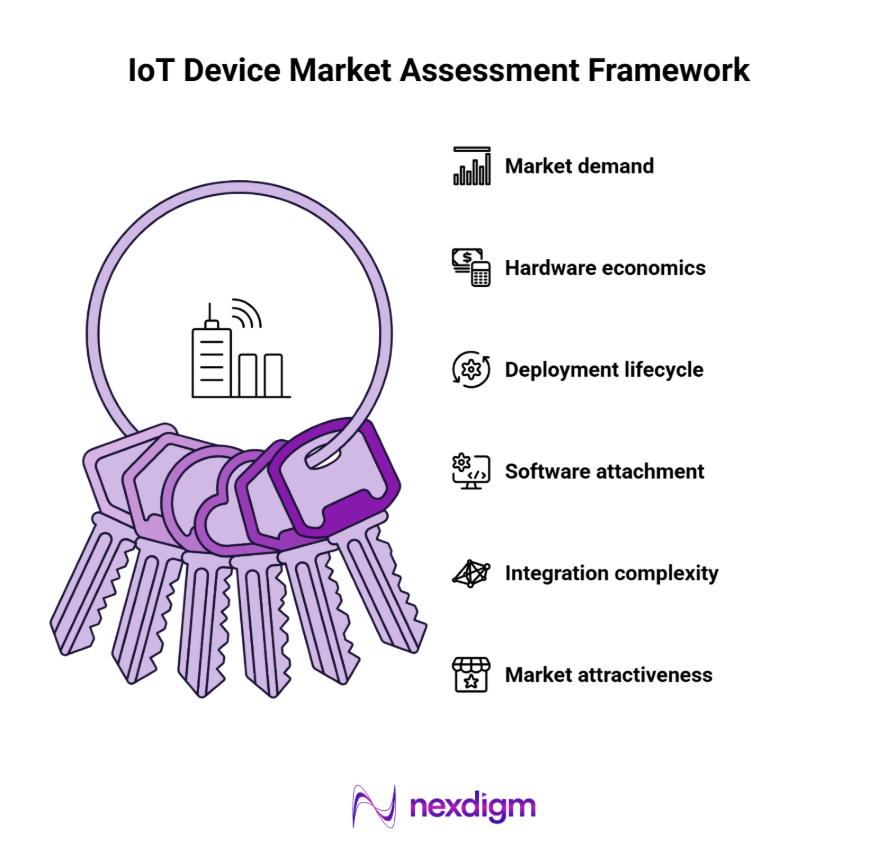
- Market demand: Quantify device volumes, deployment pipelines, replacement cycles, and sector growth.
- Hardware economics: Benchmark ASPs, BOM structures, gross margins, and expected price erosion.
- Deployment lifecycle: Assess replacement frequency, component availability, and long-term support requirements.
- Software attachment: Measure opportunities for device management, analytics, monitoring, and recurring subscriptions.
- Integration complexity: Evaluate connectivity protocols, enterprise systems, legacy infrastructure, and implementation requirements.
- Market attractiveness: Rank sectors according to revenue potential, margin durability, competitive intensity, and scalability.
This framework helps distinguish high-volume markets from high-value opportunities and identifies where hardware investment can be supported by recurring software revenue.
Nexdigm Case: Prioritizing an Industrial IoT Expansion
Nexdigm assessed an IoT provider across 15 industrial applications, 28 customer segments, and four deployment models. The analysis identified three priority segments representing 62% of projected addressable demand, with software attachment potential above 55%. The resulting market prioritization reduced the initial target universe by 41% and focused expansion on higher-margin applications.
To take the next step, simply visit our Request a Consultation page and share your requirements with us.
Harsh Mittal
+91-8422857704