
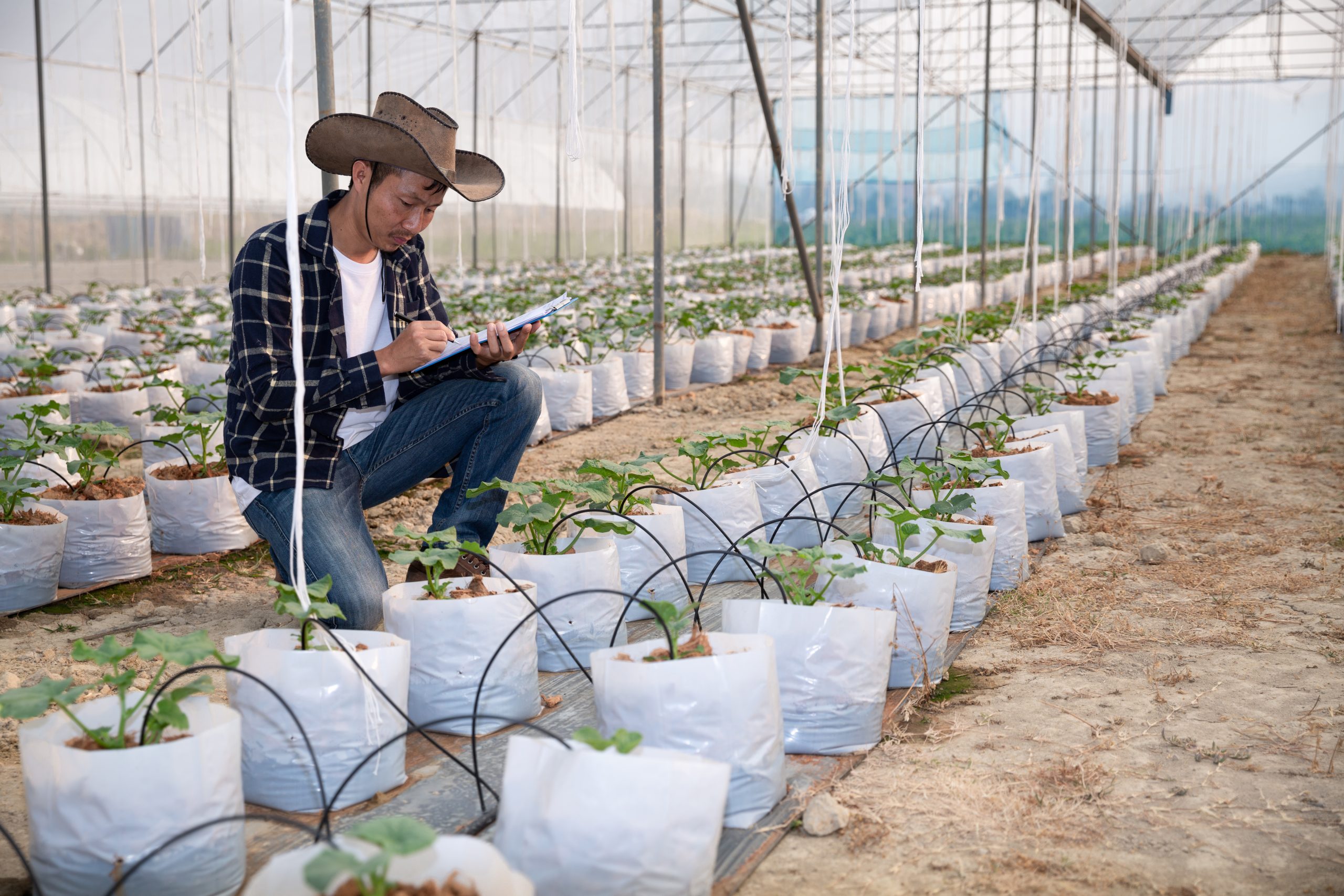
Irrigation equipment procurement has become an important decision for agricultural businesses managing water availability, crop productivity and operating costs. Drip systems, sprinklers, pumps, filtration units, pipes, valves and automated irrigation technologies serve different requirements. Selecting equipment based only on purchase price or advertised coverage can result in systems that are poorly suited to local water conditions, crop patterns or field layouts.
For agribusinesses, agricultural infrastructure developers, farmer organisations and irrigation project operators, supplier selection requires an understanding of both equipment performance and the infrastructure needed to maintain it. A system that is efficient on paper may deliver limited value if installation quality is poor, spare parts are unavailable or the supplier cannot provide technical support.
Micro Irrigation Adoption Is Expanding, but Regional Requirements Differ
India has made substantial investments in micro irrigation through government programmes promoting drip and sprinkler systems. By March 2025, approximately 96.97 lakh hectares had been covered under the Per Drop More Crop scheme since its launch in 2015–16. This included 46.37 lakh hectares under drip irrigation and 50.60 lakh hectares under sprinkler irrigation.
The expansion creates opportunities for equipment manufacturers and service providers, but demand is not uniform. Drip irrigation is particularly relevant for orchards, vegetables, plantations and crops requiring targeted water application. Sprinkler systems may be more suitable for certain field crops, horticulture applications and land conditions.
The right solution depends on water availability, source quality, soil characteristics, crop spacing, field size and pressure requirements. Suppliers offering a broad product catalogue may not necessarily have the technical expertise needed for every application.
Equipment Specifications Can Affect System Performance
Irrigation systems consist of interconnected components. Drip systems require suitable emitters, filters, pipes, valves and pressure regulation. Sprinkler systems depend on nozzle design, operating pressure, spacing and distribution uniformity. Pumps must be selected according to water source, lift, flow rate and energy requirements.
An underspecified pump can fail to deliver the required pressure across the field. Poor filtration can cause emitter blockage. Inadequate pipe quality or installation can lead to leakage and uneven water distribution.
These problems may not become apparent during the initial purchase. Their consequences emerge during operation, when water delivery becomes inconsistent or maintenance requirements increase.
Supplier Capability Extends Beyond Manufacturing
The irrigation supplier landscape includes manufacturers of drip lines, sprinklers, pumps, filtration systems, automation equipment and solar-powered solutions. It also includes system integrators, distributors, installation contractors and service providers.
The distinction matters because buyers may need an integrated system rather than individual components. A manufacturer may produce high-quality equipment but depend on third parties for installation and maintenance. A system integrator may offer end-to-end services but source critical components from multiple manufacturers.
The irrigation equipment supplier research services approach should therefore examine the complete supplier ecosystem, including manufacturing facilities, product certifications, dealer coverage, installation capacity and after-sales support.
Smart Irrigation Introduces New Technical Dependencies
Sensors, automated valves, weather data, remote monitoring and irrigation controllers can improve water management. However, technology adoption introduces additional requirements involving connectivity, software compatibility, calibration, technical support and system maintenance.
A smart irrigation solution may be commercially attractive but difficult to operate in locations with unreliable connectivity or limited technical support. Buyers should also examine data access, equipment interoperability and the cost of software or service subscriptions.
The value of automation should be measured against the operational problem it solves. Technology that reduces unnecessary irrigation or improves monitoring may justify additional expenditure, but only when the system can be maintained and used effectively.
How Buyers Should Compare Irrigation Equipment Suppliers
Supplier evaluation should begin with a clear understanding of the project requirement. Buyers need to define the crop, area, water source, irrigation method, operating pressure, expected flow rate and installation conditions before comparing quotations.
Technical comparisons should cover material quality, filtration, pump efficiency, pressure regulation, water distribution and compatibility between components. Commercial evaluation should include equipment price, installation, energy consumption, maintenance, replacement parts and warranty.
Nexdigm supports organisations through irrigation market research, supplier mapping, product benchmarking and commercial analysis. Its work can help buyers identify relevant manufacturers, assess regional supplier coverage, compare technical capabilities and evaluate sourcing options for irrigation projects.
Irrigation Equipment Supplier Evaluation Framework
A practical assessment should cover five areas:
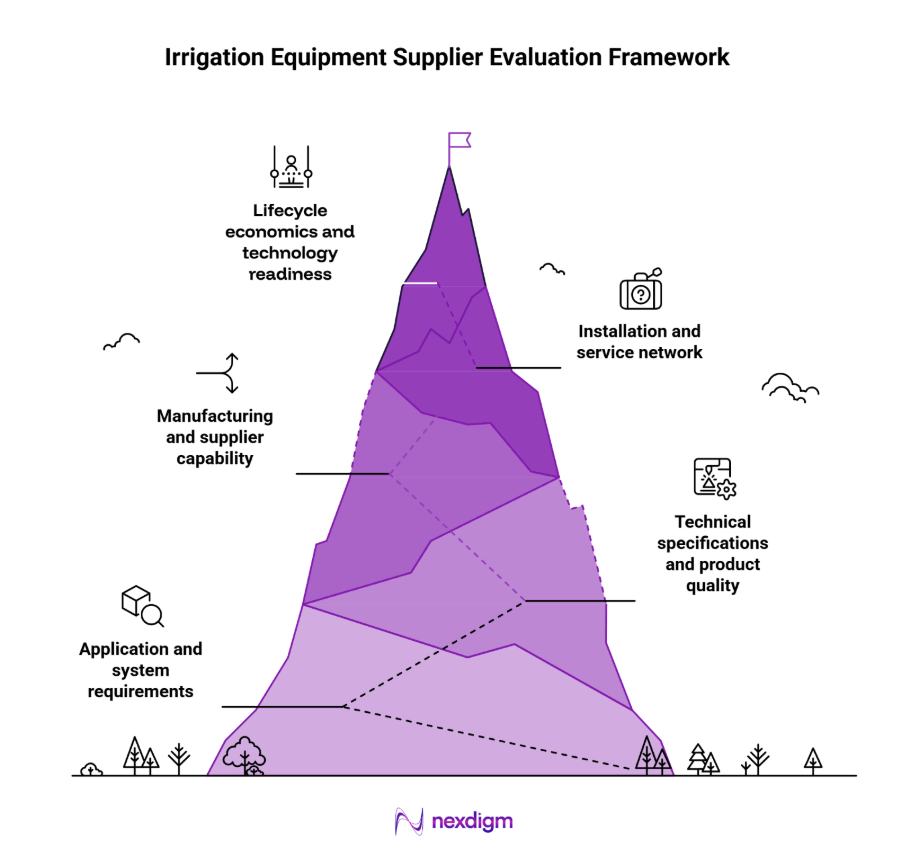
- Application and system requirements: Define crop type, irrigated area, water source, soil conditions, field layout, required flow rate and operating pressure. Establish whether drip, sprinkler, pump-based or automated irrigation is most suitable.
- Technical specifications and product quality: Compare emitter discharge rates, sprinkler performance, pipe material, filtration, pump efficiency, pressure regulation, durability and component compatibility. Examine testing and product certification documentation.
- Manufacturing and supplier capability: Assess production capacity, product range, manufacturing locations, quality controls, customisation capability and dependence on external component suppliers.
- Installation and service network: Evaluate dealer presence, system design expertise, installation capability, maintenance support, spare parts availability, response times and training.
- Lifecycle economics and technology readiness: Compare acquisition cost, installation, energy consumption, water-use efficiency, maintenance, replacement cycles and software costs. For smart systems, assess connectivity, interoperability, data access and ongoing technical support.
Nexdigm’s Case Study: Mapping Irrigation Equipment Suppliers
Nexdigm assessed 35 irrigation equipment suppliers across 4 product categories, comparing manufacturing capacity, technical specifications, dealer coverage and service infrastructure. The research shortlisted 9 suppliers and identified 5 regional markets with gaps in after-sales support.
To take the next step, simply visit our Request a Consultation page and share your requirements with us.
Harsh Mittal
+91-8422857704