

India’s irrigation market is becoming less about expanding access to water and more about controlling how existing water resources are delivered. Net irrigated area stands at 79.31 million hectares, while groundwater sources account for more than 62% of net irrigated area through tubewells and open wells. As groundwater stress increases, farmers, irrigation companies, and policymakers face a more complicated question: which irrigation architecture makes economic and agronomic sense in each location?
The Irrigation Market Is Four Different Markets
Surface irrigation remains deeply embedded across cereal-producing regions because its capital requirement is low and existing farm infrastructure supports it. Yet its water-use efficiency is only around 30% to 45%, with losses occurring through runoff, evaporation, and deep percolation.
Drip and sprinkler systems occupy a different economic position. Pressurized systems can achieve roughly 65% to 90% application efficiency, but require pumps, filtration, pipes, laterals, sprinklers, or emitters. The investment therefore has to be justified by the crop, water savings, yield response, and expected operating life.
Pressurized piped distribution represents another opportunity altogether, particularly in canal command areas where replacing open channels can reduce conveyance losses and improve water distribution.
Crop Economics Determines the Payback
Technology adoption accelerates when water efficiency translates into measurable farm economics.
Drip systems are particularly relevant for sugarcane, cotton, banana, citrus, and vegetables, where controlled root-zone application can generate substantial water savings and potentially improve yields. Sprinklers are better suited to crops such as pulses, mustard, groundnut, and wheat, particularly where uneven terrain makes land levelling expensive.
This creates a segmented market rather than a uniform penetration opportunity. A district with extensive irrigated acreage may still offer limited immediate demand if farmers cultivate low-margin crops and face weak investment capacity.
Water Stress Is Creating Conversion Pressure
Groundwater dependence changes the investment equation. Tubewells represent 49.34% of net irrigated area, while open wells contribute another 13.46%. In water-stressed regions, declining water tables can increase borewell depths, pumping requirements, and energy costs.
That creates a potential conversion trigger. Farmers who previously accepted inefficient flood irrigation may increasingly consider drip or sprinkler systems when water availability, pumping costs, or crop productivity begin affecting margins.
The strongest opportunity therefore lies at the intersection of water stress and the ability to pay for conversion.
Subsidy Access Can Make or Break Demand
The Pradhan Mantri Krishi Sinchayee Yojana’s Per Drop More Crop framework is an important demand catalyst, with support for micro-irrigation systems varying by farmer category and state implementation.
But headline subsidy percentages do not necessarily translate into immediate installations. Documentation requirements, inspections, disbursement delays, and manufacturer receivables can slow the market.
For irrigation manufacturers, this means market attractiveness must account for subsidy liquidity, not simply subsidy availability. Dealer working capital and the time between installation and reimbursement can materially influence channel expansion.
Power Reliability Is Becoming Part of Irrigation Design
Pressurized irrigation depends on dependable pumping. Intermittent rural electricity can therefore constrain adoption even where agronomic fit is strong.
Solar-powered irrigation under PM-KUSUM can change this equation by providing daytime electricity for pumping and potentially improving the reliability of pressurized systems. For irrigation suppliers, solar integration can consequently become part of the product-market proposition rather than an unrelated energy consideration.
Nexdigm’s Irrigation System Market Assessment Framework
Nexdigm can evaluate irrigation markets through five commercial lenses:
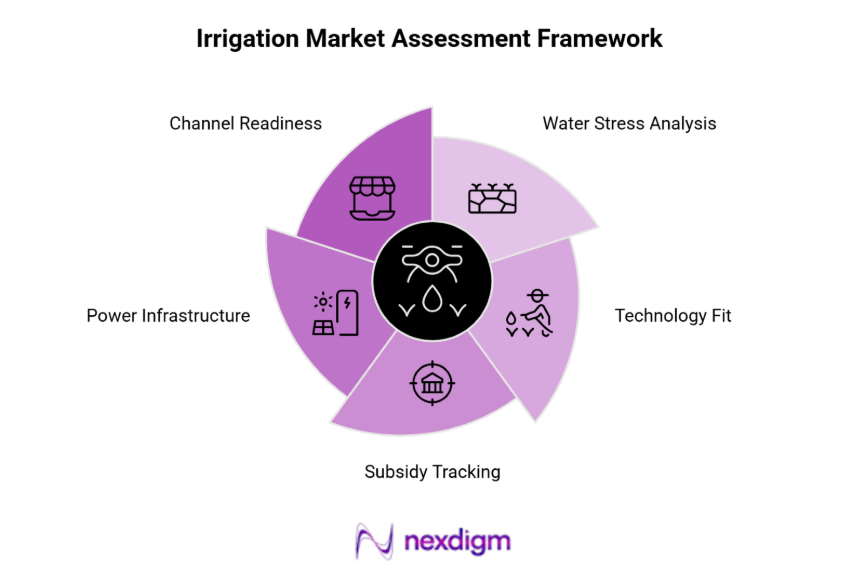
- Find Where Water Stress Creates Conversion Pressure: Map groundwater decline, borewell depth, irrigation intensity, and energy requirements to identify districts where inefficient irrigation is becoming economically difficult to sustain.
- Match Technology to Crop and Terrain: Assess crop spacing, soil characteristics, topography, water requirements, and existing infrastructure to determine where drip, sprinkler, surface, or pressurized distribution has the strongest technical fit.
- Follow the Subsidy Money: Examine state-level subsidy structures, disbursement timelines, inspection processes, and receivable cycles to understand how quickly policy support converts into commercial demand.
- Build the Power-Infrastructure Case: Evaluate electricity reliability, pump requirements, and solar irrigation adoption to identify markets where integrated irrigation-energy solutions can improve system viability.
- Measure Channel Readiness: Assess dealer coverage, technical installation capability, spare-part availability, service infrastructure, and working-capital requirements to determine whether a market can support scalable deployment.
Nexdigm Case Study: Prioritizing High-Potential Irrigation Clusters
In a scenario-based market assessment for an international micro-irrigation manufacturer, Nexdigm evaluated four states using groundwater stress, crop economics, subsidy implementation, and dealer coverage. The analysis screened 3.4 million irrigated acres and identified 185,000 priority acres across 31 clusters. The resulting opportunity was estimated at ₹310 crore, with solar-integrated drip systems prioritized in high-stress sugarcane markets. The commercial model targeted a payback period below three seasons and a potential 24% reduction in water consumption.
To take the next step, simply visit our Request a Consultation page and share your requirements with us.
Harsh Mittal
+91-8422857704