

Technology infrastructure has become a major investment priority for banks and financial services organizations seeking digital modernization and operational resilience. The Bank Tech Index 2025 found that banks allocated an average of 18% of technology budgets to cybersecurity and 10% to AI. Broadridge’s 2026 Digital Transformation Study reported that financial services firms allocate nearly one-third of technology budgets to innovation, with 28% identifying GenAI as the most impactful technology.
Additionally, another 2026 Digital Trust Insights found that 76% of financial services organizations plan to increase cybersecurity budgets. These investment trends highlight the importance of IT infrastructure spend benchmarking BFSI procurement in understanding spending priorities, evaluating cost drivers, and improving technology investment decisions.
Shifting Technology Investment Priorities Across BFSI
Financial institutions are balancing investments in cybersecurity, AI, cloud infrastructure, and digital platforms while maintaining existing technology systems. These competing priorities influence how IT budgets are allocated across infrastructure categories. Understanding spending patterns helps banks and insurers identify critical investment areas, assess technology dependencies, and align infrastructure expenditure with operational requirements and long-term modernisation objectives.
Key Factors Influencing BFSI Infrastructure Spending
Infrastructure spending decisions depend on institutional requirements, technology maturity, and changing business priorities. Three factors are particularly relevant:
- Technology Modernisation: Legacy system upgrades, cloud migration, and AI adoption influence infrastructure requirements and investment allocation.
- Security and Regulatory Requirements: Cybersecurity, data protection, and regulatory expectations drive expenditure on secure and resilient technology environments.
- Operational Scale and Efficiency: Transaction volumes, storage requirements, computing capacity, and service continuity influence infrastructure costs and procurement choices.
Together, these factors shape infrastructure investment patterns and make structured spending comparisons important for effective procurement planning.
Nexdigm’s Research-Led Approach to BFSI Infrastructure Spend Analysis
Nexdigm combines market intelligence, supplier research, and technology category analysis to help financial institutions understand infrastructure spending patterns. Our experts examine key technology segments, assess supplier offerings, and evaluate market developments to identify relevant cost drivers and procurement considerations. This approach of ours provides a structured foundation for IT infrastructure spend benchmarking BFSI procurement, connecting market-level insights with institutional technology and sourcing priorities.
Why IT Infrastructure Spend Benchmarking Matters in BFSI Procurement
As infrastructure investments expand across technology categories, financial institutions need greater visibility into spending patterns and supplier costs. IT infrastructure spend benchmarking BFSI procurement helps organizations make informed decisions by:
- Identifying Cost Variations: Compare expenditure across infrastructure categories and suppliers to recognize pricing differences and potential cost inefficiencies.
- Improving Budget Allocation: Understand investment concentration across cloud, hardware, networking, and cybersecurity to prioritize spending.
- Evaluating Supplier Commercials: Compare pricing models, service offerings, and commercial structures to assess supplier value.
- Recognizing Optimization Opportunities: Identify overlapping services, alternative providers, and sourcing models that may improve procurement efficiency.
These insights help BFSI organizations strengthen procurement oversight, improve cost visibility, and make more informed infrastructure investment decisions.
Nexdigm’s Expertise in Benchmarking BFSI Infrastructure Spending
Nexdigm helps financial institutions examine infrastructure expenditure across major technology segments through structured market and supplier analysis. Our benchmarking approach can include:
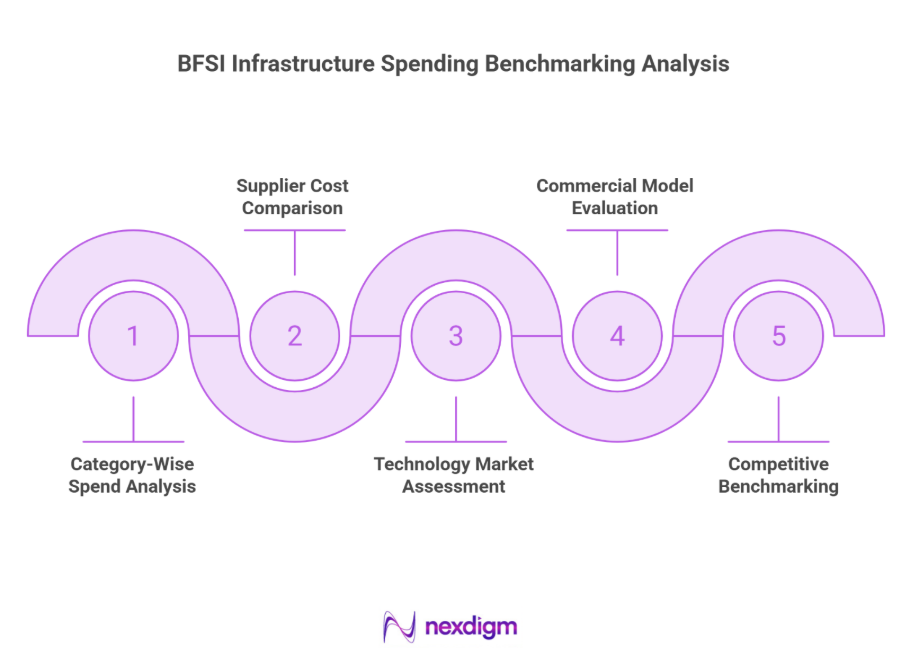
- Category-Wise Spend Analysis: Examine spending patterns across cloud infrastructure, data centers, hardware, networking, and cybersecurity.
- Supplier Cost Comparison: Compare available supplier pricing, commercial models, and service offerings across relevant technology categories.
- Technology Market Assessment: Track market developments, emerging solutions, and infrastructure pricing trends that may influence procurement costs.
- Commercial Model Evaluation: Assess subscription-based, consumption-led, licensing, and managed service models to understand their cost implications.
- Competitive Benchmarking: Compare supplier positioning and available alternatives to identify potential sourcing and procurement opportunities.
This analysis helps BFSI organizations develop a clearer understanding of infrastructure cost structures and evaluate procurement choices against broader market conditions.
Investment Opportunities Emerging From Nexdigm’s Infrastructure Spend Expertise
Nexdigm’s infrastructure spend benchmarking expertise helps BFSI organisations identify investment opportunities by connecting market intelligence, supplier comparisons, and technology spending patterns. This enables institutions to explore:
- Emerging Technology Investments: Identify opportunities in AI infrastructure, cloud platforms, advanced cybersecurity, and data management solutions.
- Alternative Supplier Opportunities: Discover specialized providers and competitive alternatives that may offer suitable capabilities and commercial advantages.
- Infrastructure Modernization: Identify investment areas where legacy systems, outdated hardware, or fragmented infrastructure may require upgrades.
- Cost-Efficient Sourcing Models: Explore managed services, cloud-based infrastructure, and flexible pricing arrangements to improve spending efficiency.
- Strategic Investment Prioritization: Evaluate technology categories based on market developments, operational requirements, and long-term business objectives.
Through these insights, Nexdigm helps financial institutions recognize relevant investment areas, assess available market opportunities, and align infrastructure procurement with future technology priorities.
Nexdigm’s Case
A financial institution engaged Nexdigm to analyze infrastructure spending across 40 technology suppliers covering cloud services, data centres, hardware, networking, and cybersecurity. The assessment indicated that 32% of suppliers offered competitive commercial models and 20% required further evaluation. These findings helped the institution identify alternative sourcing options, prioritize infrastructure investments, and strengthen procurement planning.
To take the next step, simply visit our Request a Consultation page and share your requirements with us.
Harsh Mittal
+91-8422857704