

Enterprise IT expenditure is distributed across a wide range of suppliers, technologies and service arrangements. Organisations purchase software subscriptions, cloud infrastructure, hardware, cybersecurity tools, telecommunications, managed services and professional support. Each category may be managed by a different business function, making it difficult to understand where expenditure overlaps or where commercial arrangements have become inefficient.
An IT procurement cost analysis helps organisations develop a consolidated view of technology spending and identify opportunities to improve cost efficiency without weakening operational performance. The objective is not simply to reduce supplier prices. It is to understand what the organisation purchases, whether it uses those services effectively and how its sourcing strategy can deliver better value.
Why Enterprise IT Costs Become Difficult to Control
Technology procurement often develops incrementally. Departments acquire applications to address immediate requirements, infrastructure expands to support new workloads and service contracts are renewed as operational priorities change. Over time, this can create overlapping subscriptions, fragmented supplier relationships and inconsistent commercial terms.
The problem is particularly visible in software and cloud expenditure. Different teams may purchase tools with similar functionality, while infrastructure costs can increase because of unused resources, oversized workloads or poorly managed commitments. Professional services contracts may also continue beyond their original project requirements.
These issues are not always visible in traditional procurement reports. A consolidated view needs to connect purchase orders and invoices with contracts, licence inventories, usage information and business ownership.
The Major Areas of IT Procurement Cost Opportunity
Software and SaaS expenditure
Software licensing is a natural starting point because organisations may hold overlapping subscriptions across departments. A review should examine active users, licence tiers, renewal terms, bundled features and applications with similar functionality.
The objective is to identify licences that can be reclaimed, downgraded, consolidated or renegotiated. However, software rationalisation requires input from users and IT owners to ensure that apparent duplication does not conceal differences in security, functionality or regulatory suitability.
Cloud infrastructure and platform services
Cloud expenditure can be influenced by resource utilisation, storage configuration, data transfer, reserved capacity and support plans. Organisations should compare actual consumption with contracted commitments and assess whether workloads are running on appropriately sized infrastructure.
Procurement teams should also examine how discounts are structured. A commitment that reduces unit prices may still create unnecessary expenditure if workloads change or demand falls below forecast levels.
Hardware and infrastructure procurement
Server, storage, networking and end-user device purchases can offer savings through standardisation, demand consolidation and lifecycle planning. Organisations should compare supplier pricing against equivalent specifications and assess maintenance, warranty, replacement and disposal costs.
Extending hardware life can reduce immediate capital expenditure, but only when the equipment remains reliable and compatible with business requirements. Procurement decisions should account for the operational risks associated with ageing infrastructure.
Managed services and professional services
IT service contracts may include support, monitoring, application maintenance, infrastructure management and specialist consulting. Cost analysis should examine service scope, resource utilisation, rate cards, service-level agreements and overlaps between internal teams and external providers.
Organisations should distinguish between services that are genuinely required and those retained through historical contracting arrangements. Contract changes should be based on service outcomes rather than arbitrary reductions in resource numbers.
Cybersecurity and telecommunications
Security and connectivity costs can be fragmented across products, service providers and business units. Organisations may hold multiple tools for endpoint protection, identity management, monitoring or vulnerability management.
Consolidation can create efficiencies, but reducing security coverage to achieve a lower contract value can expose the organisation to greater operational and financial risk. The assessment should consider capability overlap, integration requirements, regulatory obligations and service continuity.
A Structured Approach to Identifying Savings
Cost optimisation should begin with expenditure visibility. Procurement teams need a consistent category structure that allows them to compare spend across suppliers, business units and contract periods. This should be combined with usage and performance data wherever possible.
The next step is to distinguish between different types of opportunity. Some savings can be achieved through commercial negotiation, while others require demand management, technology rationalisation or changes to the operating model.
A useful prioritisation approach considers:
- The size of the expenditure category and the proportion of spend that can realistically be influenced.
- The level of supplier competition and the availability of alternative providers.
- The operational impact of changing contracts, applications or infrastructure.
- The implementation effort, transition cost and time required to realise savings.
This prevents organisations from prioritising a large theoretical saving that would require a disruptive migration or create unacceptable service risk.
Measuring Value Beyond Immediate Savings
A successful IT procurement strategy should improve cost transparency and long-term control. Savings achieved during one renewal cycle may disappear if departments continue to purchase independently or if consumption remains unmanaged.
Organisations should establish clear ownership of technology categories, renewal calendars, contract approval processes and supplier performance reviews. Regular benchmarking can help identify changes in market pricing and provide evidence for future negotiations.
Cost optimisation should also consider business value. A higher-priced service may be justified if it improves system availability, strengthens security or reduces internal support requirements. The relevant measure is the total cost of delivering the required outcome, not simply the lowest available supplier quote.
How Nexdigm Supports IT Procurement Cost Analysis
Nexdigm supports organisations through procurement research, spend analysis, supplier benchmarking and commercial intelligence. Its work can help clients understand category-level expenditure, identify supplier concentration and pricing opportunities, compare market alternatives and prioritise cost optimisation initiatives based on commercial and operational considerations.
Enterprise IT Procurement Cost Optimization Framework
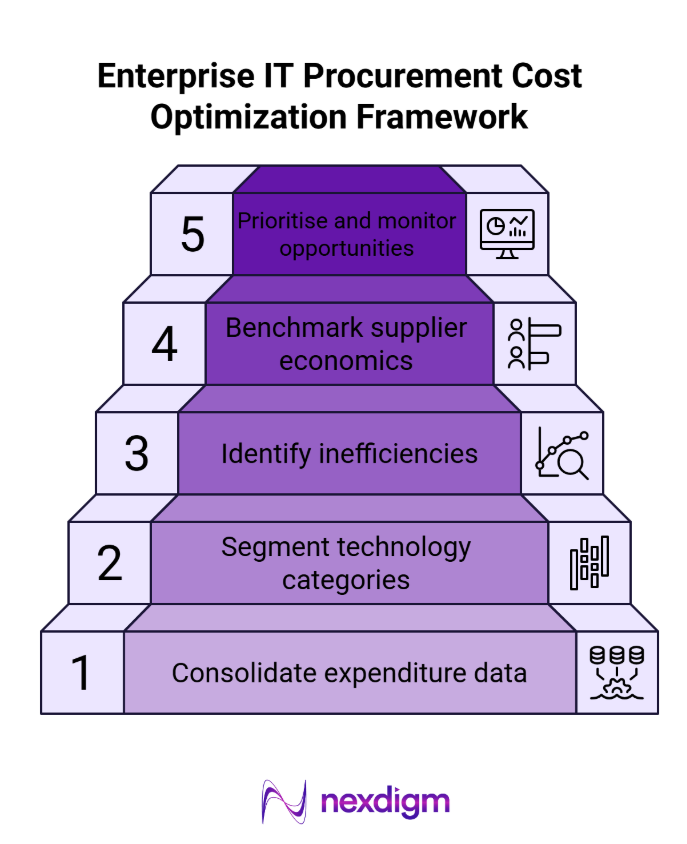
- Consolidate expenditure data: Bring together invoices, contracts, purchase orders, subscriptions and supplier records.
- Segment technology categories: Classify expenditure across software, cloud, hardware, services, cybersecurity and connectivity.
- Identify inefficiencies: Examine unused capacity, overlapping products, fragmented sourcing and unfavourable contract terms.
- Benchmark supplier economics: Compare pricing, service scope, commercial structures and available market alternatives.
- Prioritise and monitor opportunities: Assess savings potential, implementation risk, business impact and ongoing governance requirements.
Nexdigm’s Case Study: Identifying Enterprise IT Cost Opportunities
Nexdigm analysed expenditure across seven IT categories and 26 suppliers, identifying 18 cost optimisation opportunities. The assessment prioritised six initiatives for commercial review, supported by supplier benchmarking and contract-level analysis.
To take the next step, simply visit our Request a Consultation page and share your requirements with us.
Harsh Mittal
+91-8422857704