

IT services firms must price engagements around more than hourly rates, balancing specialist talent costs, utilization, delivery complexity, service levels, project risk, and client value expectations. IT services pricing feasibility consulting provides a structured basis for validating whether proposed rates and commercial models can sustain both competitiveness and profitability.
Supported by IT services pricing analysis, rate benchmarking, margin analysis, competitive pricing intelligence, and pricing feasibility assessment, firms can strengthen commercial decisions and client alignment, moving a step towards stronger positioning in the rapidly evolving landscape.
A recent study forecast revealed worldwide IT services spending would reach approximately $1.73 trillion in 2025, increasing 9% year over year. This expanding market reinforces the role of Pricing Analysis Services in benchmarking rates, evaluating delivery economics, and protecting margins.
Pricing Feasibility Analysis for IT Services and Delivery Cost Management
Pricing feasibility analysis helps IT service providers evaluate cost structures, delivery requirements, competitive positioning, and client expectations to establish sustainable pricing across the IT industry. The analysis can be assessed across the following dimensions covering cost efficiency and profitability, and they are:
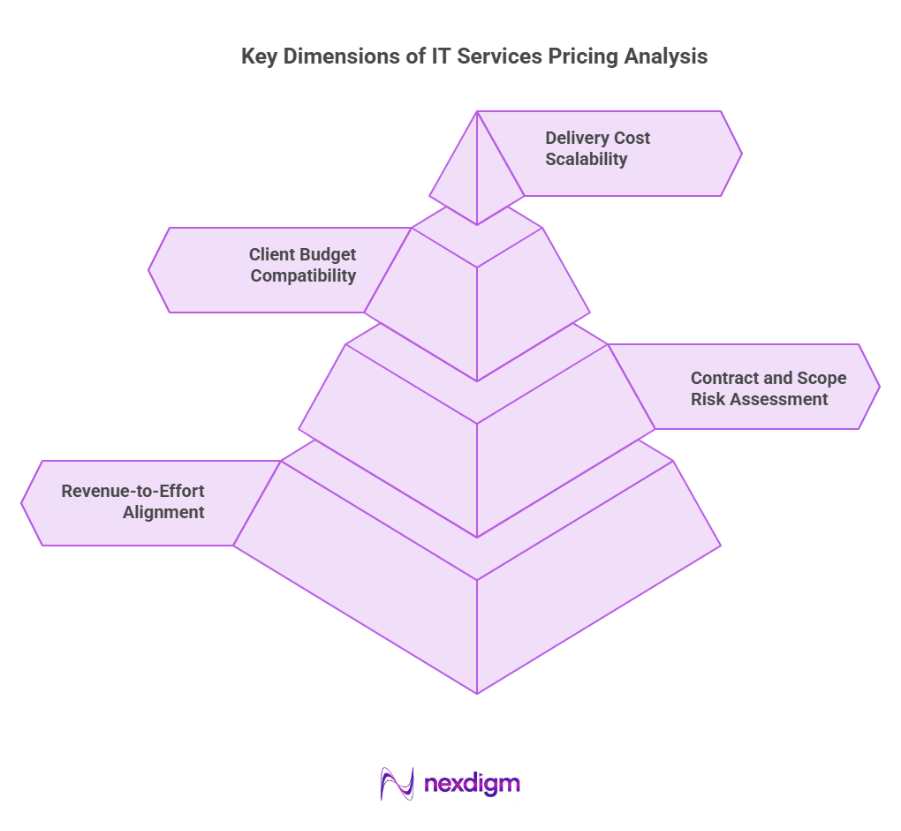
- Delivery Cost Scalability: Examines how staffing, infrastructure, tools, and support costs change as service volumes grow, helping determine whether pricing remains financially viable across different delivery levels.
- Client Budget Compatibility: Analyzes customer budget limitations, procurement requirements, purchasing behavior, and willingness to pay to determine whether proposed pricing is commercially realistic for targeted client segments.
- Contract and Scope Risk Assessment: Assesses scope changes, unclear requirements, service-level commitments, penalties, and additional support obligations that may increase delivery costs beyond assumptions used in initial pricing decisions.
- Revenue-to-Effort Alignment: Compares expected revenue with hours, expertise, resources, and management effort required for delivery to identify engagements where pricing may not adequately compensate operational commitment.
Nexdigm’s Advisory Role in Balancing IT Service Costs, Pricing, and Client Expectations
Nexdigm supports IT service providers with structured pricing analysis to align delivery costs, service value, profitability, and client expectations. Its advisory approach evaluates cost drivers, pricing models, market benchmarks, resource requirements, and margin considerations to strengthen commercial decisions. This enables businesses to establish sustainable, competitive pricing while improving cost visibility, managing delivery risks, and supporting profitable client engagements.
Nexdigm’s Pricing Analysis Decision Model for IT Businesses Managing Delivery Costs
Nexdigm’s Pricing Decision Model helps IT service providers with strategic insights which help them with pricing decisions across diverse client engagements and contracts. The model can be applied through focused strategies that strengthen pricing discipline, and they are:
- Client Value Alignment: Connects pricing with service outcomes, business impact, technical expertise, and client priorities, ensuring proposed fees reflect perceived value while remaining acceptable to targeted customers.
- Rate Card Analysis Strategy: Reviews hourly, daily, role-based, or blended rates to determine whether pricing reflects resource costs, skill levels, market positioning, and client expectations.
- Project Pricing Feasibility Strategy: Compares estimated effort, project complexity, delivery timelines, resource costs, and contingency requirements to determine whether quoted project prices are commercially viable.
- Cloud Services Pricing Analysis Strategy: Evaluates cloud consumption, licensing, migration effort, support requirements, and vendor charges to determine appropriate pricing structures for cloud-based IT service offerings.
- Technology Complexity Pricing Strategy: Measures how legacy systems, integrations, platforms, cybersecurity requirements, and specialized technologies influence delivery effort and the appropriate price for IT services.
Nexdigm’s Case
Nexdigm supported a global enterprise in strengthening pricing and cost analysis through standardized workflows, automation, and real-time reporting. The engagement achieved 95%+ analytical accuracy, reduced analysis turnaround time by 40%, and improved price-volume visibility, enabling faster, data-driven commercial decisions and stronger pricing governance.
To take the next step, simply visit our Request a Consultation page and share your requirements with us.
Harsh Mittal
+91-8422857704