

IT sourcing decisions increasingly shape how businesses manage technology costs, access specialist capabilities, and respond to changing digital requirements. As cloud services, artificial intelligence, cybersecurity, and managed technology solutions expand, organizations must determine which capabilities to build internally, source externally, or manage through strategic partnerships.
An October 2026 forecast estimates worldwide IT spending will reach US$7.35 trillion in 2027, representing 15% growth from 2026. It also projects data center systems spending to rise 55.5% in 2027, reflecting substantial investment in digital infrastructure.
These shifts create opportunities but also increase pressure to allocate budgets effectively, assess vendor dependencies, and manage technology risks. A structured IT sourcing strategy analysis can help businesses balance cost, capability, vendor mix, and long-term technology priorities.
The Challenge of Balancing Cost and Technology Capability
IT sourcing is not simply a decision to select the lowest-cost provider. Businesses must consider the total cost of ownership, implementation complexity, service quality, scalability, and access to specialist expertise. Internal teams may offer greater control, while external providers can bring technical depth and flexibility. The challenge is finding a sourcing mix that meets business needs without creating unnecessary cost or dependency.
Considerations That Shape an Effective IT Sourcing Strategy
A practical sourcing strategy should connect technology requirements with commercial priorities and risk tolerance. Three considerations can guide this evaluation:
- Cost and Commercial Sustainability: Compare pricing models, licensing structures, implementation expenses, and ongoing support costs to understand total ownership costs and identify potential savings.
- Capability and Vendor Alignment: Evaluate technical expertise, delivery capacity, service coverage, innovation capabilities, and integration experience against current and future business requirements.
- Vendor Mix and Technology Risk: Assess supplier concentration, platform dependencies, data security, service continuity, and exit provisions to understand exposure and maintain sourcing flexibility.
Balancing these considerations helps organizations avoid fragmented procurement decisions and develop a sourcing model aligned with business priorities.
Nexdigm’s Expertise in Aligning IT Sourcing Models with Business Priorities
Our IT sourcing strategy analysis can help businesses evaluate build-versus-buy options, compare outsourcing and managed service models, and identify suitable providers across technology categories. By aligning sourcing choices with cost objectives, internal capabilities, scalability requirements, and technology priorities, our expertise can support more balanced sourcing decisions and long-term procurement planning.
Evaluating the Commercial Value of IT Sourcing Alternatives with Nexdigm
Selecting a sourcing model also requires understanding the commercial implications of available options. Nexdigm can help businesses examine:
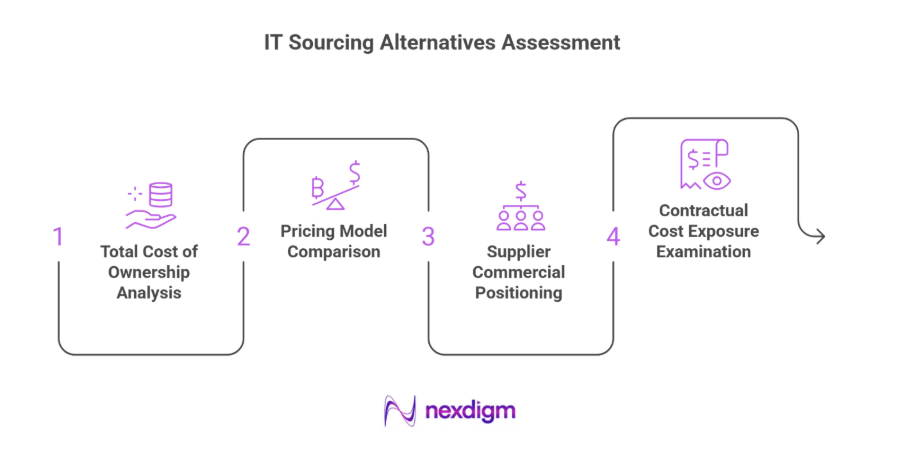
- Total Cost of Ownership: Assess licensing, implementation, maintenance, support, and renewal costs across sourcing alternatives.
- Pricing Model Comparison: Evaluate subscription, usage-based, fixed-fee, and outcome-linked commercial structures.
- Supplier Commercial Positioning: Compare vendor pricing indicators and service offerings to identify potential negotiation opportunities.
- Contractual Cost Exposure: Examine renewal clauses, price escalation terms, service-level commitments, and additional charges that may affect long-term expenditure.
These insights can help procurement teams assess commercial value beyond initial contract costs and make more informed sourcing decisions.
Turning Nexdigm’s IT Sourcing Intelligence into Procurement Priorities
The experts of Nexdigm can help businesses convert technology market and supplier intelligence into practical sourcing priorities. This can involve identifying categories for sourcing review, highlighting opportunities for supplier diversification, evaluating alternative service providers, and prioritizing technology investments. By connecting research findings with commercial objectives and capability requirements, Nexdigm can support structured procurement planning and more informed technology sourcing decisions.
Nexdigm’s Insights into Emerging Technology Sourcing Opportunities
Nexdigm can help businesses assess emerging technology markets and identify sourcing opportunities across cloud computing, artificial intelligence, cybersecurity, and digital infrastructure. By evaluating market developments, supplier capabilities, service models, and commercial trends, our experts can provide procurement teams with insights to anticipate technology requirements, explore alternative sourcing options, and align procurement decisions with evolving business priorities.
Nexdigm’s Case
A multinational enterprise wanted to review its IT sourcing strategy to improve cost visibility, assess vendor capabilities, and identify alternative technology partners. In this scenario, Nexdigm’s research evaluated technology providers across 7 categories, including cloud services, cybersecurity, IT consulting, software, and managed services. The assessment identified 9 providers for further consideration, highlighted cost benchmarking opportunities across 3 categories, and identified supplier concentration concerns in 2 critical technology areas.
To take the next step, simply visit our Request a Consultation page and share your requirements with us.
Harsh Mittal
+91-8422857704