

A new IT supplier may offer the right technology, competitive pricing and an implementation timeline that fits the business requirement. Yet onboarding can expose an organisation to issues that were not apparent during product demonstrations or commercial negotiations. The provider may rely on subcontractors, store data in unexpected locations, have limited recovery capabilities or lack the resources required to support a complex enterprise environment.
These concerns make supplier onboarding a substantive procurement and governance exercise. IT supplier due diligence research helps organisations establish whether a prospective provider is capable, financially sustainable, secure and suitable for the role it will perform.
The Decision Begins with Supplier Criticality
Due diligence should be proportionate to the supplier’s role. A vendor providing a non-essential productivity application does not necessarily require the same review as one managing identity infrastructure, hosting sensitive customer data or supporting a business-critical enterprise system.
Before requesting documents, organisations should establish what the supplier will deliver and what access it will receive. This includes identifying the systems it will connect to, the data it will process, the business functions it will support and the consequences of service failure.
The assessment should also consider the proposed operating model. A supplier may perform services directly, use regional delivery centres or rely on subcontractors. These arrangements can affect data access, service quality, regulatory exposure and accountability.
What the Due Diligence Process Should Establish
- Legal identity, ownership and business standing
The organisation should verify the supplier’s registered identity, ownership structure, operating locations and relevant corporate registrations. Ownership information can be particularly important where the supplier has undergone recent acquisitions or operates through multiple subsidiaries.
The review should establish which legal entity will sign the agreement, which entity will provide the service and whether any affiliates or subcontractors will be involved. This prevents ambiguity over responsibility if performance or compliance issues arise. - Financial and operational capability
A critical IT supplier needs sufficient resources to maintain its services and meet contractual commitments. Financial due diligence may examine audited financial statements, liquidity, profitability, debt exposure and significant changes in ownership or business operations.
Operational capability should be assessed separately. Relevant evidence includes workforce availability, technical expertise, implementation experience, service locations, support arrangements and capacity to handle the expected workload.
A financially stable supplier may still lack the specialist resources required for a complex implementation. Conversely, a technically capable provider may face financial constraints that threaten long-term service continuity. - Technical competence and delivery record
Organisations should review the supplier’s experience with comparable technologies, integrations and enterprise environments. References from similar customers can help establish whether the provider has delivered projects of comparable complexity.
The assessment should cover implementation methodology, testing procedures, documentation, change management and post-deployment support. Where possible, technical demonstrations or controlled proof-of-concept exercises should be used to validate important claims. - Cybersecurity and data protection
The supplier’s security posture should reflect the sensitivity of the information and systems it will access. Due diligence may examine identity and access management, encryption, vulnerability management, incident response, security testing and employee security training.
Organisations should also establish where data will be processed and stored, how it will be retained, and whether it will be shared with third parties. Relevant certifications and independent audit reports can provide supporting evidence, but they should be checked for scope and applicability to the specific service. - Compliance and contractual readiness
The supplier should demonstrate an understanding of the laws, regulations and contractual obligations relevant to its service. Depending on the organisation and sector, this may include privacy requirements, cybersecurity obligations, financial-sector rules, data residency conditions or industry-specific standards.
Legal and procurement teams should review liability provisions, confidentiality, intellectual property, subcontracting, audit rights, incident notification, service levels and termination assistance before onboarding is approved.
Use Evidence to Resolve the Questions That Matter
Supplier questionnaires are useful for gathering information, but self-reported answers should not be treated as conclusive proof. Critical claims need to be supported by documents, independent reports, reference checks or technical validation.
A structured evidence register can help track what has been received, what remains outstanding and whether any findings require escalation. It should also record the date and scope of the evidence. An old security assessment may not reflect the supplier’s current environment, while a corporate certification may not cover the specific service being purchased.
Where information is incomplete, the organisation should decide whether the gap can be resolved before contract signature, addressed through contractual protections or accepted through a documented risk decision. Critical weaknesses should not disappear into an administrative approval simply because a project deadline is approaching.
Making Due Diligence Part of the Onboarding Lifecycle
Supplier approval should not be treated as a permanent status. Critical providers need periodic reviews, especially when they change ownership, introduce new subcontractors, modify data processing arrangements or experience significant security incidents.
The onboarding process should also connect with ongoing performance management. Service-level reports, incident records, financial indicators and compliance updates can help determine whether the supplier continues to meet the conditions under which it was approved.
How Nexdigm Supports IT Supplier Due Diligence Research
Nexdigm supports procurement and technology teams through supplier research, market intelligence, corporate and commercial analysis, and vendor landscape assessment. Its work can help organisations examine prospective providers, understand supplier positioning, identify potential concerns and strengthen the evidence base for critical sourcing decisions.
Critical IT Supplier Due Diligence Checklist
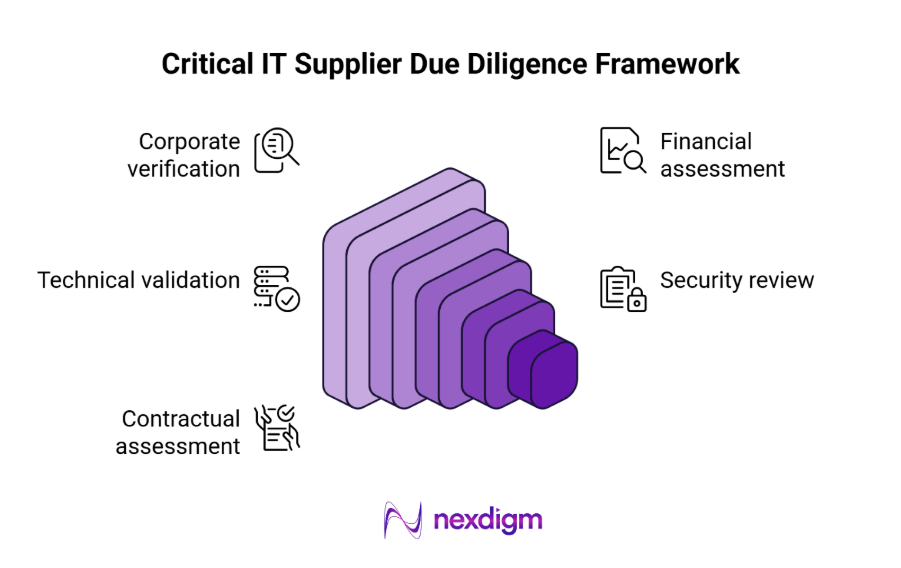
- Corporate verification: Confirm legal identity, ownership, operating locations and contracting entities.
- Financial assessment: Review financial stability, business continuity and capacity to sustain the service.
- Technical validation: Examine relevant experience, delivery resources, architecture and support capabilities.
- Security and compliance review: Validate data protection, cybersecurity controls, certifications and regulatory obligations.
- Contractual assessment: Review liability, service levels, subcontracting, audit rights and exit arrangements.
Nexdigm’s Case Study: Evaluating a Critical IT Supplier
Nexdigm reviewed 10 prospective IT suppliers across six due diligence dimensions, verified 28 corporate and operational evidence points and identified four providers requiring enhanced review before onboarding.
To take the next step, simply visit our Request a Consultation page and share your requirements with us.
Harsh Mittal
+91-8422857704