

K-12 education markets are becoming increasingly differentiated by student demographics, parent preferences, affordability, location, and school format. Recent data indicates that private schools account for around one in five students from pre-primary through secondary education across OECD countries, while competition for students is reported by principals serving about four in five students.
These dynamics make market selection critical for school operators, education groups, and investors considering new campuses or expansion. A growing student population does not automatically translate into a viable school opportunity. Catchment characteristics, household economics, existing capacity, curriculum preferences, competitor density, and willingness to pay all influence potential enrollment.
A structured K-12 education market assessment helps stakeholders identify where demand is strongest, which student cohorts are underserved, what school formats fit local preferences, and where competitive conditions may support sustainable growth.
Where the Next Student Base Is Emerging
K-12 demand can vary considerably between neighborhoods, cities, and demographic groups. Population growth, household formation, migration, income levels, and rising participation in private education can reshape local school markets.
Nexdigm can help assess these factors at the catchment and student-cohort level, identifying areas where demographic momentum and education demand create stronger opportunities for new or expanded school capacity.
Understanding the Catchment Potential
A school’s addressable market depends on more than geographic proximity. Travel time, transport access, household income, school density, local preferences, and competitor positioning can determine whether families are willing to consider a particular institution.
Nexdigm can evaluate catchments using demographic and market indicators to estimate the realistic student pool, helping operators distinguish between a large geographic population and an actionable enrollment opportunity.
Nexdigm’s Industry-Led Expertise in Assessing K-12 Market
Nexdigm brings expertise in market intelligence, education-sector research, demand assessment, competitive benchmarking, location analysis, and strategic advisory to support K-12 growth decisions.
Its approach connects student demographics with household economics, school capacity, curriculum preferences, competition, pricing, accessibility, and local market conditions. This helps education stakeholders understand not only where students are located, but which markets can realistically support additional school capacity.
Why a K-12 Market Assessment Matters
As competition intensifies and student demographics continue to evolve, education providers require a structured approach to evaluate market opportunities before expansion or investment. Nexdigm’s K-12 Market Assessment Framework helps institutions identify high-potential catchments, understand enrollment demand, assess competitive dynamics, and align offerings with parent expectations. This enables informed decision-making, reduces market-entry risks, and supports sustainable enrollment growth and long-term institutional success.
Nexdigm’s K-12 Market Assessment Framework
Nexdigm’s K-12 education market assessment can evaluate potential markets across several areas. Such dimensions in focus are:
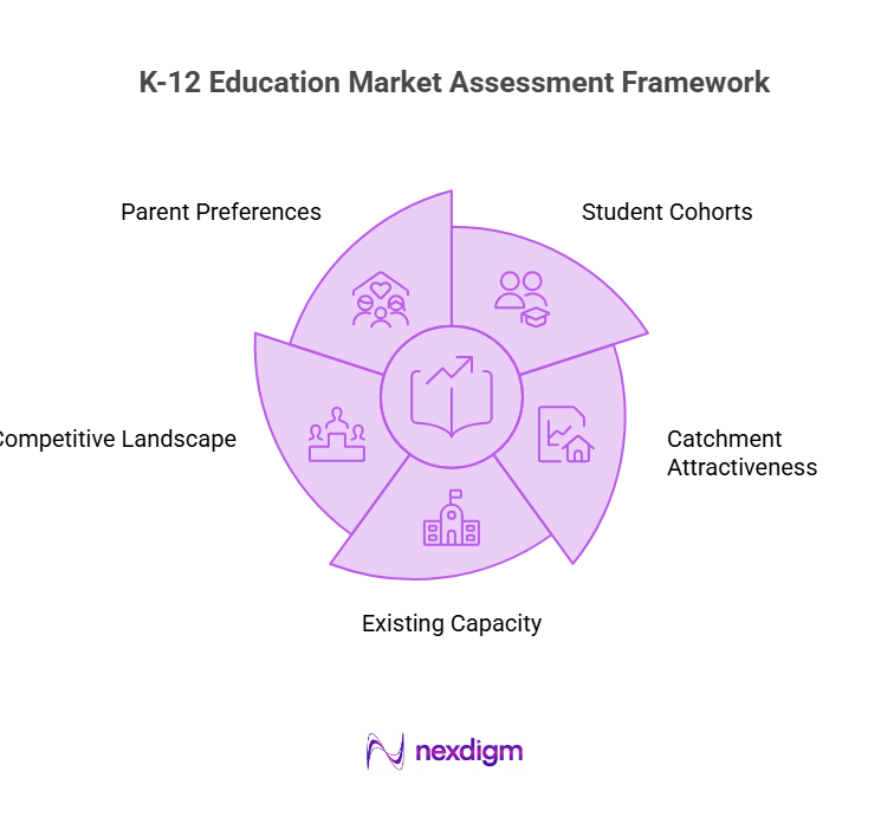
- Student Cohorts: Analyze school-age population trends, demographic shifts, migration patterns, and enrollment growth to estimate future student demand and long-term market sustainability.
- Catchment Attractiveness: Assess household concentration, income levels, accessibility, commuting behavior, and geographic reach to determine the strength and viability of school catchment areas.
- Existing Capacity: Evaluate current school infrastructure, available seats, enrollment levels, utilization rates, and curriculum offerings to identify unmet demand and supply gaps.
- Competitive Landscape: Benchmark competing schools based on fee structures, academic curricula, brand positioning, facilities, reputation, and target student segments within the market.
- Parent Preferences: Examine key school selection criteria, including academic performance, affordability, safety, convenience, faculty quality, and extracurricular opportunities valued by families.
These dimensions help create a more complete view of market attractiveness and enrollment potential.
Areas Where Nexdigm’s K-12 Market Assessment Supports Growth
Nexdigm’s K-12 market assessment translates market intelligence into practical decisions across the school-development and expansion lifecycle. By connecting demand, catchment characteristics, competition, affordability, and school formats, the assessment helps operators with:
- New School Development: Nexdigm evaluates student populations, household profiles, existing school supply, competitive intensity, accessibility, and demand trends to identify locations where a new school could achieve sustainable enrollment.
- Campus Expansion: By comparing current enrollment with available capacity and underlying catchment demand, Nexdigm helps determine whether an existing school has sufficient market potential to justify additional classrooms, facilities, or student capacity.
- Format Selection: Nexdigm assesses parent preferences, affordability, competitive offerings, curriculum demand, and student profiles to help operators determine whether a premium, international, specialized, affordable, or alternative school model best fits the market.
- Catchment Expansion: Analysis of surrounding demographics, household concentrations, travel patterns, accessibility, and competing schools can help identify neighboring areas and student cohorts that represent realistic opportunities for expanding the school’s recruitment reach.
Together, these applications enable education operators to move from identifying market opportunity to making informed decisions about location, capacity, format, pricing, and investment.
Nexdigm’s Case
Nexdigm supported an education stakeholder evaluating K-12 expansion across nine potential catchments. The assessment mapped 40+ competing schools, evaluated four school-format options, and identified three priority markets with stronger combinations of student demand, capacity gaps, and competitive opportunity, helping refine the proposed expansion strategy.
To take the next step, simply visit our Request a Consultation page and share your requirements with us.
Harsh Mittal
+91-8422857704