

For a new school, the address is part of the product. Parents may like a curriculum and still reject the school if the daily commute is impractical, fees stretch the household budget or the campus does not feel safe. A school entering a new market must therefore build its proposition around how families actually choose schools, rather than assuming that a growing residential area guarantees enrollment.
The decision involves a local demand assessment, a clear position against competing schools and a realistic plan for building capacity over several academic years.
What India’s School Market Data Says About Entry
India recorded approximately 24.69 crore school students across 14.71 lakh schools in 2024–25, according to UDISE+ data. NITI Aayog’s 2026 analysis of school education also identified important shifts in enrollment and school choice over the preceding decade. National figures provide scale, but local conditions can differ sharply by state, district and stage of schooling.
A school operator should start by mapping the likely catchment. The number of children living nearby matters, but so do household income, residential development, transport routes, existing school capacity and the number of families willing to pay for private education. A neighbourhood with many children may already be well served, while another may have fewer students but limited access to the type of school parents prefer.
Demand also varies by grade. A new school may fill its early years quickly but struggle to attract older students, who are less likely to transfer. The entry plan should model the first cohort’s progression and the cost of adding grades, rather than treating the school’s full planned capacity as immediately available.
How Parents Evaluate a New School
Parents usually compare more than academic results. They look for dependable teachers, a safe environment, clear communication, manageable class sizes, suitable facilities and confidence that the school will remain stable.
Curriculum is part of that decision, but it must be understood in context. An international or specialised curriculum may attract a particular segment while raising staffing, material and fee requirements. A school offering a recognised national curriculum may reach a broader market, provided it has a credible teaching model and clear differentiation.
Price transparency is equally important. Tuition is only one part of the annual cost. Transport, uniforms, books, activities, technology and fee revisions influence affordability. A school that communicates these costs clearly can reduce uncertainty during the admissions process.
K-12 Education Market Entry Consulting: Turning Preferences Into a Business Case
K-12 education market entry consulting should establish which parent segments the school can serve, what they value and whether the proposed offer can be delivered at a sustainable cost.
A market assessment should cover:
- Catchment and access: Travel times, residential growth, age-group demographics and competing schools.
- Parent preferences: Curriculum expectations, teaching quality, safety, facilities, communication and student support.
- Fee positioning: Competitor fees, household affordability, ancillary charges and likely price sensitivity.
- Academic and operating model: Teacher availability, class sizes, grade-wise capacity, facilities and compliance requirements.
- Enrollment conversion: Parent enquiries, campus visits, applications, offer acceptance and confirmed admissions.
This evidence helps distinguish between a feature parents genuinely value and one that adds cost without influencing school choice. It can also identify where a partnership, transport service or phased facility investment may address a concern more efficiently than building everything at launch.
School Market Entry Strategy Framework
The K-12 School Market Entry Framework connects local demand with launch planning.
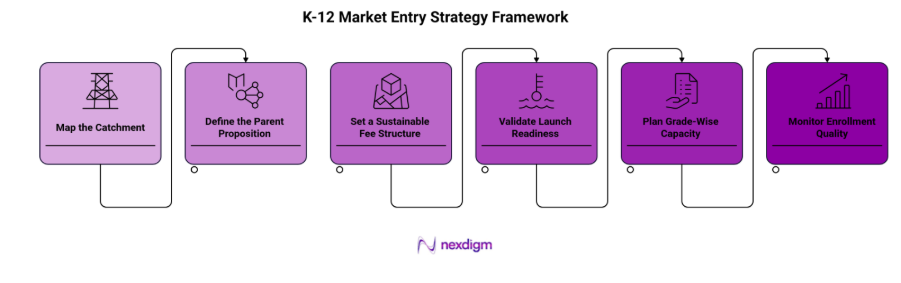
- Map the Catchment: Estimate eligible children, school-age population trends and accessible demand by grade.
- Define the Parent Proposition: Select curriculum, teaching approach and service features that match the target segment.
- Set a Sustainable Fee Structure: Model total household cost, expected fee collection and financial support.
- Plan Grade-Wise Capacity: Sequence admissions, classrooms, teacher recruitment and facility investment.
- Validate Launch Readiness: Check applicable recognition, affiliation, safety, building and staffing requirements before committing to opening dates.
- Monitor Enrollment Quality: Track conversion, retention, parent feedback and operating performance as each cohort progresses.
The most attractive entry market is not always the wealthiest or fastest-growing neighbourhood. It is the one where the school can meet a clearly identified need, attract enough families and maintain the promised standard of education.
Nexdigm Case Study: Assessing a School Launch
Nexdigm assessed four proposed school catchments, comparing age-group demographics, competitor fees, parent preferences and grade-wise capacity. Two locations progressed to financial modelling. The preferred option used a phased grade launch and a fee structure aligned with local affordability, with expansion tied to admissions and teacher recruitment milestones.
To take the next step, simply visit our Request a Consultation page and share your requirements with us.
Harsh Mittal
+91-8422857704