

K-12 expansion is fundamentally a capacity decision. A school operator can identify a growing population, rising education spending or an underserved locality, but those indicators only become commercially meaningful when they translate into sustainable enrolment and operating economics.
India’s school system recorded 24.69 crore students across 14.71 lakh schools in 2024–25. Government schools represented 69% of schools and 49% of students, while private schools represented 26% of schools and 41% of students.
The scale of the system creates substantial room for expansion, but school economics are intensely local.
The Expansion Case Begins with Enrolment
A new campus needs enough students to fill its classrooms over time. An existing operator needs to know whether a new branch will draw students away from competitors or simply divide an existing pool of demand.
The first step is therefore to estimate addressable enrolment by catchment, grade and household segment.
Population growth alone is insufficient. The analysis should consider:
- school-age population;
- current enrolment;
- grade-level distribution;
- competing school capacity;
- household affordability;
- prevailing fees; and
- likely migration into or out of the catchment.
The result should be an enrolment range rather than a single headline number.
Capacity Utilisation Drives the Economics
School infrastructure creates substantial fixed costs before the first cohort arrives.
Land, construction, classrooms, laboratories, transport facilities and administrative infrastructure can require significant upfront investment. Faculty and support staff then add recurring costs as the school scales.
This makes capacity utilisation one of the central variables in K-12 feasibility.
A school with 1,000 seats does not have a 1,000-student revenue opportunity if the catchment can support only 500 relevant students at the proposed fee. Conversely, a strong catchment may justify phased capacity expansion rather than full-scale development from the outset.
Fee Positioning Determines Which Demand Is Addressable
India’s private schools serve 41% of enrolled students nationally. But the private-school market contains very different fee and positioning segments.
A premium international or CBSE school may target households with substantially different affordability and expectations from a mid-market school.
The assessment therefore needs to compare proposed fees with local household economics and existing school fees. Willingness to pay should be considered alongside competing alternatives, including government schools and lower-cost private institutions.
The objective is to establish the portion of the student population that is commercially addressable at the proposed price.
Location Can Change the Entire Business Case
Two sites within the same city can have different expansion potential.
Travel time, road connectivity, residential development, competing schools and future housing projects can influence the practical catchment. The site also needs to support the proposed school format, including land requirements, regulatory conditions and access to infrastructure.
A K-12 expansion assessment should therefore connect market demand with site-level feasibility rather than treating location as an operational detail.
A School Can Be Demand-Rich and Still Economically Weak
The critical calculation is the relationship between enrolment, fee revenue and operating costs. A feasibility model can test different scenarios for student acquisition and capacity utilisation, including slower-than-expected enrolment, fee discounts, teacher-cost increases and delayed occupancy.
This makes the expansion decision more robust than relying on a single base-case forecast.
Nexdigm’s K-12 Feasibility Framework
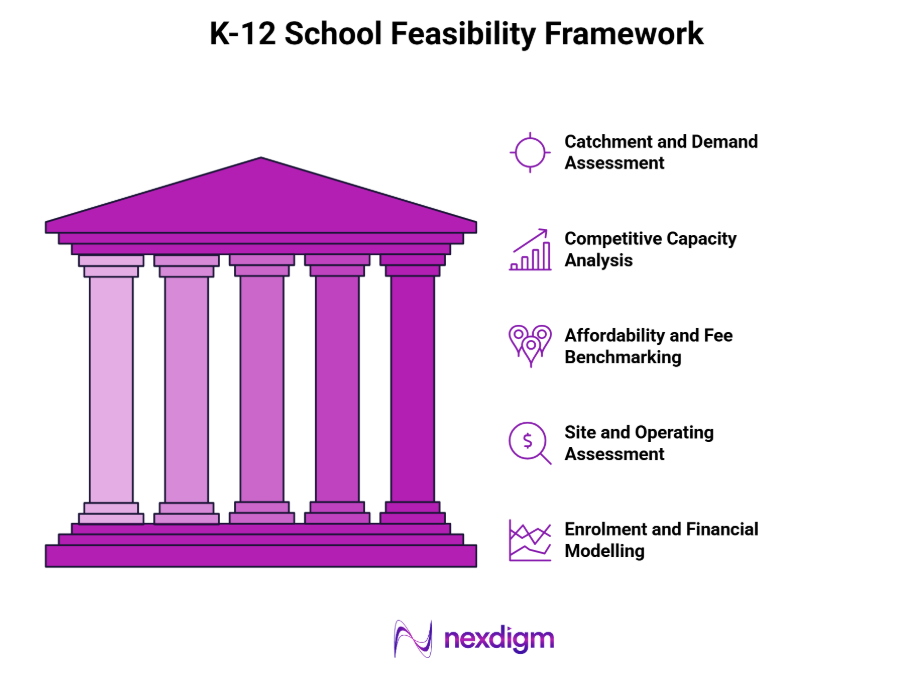
- Catchment and Demand Assessment
Estimate student populations and addressable demand by geography and grade. - Competitive Capacity Analysis
Map schools, enrolment, available capacity, curriculum, fees and positioning. - Affordability and Fee Benchmarking
Assess household economics and local fee structures to determine viable price positioning. - Site and Operating Assessment
Evaluate location, infrastructure requirements, staffing and regulatory considerations. - Enrolment and Financial Modelling
Model capacity utilisation, revenue, operating costs and downside scenarios to assess expansion viability.
Case Study: Testing an International School Expansion
A leading UK-based educational institute engaged Nexdigm to evaluate India’s international-school landscape before expansion. Nexdigm interviewed more than 25 ecosystem stakeholders and assessed international-school programmes for ages 5–17, business models, fee structures, curricula, competitors and regulatory requirements. The resulting market assessment supported the client’s India entry strategy.
Nexdigm can support school operators and education investors with catchment assessment, demand sizing, competitor analysis, fee benchmarking and K-12 feasibility modelling.
To take the next step, simply visit our Request a Consultation page and share your requirements with us.
Harsh Mittal
+91-8422857704