
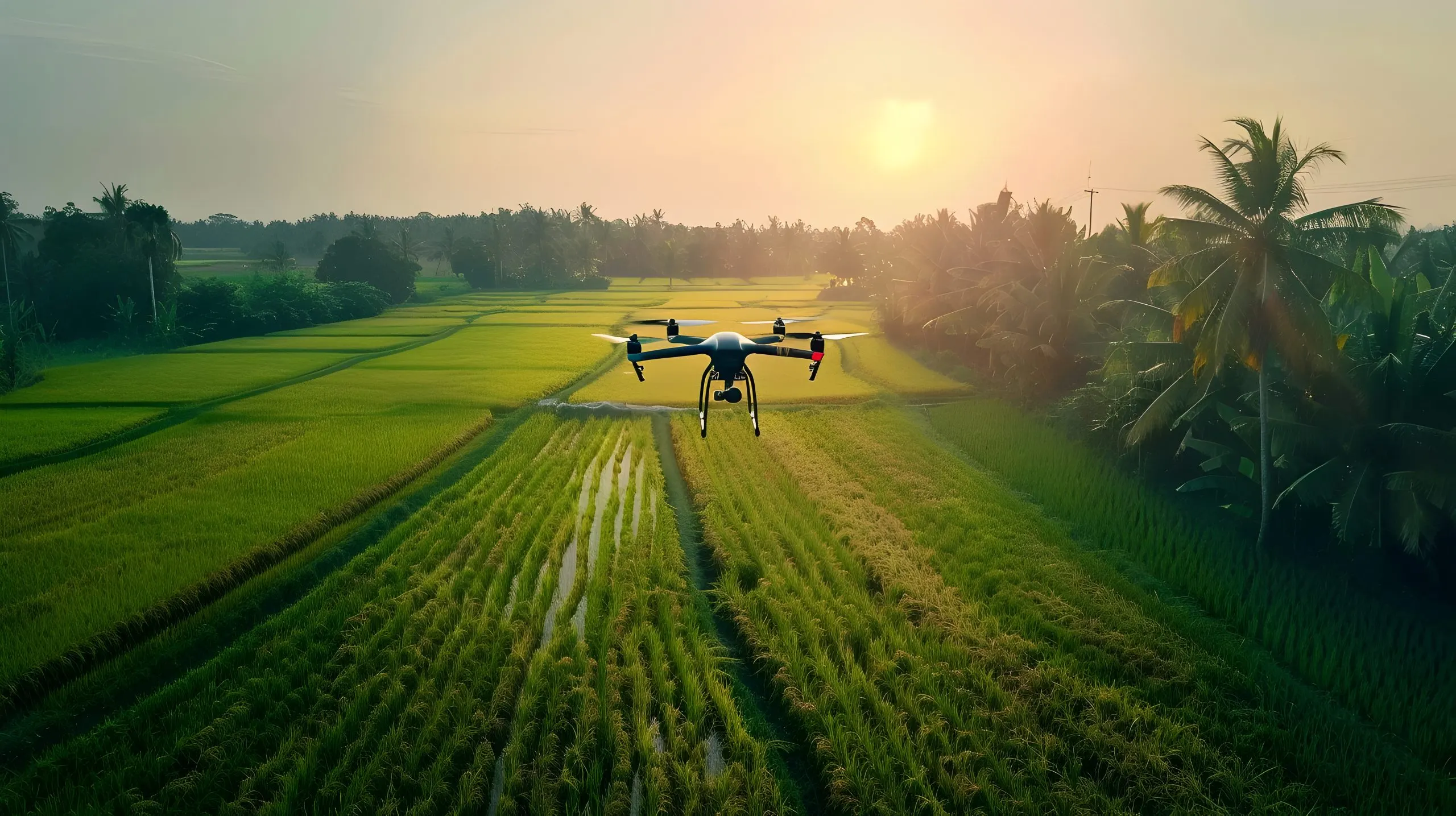
The KSA agriculture drones market is expanding as farms, agritech companies, food security projects, greenhouse operators, and drone service providers look for more efficient ways to manage crops in arid conditions. Drones are being used for crop monitoring, field mapping, spraying, irrigation assessment, pest detection, thermal imaging, multispectral analysis, and yield planning. Saudi Arabia’s agriculture drones market is expected to grow at 18.1% CAGR, supported by precision farming adoption and agricultural modernization. Demand is also being shaped by water conservation needs, large outdoor farming areas, and rising investment in smart agriculture.
Key market drivers are strengthening agriculture drone demand in KSA
Water-efficient farming is increasing demand for precision monitoring
Water management is one of the most important priorities for agriculture in Saudi Arabia. Farms need technologies that can help monitor crop stress, irrigation gaps, soil moisture variation, and field-level performance more accurately. Drones equipped with thermal cameras, multispectral sensors, and mapping tools can help farmers identify problem areas early and make better decisions on irrigation and crop care. This is particularly important for dates, vegetables, fruits, fodder crops, greenhouse farming, and desert agriculture projects. In a country where resource efficiency is central to agricultural sustainability, drones can help reduce wastage and support smarter farm management.
Outdoor farming and large farm areas are supporting drone adoption
Outdoor farming represents around 90% of Saudi Arabia’s agriculture drones market, showing strong demand across open-field farming and large-scale agricultural areas. Drones help farmers cover land faster than manual scouting and can be useful for spraying, crop inspection, pest detection, mapping, and input planning. Rotary-wing drones hold around 65.0% share in the Middle East and Africa agriculture drones market, reflecting demand for platforms that can hover, spray, inspect, and operate across varied field conditions. For farms managing wide areas under challenging weather conditions, drones can improve speed, visibility, and operational flexibility.
Drone services are making advanced technology easier to access
Drone-as-a-service models are becoming important because many farms may not want to purchase, operate, and maintain drones directly. Regional drone services are projected to grow at nearly 17.2% CAGR, supporting wider adoption through trained operators and agritech service providers.
Government food security and Vision 2030 initiatives are supporting drone adoption
Government priorities around Vision 2030, food security, water conservation, agricultural modernization, and digital transformation are creating a supportive environment for agriculture drones in Saudi Arabia. Public and private initiatives are encouraging the use of smart farming technologies, controlled-environment agriculture, automation, sensors, and data-led farm management. Drone adoption is also shaped by aviation safety, licensing, and operational compliance requirements, making trained operators and regulatory awareness important. These initiatives support better crop monitoring, efficient irrigation, safer spraying, and improved productivity across farms and food security-linked projects.
Competitive landscape is expanding across drone suppliers, agritech firms, and service providers
The KSA agriculture drones market includes UAV suppliers, drone service companies, agritech startups, greenhouse technology providers, irrigation solution companies, sensor providers, farm software platforms, and food security project operators. Competition is shaped by drone durability, payload capacity, flight safety, sensor quality, spraying precision, software integration, Arabic-language support, compliance knowledge, and local after-sales service. Suppliers are targeting dates, vegetables, fruits, fodder crops, greenhouses, large farms, and controlled-environment agriculture. Companies that combine reliable hardware, practical analytics, regulatory support, training, and climate-ready service models are better positioned to build adoption.
Market challenges continue to affect adoption and operational reliability
Harsh climate conditions can affect drone performance
High temperatures, dust, wind, and dry field conditions can affect battery life, flight stability, sensor accuracy, and maintenance needs. Drones used in Saudi agriculture must be durable and suited to arid environments.
Cost, regulation, and technical capability remain barriers
Drone hardware, sensors, software, operator training, maintenance, and compliance can require significant investment. Farms also need support in interpreting aerial data and converting it into practical irrigation, spraying, and crop decisions.
Future outlook
The future outlook for the KSA agriculture drones market remains positive, supported by smart farming, water-efficient agriculture, food security investment, outdoor farming, and precision crop management. The Middle East and Africa agriculture drones market is projected to expand from USD 226.8 million to USD 476.3 million at 16.0% CAGR, while Saudi Arabia’s broader drone market is projected to reach USD 787.35 million at 10.70% CAGR. Opportunities are expected across crop monitoring drones, spraying drones, thermal imaging, multispectral sensors, irrigation analytics, date palm monitoring, greenhouse inspection, AI-based crop health tools, and drone-as-a-service models. Businesses that combine climate-ready hardware, local compliance support, farm analytics, and practical service delivery will be better positioned for long-term growth.
Consultants at Nexdigm, in their latest publication “KSA agriculture drones market outlook to 2035,” analyze the sector By Drone Type (Fixed-Wing Drones, Rotary-Wing Drones, Hybrid VTOL Drones, Spraying Drones), By Application (Precision Spraying, Crop Health Monitoring, Field Mapping & Surveying, Irrigation Management)
Nexdigm suggests that businesses in the KSA agriculture drones market should focus on water-efficient, climate-ready, and precision-driven drone solutions that support demand for crop monitoring, field mapping, spraying, irrigation assessment, pest detection, thermal imaging, multispectral analysis, and yield planning.
To take the next step, simply visit our Request a Consultation page and share your requirements with us.
Harsh Mittal
+91-8422857704