

KYC operations are becoming more technology-intensive as financial institutions balance regulatory expectations with faster digital onboarding and increasingly complex identity risks. A 2025 financial-crime benchmarking survey found that 94% of banks identify high manual workloads as a primary AML/KYC challenge, while 60% still rely on manual intervention for more than half of their AML/KYC processes. At the same time, 69% expect to invest in KYC automation over the next three years.
Provider selection is also becoming more demanding as identity threats evolve. A 2025 KYC market study found that 91% of KYC practitioners consider accuracy important, while 89% prioritize both data quality and regulatory compliance. 79% also consider scalability important when selecting KYC solutions.
Against this backdrop, KYC compliance service vendor research can help financial institutions compare providers based on coverage, accuracy, automation, data capabilities, scalability, and compliance readiness.
KYC Is Moving From Periodic Checks Towards More Continuous Risk Management
Traditional KYC processes often rely on onboarding checks and periodic reviews, but changing customer behavior and digital fraud risks are encouraging institutions to strengthen ongoing monitoring. In a 2025 survey, 72% of organizations reported plans to adopt perpetual KYC within two years, reflecting a shift toward more continuous assessment of customer risk. This evolution increases the importance of providers that can combine reliable identity data, automated verification, risk signals, workflow capabilities, and appropriate human review.
Provider Capability Can Be Viewed Through Several Dimensions
A useful starting point is to assess providers across the areas most directly connected to KYC effectiveness:
- Coverage & Accuracy: Examine geographic coverage, identity sources, verification methods, data quality, document checks, and accuracy across customer types.
- Automation & Integration: Evaluate onboarding automation, workflow orchestration, API connectivity, screening, case management, and integration with existing compliance systems.
These dimensions help institutions distinguish providers that simply perform identity checks from those capable of supporting broader, scalable KYC and customer due-diligence operations.
KYC Capability Must Adapt to Changing Risk Profiles
KYC requirements can vary significantly by customer type, geography, product, risk level, and regulatory exposure. Providers therefore need to support differentiated verification and review processes rather than applying the same checks to every customer. Nexdigm can assess whether suppliers offer the flexibility to adjust workflows, verification depth, escalation rules, and monitoring based on changing risk conditions, helping institutions build KYC operations that remain responsive as customer profiles and compliance requirements evolve.
Nexdigm’s Role in Mapping KYC Suppliers and Capability
Experts at Nexdigm use KYC compliance service vendor research to map providers against an institution’s:
- Customer segments: A provider may need different capabilities for retail customers, high-net-worth customers, businesses, or complex legal entities.
- Geographic footprint: Coverage of identity sources, documents, regulations, and verification methods can vary across countries and regions.
- Onboarding model: Digital-first onboarding may require stronger automated verification, APIs, document checks, and real-time decisioning.
- Risk priorities: Institutions may place greater emphasis on sanctions screening, beneficial ownership, enhanced due diligence, or ongoing monitoring depending on their risk profile.
This helps identify which suppliers offer broad KYC capabilities and which demonstrate stronger relevance in areas such as identity verification, screening, corporate KYC, beneficial ownership, or ongoing monitoring.
How Nexdigm Compares Supplier Strengths Against KYC Priorities
Nexdigm can compare mapped KYC providers against the institution’s most important requirements, assessing coverage, verification accuracy, automation, integration, scalability, data quality, and compliance readiness. The analysis can highlight where suppliers demonstrate stronger capabilities, where limitations may affect implementation, and where specialist providers offer differentiated value. This creates a clearer basis for prioritizing suppliers for deeper technical, operational, and compliance evaluation.
Nexdigm’s Framework for Assessing KYC Priorities
Nexdigm’s experts use a structured framework to evaluate KYC providers against institutional requirements and identify the suppliers most relevant for deeper assessment. The steps of the framework are:
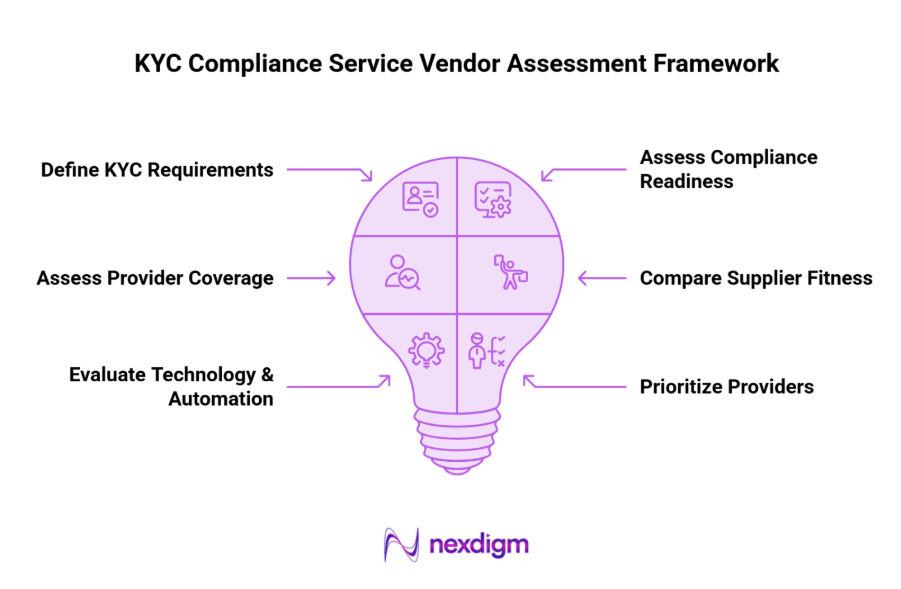
- Define KYC Requirements: Establish customer segments, jurisdictions, onboarding volumes, risk profiles, regulatory expectations, and priority compliance processes.
- Assess Provider Coverage: Examine identity data, document verification, screening, beneficial ownership, customer due diligence, and geographic coverage.
- Evaluate Technology & Automation: Review APIs, workflow automation, risk scoring, case management, integration, scalability, and data capabilities.
- Assess Compliance Readiness: Examine governance, auditability, monitoring, regulatory adaptability, data controls, and escalation mechanisms.
- Compare Supplier Fit: Identify relative strengths, capability gaps, implementation considerations, and areas of differentiation against the institution’s priorities.
- Prioritize Providers: Use the findings to identify suppliers for technical validation, proof-of-concept exercises, RFPs, or commercial evaluation.
This framework helps Nexdigm turn KYC compliance service vendor research into a structured view of supplier capability, practical fit, and compliance relevance.
Nexdigm’s Case
Nexdigm assessed 34 KYC service providers across identity coverage, verification accuracy, automation, integration, data quality, and compliance readiness. 29% demonstrated strong alignment with priority KYC requirements, 21% showed differentiated automation capabilities, and 15% required additional validation around data coverage or integration. The assessment helped the institution prioritize providers for technical due diligence, proof-of-concept evaluation, and commercial discussions.
To take the next step, simply visit our Request a Consultation page and share your requirements with us.
Harsh Mittal
+91-8422857704