

The last-mile delivery stage often represents the total logistics costs, making it a critical area for operational and financial optimization. Efficient last-mile operations directly affect delivery speed, customer satisfaction, and profitability. Competitive intelligence tracks how competitors manage routes, costs, fleet utilization, and service performance provides insights into industry best practices.
Conducting last-mile delivery benchmarking enables businesses to identify inefficiencies, optimize delivery networks, and gain a competitive edge in high-demand logistics markets.
Industry data show that last‑mile delivery can account for 50-55% of total logistics costs, driven by fuel, labor, route inefficiencies, and delivery density. Urban delivery costs are rising upto 25-30% annually due to congestion and customer expectations for faster delivery. Benchmarking performance metrics such as cost per delivery, on‑time rate, and delivery density against industry peers helps companies uncover savings and improve service levels in competitive logistics markets.
Competitive Intelligence on Last-Mile Delivery Costs and Operational Efficiency
Competitive Intelligence on Last-Mile Delivery Costs and Operational Efficiency involves analyzing how competitors manage delivery routes, labor, fleet utilization, and technology to identify cost-saving opportunities and optimize service performance.
- Delivery Cost Benchmarking: Compares competitor last-mile expenses per order, including labor, fuel, and route costs, to identify efficiency opportunities.
- Route Optimization Analysis: Evaluates competitor delivery routing strategies, load planning, and scheduling to reduce travel time and operational costs.
- Fleet Utilization Assessment: Reviews competitor vehicle usage, capacity, and scheduling to improve efficiency and lower per-delivery expenses.
- Technology and Automation Insights: Assesses how rivals implement GPS, route-planning software, and delivery tracking for operational efficiency improvements.
- Labor Productivity Comparison: Examines competitor workforce allocation, shift management, and driver performance to optimize cost and service levels.
Nexdigm’s Route Planning and Fleet Utilization Advisory
Nexdigm’s Route Planning and Fleet Utilization Advisory helps businesses optimize last-mile delivery networks by analyzing routes, fleet capacity, vehicle scheduling, and load planning. The service identifies inefficiencies, reduces travel time and fuel costs, improves vehicle utilization, and enhances on-time delivery performance. By benchmarking against industry peers, Nexdigm provides actionable recommendations to lower operational costs and improve overall delivery network efficiency.
Nexdigm’s Competitive Benchmarking for Last Mile Delivery Network Efficiency
Nexdigm’s Competitive Benchmarking for Last-Mile Delivery Network Efficiency analyzes competitors’ delivery costs, route strategies, fleet utilization, and service performance to identify operational gaps, optimize networks, and achieve cost-effective, high-performing last-mile logistics:
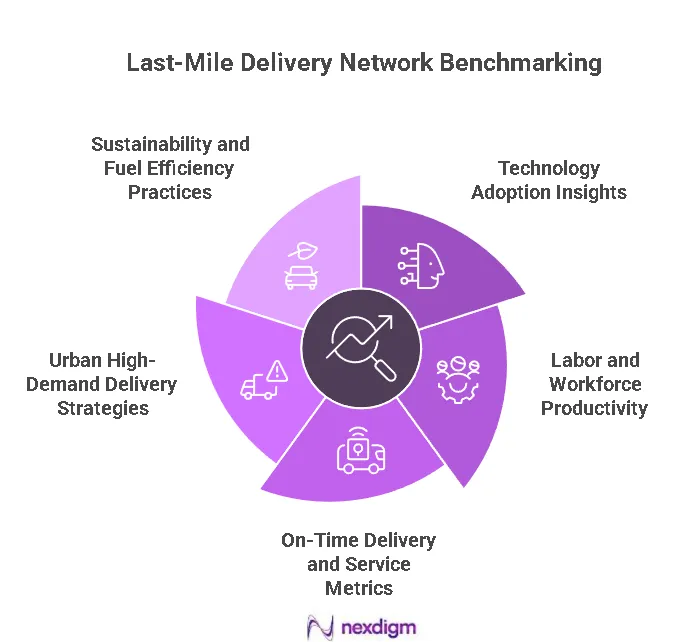
- Technology Adoption Insights: Assesses competitor use of GPS, route-planning software, and delivery tracking to improve operational efficiency and reduce errors.
- Labor and Workforce Productivity: Examines competitor driver allocation, shift planning, and workforce efficiency to optimize costs while maintaining delivery performance.
- On-Time Delivery and Service Metrics: Tracks competitors’ delivery accuracy, speed, and customer satisfaction to identify performance gaps and best practices.
- Urban High-Demand Delivery Strategies: Analyzes competitor approaches to congested or peak-demand areas to improve efficiency and minimize operational delays.
- Sustainability and Fuel Efficiency Practices: Reviews eco-friendly fleet initiatives, fuel optimization, and electric vehicle adoption to reduce costs and environmental impact.
Nexdigm’s case:
Nexdigm assisted a large retail logistics provider struggling with high last‑mile costs, which accounted for over 55% of total delivery expenses across 10 major cities. By conducting competitive benchmarking and route optimization analysis, Nexdigm identified inefficiencies in fleet usage and scheduling. The recommendations helped reduce last‑mile costs by 12–15%, improve on‑time delivery rates, and enhance overall operational performance.
To take the next step, simply visit our Request a Consultation page and share your requirements with us.
Harsh Mittal
+91-8422857704