

Last-mile delivery is increasingly becoming a city-level growth decision. E-commerce, quick commerce, direct-to-consumer models, urbanization, and changing customer expectations are increasing demand for faster and more flexible delivery networks.
The opportunity is particularly relevant in India. The World Bank expects India’s urban population to almost double to 951 million by 2050, creating significant long-term demand for urban logistics and delivery infrastructure.
For parcel companies, 3PLs, e-commerce businesses, retailers, quick-commerce operators, logistics startups, investors, and distribution companies, a last mile delivery expansion entry consulting approach can help them compare cities based on market attractiveness and scalability, to identify priority cities and determine where a new last-mile network can achieve commercially sustainable growth.
Why City Prioritization Matters for Last-Mile Expansion
The success of a last-mile network depends heavily on selecting the right cities. Population size alone is rarely a reliable indicator of market potential. Factors such as customer density, order frequency, traffic conditions, delivery distances, spending patterns, warehousing availability, and competitive intensity can significantly influence operating efficiency and long-term profitability.
Emerging Cities Are Driving the Next Wave of Demand
Rapid growth in e-commerce, quick commerce, and direct-to-consumer channels is expanding logistics demand beyond major metropolitan areas. As digital commerce adoption spreads across Tier 2 and Tier 3 cities, delivery providers have increasing opportunities to establish networks in underserved markets with strong growth potential and evolving consumer expectations.
Delivery Economics Depend on Density and Market Dynamics
High-density customer clusters can improve route efficiency, increase delivery volumes, and reduce operating costs per order. However, growth alone does not guarantee attractive returns. A city’s overall attractiveness depends on a combination of demand potential, logistics economics, competitive intensity, infrastructure availability, and scalability, making a balanced assessment critical for expansion decisions.
How Nexdigm Supports Last-Mile Expansion Strategy
As last-mile delivery networks expand across urban and emerging markets, Nexdigm helps organizations evaluate city-level opportunities through a structured and data-driven approach. By combining market intelligence, logistics economics, competitive analysis, and scalability assessment, Nexdigm enables businesses to make informed expansion decisions and focus investments on high-potential markets.
Nexdigm Helps Prioritize the Right Cities for Growth
Through its last mile delivery expansion entry consulting approach, Nexdigm helps organizations identify and prioritize cities with the strongest potential for sustainable growth. By evaluating demand levels, delivery economics, competitive intensity, infrastructure availability, and scalability, Nexdigm enables businesses to focus expansion efforts on locations that offer the highest likelihood of long-term commercial success.
Nexdigm’s Framework for Last-Mile Delivery Expansion
Through its expansion approach framework, Nexdigm helps organizations evaluate city-level opportunities and prioritize markets with the strongest growth potential. The framework combines demand, economics, competition, and scalability considerations to support more informed expansion decisions through the following steps:
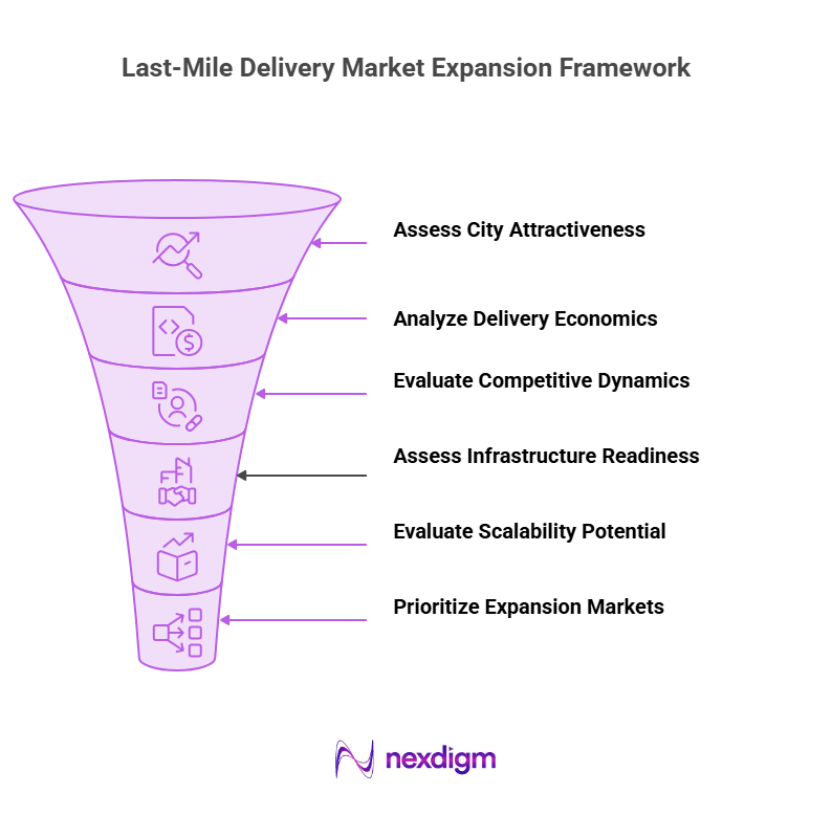
- Step 1: Assess City Attractiveness
Evaluate market size, urbanization trends, e-commerce activity, consumer demand, and growth potential across target cities. - Step 2: Analyze Delivery Economics
Assess order density, delivery distances, traffic conditions, operating costs, and route efficiency to determine commercial viability. - Step 3: Evaluate Competitive Dynamics
Review competitor presence, service coverage, market saturation, and barriers to entry across potential expansion markets. - Step 4: Assess Infrastructure Readiness
Analyze warehousing availability, fulfillment capabilities, transportation networks, and supporting logistics infrastructure. - Step 5: Evaluate Scalability Potential
Assess long-term growth prospects, network expansion opportunities, and operational feasibility to support sustainable expansion. - Step 6: Prioritize Expansion Markets
Combine market, operational, and commercial insights to identify the cities best aligned with growth objectives and investment priorities.
By integrating insights from the framework assessment, Nexdigm’s last mile delivery expansion entry consulting approach helps organizations identify high-potential cities and develop focused expansion strategies that support scalable and profitable growth.
Nexdigm in Creating Long-Term Value for Last-Mile Delivery Expansion
A structured expansion framework helps organizations move beyond short-term growth opportunities and focus on sustainable value creation. By evaluating demand potential, delivery economics, competitive dynamics, infrastructure readiness, and scalability, Nexdigm’s last mile delivery expansion entry consulting approach enables businesses to:
- Improve Expansion ROI: Direct investments toward cities with stronger commercial potential, helping maximize returns and improve resource allocation.
- Reduce Expansion Risk: Identify operational, competitive, and infrastructure challenges early to support more informed expansion decisions.
- Prioritize High-Potential Markets: Focus on cities where demand, profitability, and scalability are most closely aligned with growth objectives.
- Build Scalable Delivery Networks: Develop network strategies that can efficiently support future growth and changing customer demand patterns.
- Strengthen Long-Term Competitiveness: Create a sustainable market presence by balancing growth opportunities with operational and economic viability.
With these benefits, Nexdigm helps organizations identify high-potential cities, optimize expansion decisions, and build scalable delivery networks.
Nexdigm’s Case
A logistics company engaged Nexdigm to evaluate potential city expansions using demand, customer density, competition, infrastructure, and delivery economics. The assessment helped prioritize six high-potential cities, improve projected network utilization by 17%, and identify opportunities to reduce delivery costs by 12%, supporting a more focused and commercially viable expansion strategy.
To take the next step, simply visit our Request a Consultation page and share your requirements with us.
Harsh Mittal
+91-8422857704