
India’s last-mile delivery market is expanding, but the opportunity is becoming more geographically complex. The e-commerce last-mile delivery market is estimated at $3.66 billion in 2026 and projected to reach $7.57 billion by 2031, representing a 15.63% CAGR. Tier 3 and below cities are expected to grow faster than Tier 1 markets, while same-day delivery is projected to be the fastest-growing delivery format.
For an operator considering a new market, that growth does not automatically translate into an attractive entry opportunity. The commercial case depends on whether enough orders can be concentrated within viable delivery zones, at a price that covers the cost of riders, vehicles, hubs, failed deliveries and returns.
Order Growth Is Not the Same as Route Density
A market can generate substantial parcel volumes while remaining expensive to serve. Orders dispersed across a large geographic area create longer stem distances, more kilometres between stops and lower deliveries per courier shift. A smaller market with concentrated demand can therefore produce better asset utilization and lower cost per completed delivery.
This distinction becomes increasingly important as e-commerce expands beyond India’s largest metros. Tier 3 and below markets are projected to grow at an 18.68% CAGR through 2031, compared with the existing scale of Tier 1 markets. The opportunity is growing, but the network required to serve it may look very different from a dense metropolitan operation.
Delivery Speed Changes the Economics
The service promise determines how much consolidation an operator can achieve.
Scheduled and next-day deliveries allow operators to aggregate shipments, plan routes around geographic clusters and improve vehicle utilization. Same-day services compress those planning windows. Ultra-fast delivery goes further, requiring inventory and delivery capacity to be positioned close to the customer.
Consumer expectations are moving in that direction. An A&M-CII survey of 2,019 respondents across 54 cities found that 77% of Indian consumers expected delivery within two hours. Yet standard delivery still accounted for 58.19% of India’s e-commerce last-mile market in 2025, showing that speed and scale are developing as parallel requirements rather than one replacing the other.
The entry decision therefore must match the delivery proposition with the density and economics of the target market.
Geography Determines Whether the Network Works
The same parcel volume can produce very different economics depending on where customers are located.
Dense urban clusters offer higher drop density but come with steep rents, congestion, parking constraints, and building access delays. Conversely, smaller cities lower operating overhead but increase stem mileage and transit times across dispersed neighbourhoods.
Market assessments require neighbourhood-level precision, evaluating postal-code density, delivery radii, road infrastructure, traffic patterns, and micro-hub availability rather than broad city figures. Major platforms mirror this shift, with Flipkart Minutes rolling out over 1,200 micro-fulfilment hubs across 150-plus cities to capture growing Tier 2 and regional demand.
Returns and Failed Deliveries Can Reshape the Margin
Delivery economics extend well beyond the fulfilment centre, as failed attempts, returns, and cash-on-delivery handling erode margins without adding revenue. Because product mix dictates reverse-logistics risk, with fashion requiring far more return handling than groceries, network models must account for payment types, customer return behaviour, and service-level commitments.
Consequently, two markets with identical order volumes can yield drastically different profitability depending on route efficiency, re-attempt rates, and total handling effort.
The Entry Case Should Be Built Around Unit Economics
A viable last-mile market entry hinges on whether local demand sustains a profitable operating model before deploying capital. Assessing core metrics, including order density, delivery radius, rider productivity, first-attempt rates, and reverse-logistics costs, determines the ideal network setup, whether that means centralized hubs versus micro-fulfillment, or captive fleets versus gig partnerships. The goal is identifying profitable delivery volume rather than just gross parcel demand.
How Nexdigm Tests Last-Mile Entry Economics
Nexdigm’s last mile delivery feasibility study consulting approach can evaluate six areas before a network expansion decision:
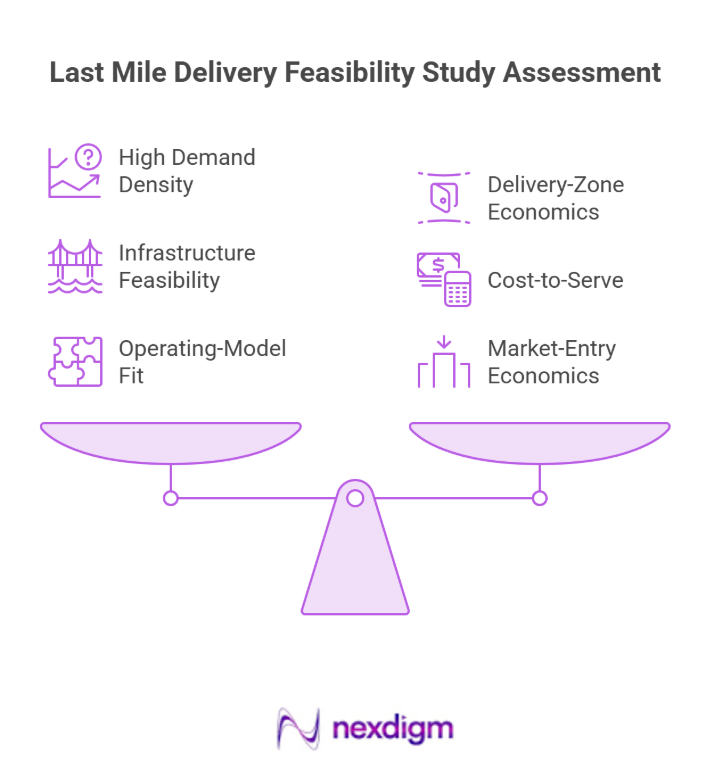
- Demand and order density: Map parcel volumes by geography, customer segment, product category and delivery frequency.
- Delivery-zone economics: Assess stop density, average delivery radius, route kilometres and courier productivity.
- Infrastructure feasibility: Evaluate hub locations, road accessibility, vehicle restrictions and operating-hour constraints.
- Cost-to-serve: Model labour, fuel, fleet, hub, technology, failed-delivery and reverse-logistics costs.
- Operating-model fit: Compare captive fleets, gig networks and third-party delivery partnerships against the target service proposition.
- Market-entry economics: Establish break-even volumes, viable service levels, investment requirements and a phased rollout plan.
The result is a market-entry view that connects demand potential with the operating economics required to serve it.
Nexdigm Case: Improving Fleet Economics Through Utilization
Nexdigm worked with a regional freight operator in 2025 on a benchmarking and analytics program covering vehicle utilization, competitive performance and route optimization. The intervention identified opportunities to improve fleet deployment and operating efficiency. Within nine months, fleet utilization increased from 65% to 88%. Transportation costs declined by 19%, unplanned maintenance fell by 24%, and on-time delivery performance improved by 17%.
The case demonstrates why last-mile and delivery-network expansion cannot be evaluated through demand volume alone. The commercial outcome depends on how effectively that demand can be converted into productive routes, utilized assets and completed deliveries.
To take the next step, simply visit our Request a Consultation page and share your requirements with us.
Harsh Mittal
+91-8422857704