

The first question for a logistics company entering a new delivery market is not how many vehicles it should buy. It is how much of the delivery operation it needs to control.
An owned fleet offers consistency and direct oversight. Gig capacity can absorb fluctuating demand without carrying the same fixed cost. Regional delivery partners can provide geographic reach before an entrant has built its own network. The commercial decision lies in determining where each model creates enough value to justify its cost and risk.
Three Models, Three Different Exposures
An owned fleet puts the provider closest to the customer. Drivers, vehicles, routing and maintenance can be managed directly, which makes the model suitable for deliveries where service quality, handling or brand experience is particularly important. The disadvantage is structural: vehicles, people and supporting infrastructure continue to incur costs when demand softens.
Gig networks reverse much of that exposure. Capacity can expand around demand peaks and contract when order volumes fall, making the model useful for markets where delivery patterns are difficult to predict. Control becomes less direct, however, and courier availability and consistency can vary by location and time.
Delivery partners solve a different problem. They provide access to established routes and postal codes without requiring an entrant to recreate an entire local network. That can accelerate geographic coverage, although the provider gives up some control over execution and retains less of the value generated on each delivery.
The Geography Should Shape the Choice
A delivery network rarely has uniform economics across its entire service area.
In dense urban zones, an owned fleet can benefit from short distances between consecutive drops and relatively predictable baseline demand. In the same city, gig capacity may make more sense during evening peaks or promotional periods when order volumes temporarily exceed the normal fleet’s capacity.
The economics change again at the edge of the network. Sending an owned vehicle deep into a low-density suburban or rural zone can consume substantial driving time for relatively few deliveries. A regional delivery partner may serve that area more efficiently because it already has vehicles, drivers and routes operating there.
The result can be a mixed network rather than a single operating model.
Service Commitments Narrow the Options
The delivery promise is another important constraint.
A provider handling standard parcels may have considerable flexibility in how capacity is sourced. A business transporting temperature-sensitive products, high-value goods or time-critical B2B shipments has far less tolerance for inconsistent execution.
The same applies to customer experience. Where the courier is an extension of the brand, direct training and supervision become more valuable. Where the primary requirement is broad geographic coverage, an established delivery partner may provide a more practical solution.
The right question is therefore not which model has the lowest nominal delivery cost. It is which model can meet the required service level at an acceptable total cost.
Flexibility Has Its Own Price
Asset-light capacity can appear attractive because it limits upfront investment, but the economics need to be evaluated beyond the first year.
External providers and gig platforms build their own margins into the cost of each delivery. During periods of tight capacity, rates can rise and availability can become less predictable. An owned network has the opposite exposure: its costs are largely committed before the parcel arrives.
This creates a trade-off between fixed-cost risk and variable-cost premiums. A market with stable baseline demand may justify internal capacity, while uncertain or highly seasonal demand can favour external capacity even if the per-delivery rate is higher.
The Best Entry Model May Change with Scale
A new entrant does not have to make a permanent fleet decision on day one.
Partner capacity can provide initial geographic coverage while customer demand is being established. Once specific zones develop sufficient recurring volume, the provider can internalize those routes. Gig capacity can continue to absorb peaks around the core operation, while external partners serve locations that remain too dispersed to justify dedicated resources.
This creates an operating model that grows with demonstrated demand rather than requiring the entire network to be designed around its eventual scale.
How Nexdigm Tests the Operating-Model Decision
A last mile delivery market entry distribution strategy compares the three models across:
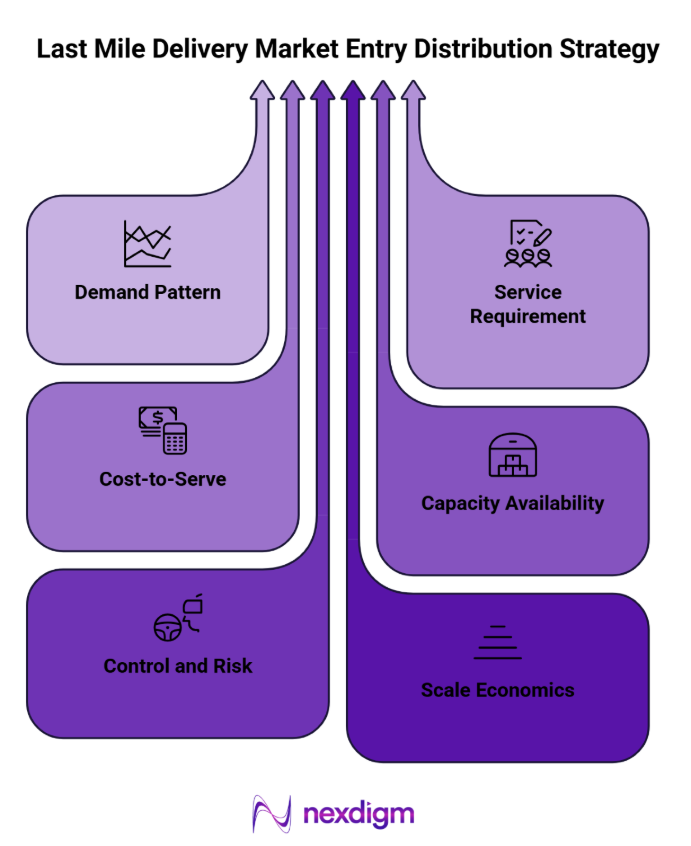
- Demand pattern: volume, density, seasonality and geographic concentration.
- Service requirement: delivery windows, handling standards and customer experience expectations.
- Cost-to-serve vehicle, labour, fuel, hub, partner and technology costs.
- Capacity availability: local driver supply, partner coverage and fleet requirements.
- Control and risk service consistency, compliance, visibility and operational dependency.
- Scale economics: the point at which internal capacity becomes more attractive than externally sourced delivery.
The analysis can then determine which model fits each delivery zone, rather than forcing the entire market into one fleet structure.
Nexdigm Case: Making Existing Fleet Capacity More Productive
A regional freight and delivery operator was facing low vehicle utilization, elevated transportation costs and maintenance-related disruptions. Nexdigm assessed fleet deployment and operating processes, with the intervention focused on route planning, vehicle utilization and maintenance management.
Within nine months, vehicle utilization increased from 65% to 88%. Transportation costs declined by 19%, unplanned maintenance downtime fell by 24%, and on-time delivery performance improved by 17 percentage points.
The case illustrates a broader entry principle: before deciding how much delivery capacity to add, providers need to understand how effectively the capacity already available can be deployed.
To take the next step, simply visit our Request a Consultation page and share your requirements with us.
Harsh Mittal
+91-8422857704