
Last-mile delivery is becoming one of the most important cost and service challenges across modern logistics. Industry estimates commonly place the last mile at around 40–50% of total delivery costs, making route efficiency, customer density, and infrastructure increasingly important to profitability.
At the same time, e-commerce growth is increasing shipment volumes while customers expect faster, more flexible delivery. For retailers, e-commerce companies, 3PL providers, logistics operators and delivery technology businesses, the challenge is identifying where costs are highest, what causes them, and where operational or infrastructure changes can create measurable improvement.
Nexdigm connects delivery demand, customer density, transportation costs, infrastructure, workforce requirements, technology adoption, and service expectations to identify commercially relevant opportunities.
How Nexdigm Understands the Last-Mile Economics
Last-mile economics differ considerably between locations. Dense urban markets may experience congestion, parking restrictions, and high labor costs. Suburban and rural markets can face longer routes, lower stop density, and greater vehicle requirements.
Nexdigm assesses these differences to understand the specific factors creating cost pressure in each market. The objective is not simply to identify expensive routes. It is to determine why they are expensive and what could improve their economics.
Connecting Cost With Growth
Growing delivery volumes can create both pressure and opportunity. When customer density increases, additional delivery capacity can potentially improve route economics.
When demand expands across dispersed locations, regional hubs or alternative delivery models may become more valuable. Nexdigm assesses these patterns to understand where future demand can support changes in the delivery network.
Nexdigm’s Last-Mile Opportunity Framework
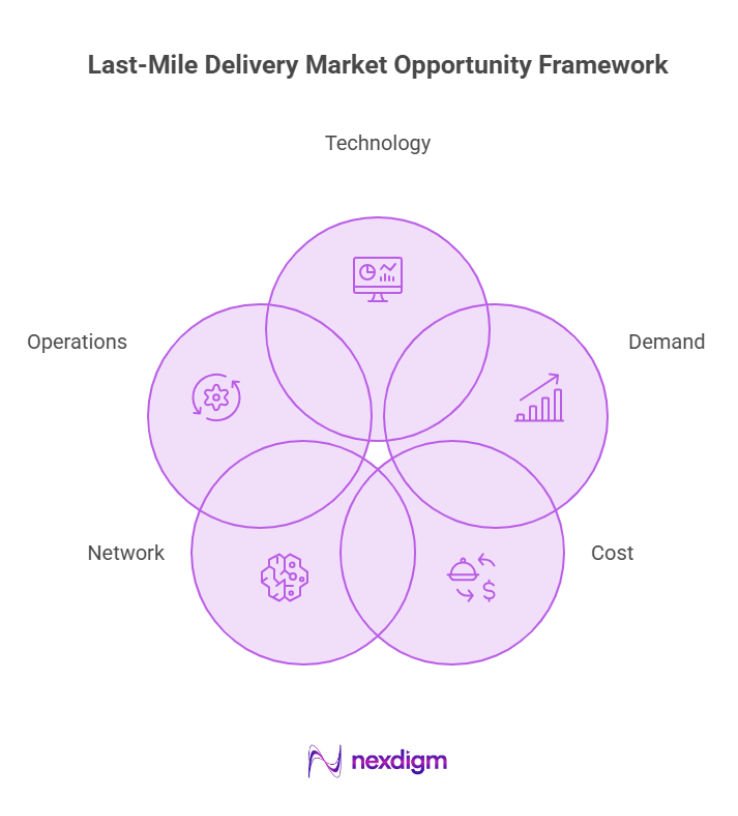
Nexdigm’s Last mile delivery market opportunity analysis uses five simple areas: demand, cost, network, operations, and technology.
Together, these areas show where last-mile costs originate and which interventions can improve efficiency, capacity, delivery performance, and long-term commercial value.
Demand
- Delivery volumes: Nexdigm tracks current and projected shipments to identify markets where growing demand could place increasing pressure on last-mile capacity.
- Customer density: Higher customer concentration can improve stop density, support efficient routes, and strengthen the economics of localized delivery infrastructure.
- Service expectations: Same-day, next-day, scheduled, and flexible delivery requirements influence fleet capacity, facility positioning, and overall operating costs.
- Market growth: Nexdigm identifies emerging markets where rising e-commerce activity could create new last-mile infrastructure and service requirements.
Cost
- Delivery distance: Longer routes increase fuel consumption, driver time, vehicle requirements, and cost per completed delivery.
- Labor costs: Driver wages, workforce shortages, overtime, and recruitment challenges can materially influence the economics of last-mile operations.
- Failed deliveries: Missed deliveries create additional trips, labor requirements, and customer-service costs while reducing vehicle productivity.
- Stop density: Higher stops per route can improve delivery economics, while dispersed customers increase travel time and cost per shipment.
Network
- Facility location: Nexdigm evaluates fulfillment centers, delivery stations, urban hubs, and micro-fulfillment sites based on customer proximity and transportation access.
- Route structure: Efficient route design reduces unnecessary travel while improving vehicle utilization, delivery capacity, and driver productivity.
- Urban hubs: Smaller facilities positioned closer to dense customer areas can support faster delivery while reducing final-mile distances.
- Capacity balance: Comparing facility and fleet capacity with local demand helps identify markets facing potential delivery constraints.
Operations
- Fleet utilization: Nexdigm measures vehicle utilization to identify opportunities for better scheduling, routing, consolidation, and capacity management.
- Driver productivity: Delivery stops, route duration, waiting time, and successful deliveries help determine where workforce productivity can be improved.
- Delivery windows: Narrow customer time windows can increase route complexity and reduce vehicle utilization, affecting overall delivery economics.
- Returns handling: Reverse logistics can increase route complexity, requiring integrated planning for outbound deliveries and returned products.
Technology
- Route optimization: Digital routing tools can improve sequencing, reduce unnecessary travel, and increase the number of successful deliveries.
- Delivery visibility: Real-time tracking provides customers and operators with greater visibility into delivery progress, exceptions, and expected arrival times.
- Fleet technology: Telematics can monitor vehicle location, utilization, driving behavior, fuel consumption, and maintenance requirements.
- Data analytics: Nexdigm evaluates delivery data to identify recurring cost patterns, route inefficiencies, capacity gaps, and service opportunities.
How Nexdigm Provides Future Growth Opportunities
The strongest opportunities typically emerge where delivery costs are high, demand is growing, customer density is changing, and network capacity remains limited.
Nexdigm evaluates these signals to identify markets where new facilities, better routes, alternative delivery models, or technology investment could improve commercial performance.
The framework also analyzes emerging consumer markets, urban expansion, and changing delivery expectations to identify future logistics requirements. This helps stakeholders prioritize investments with the greatest potential for operational and commercial impact.
Nexdigm’s Case
An e-commerce logistics provider used Nexdigm’s Last mile delivery market opportunity analysis to identify costly routes and optimize delivery zones. Within 12 months, cost per delivery declined 18%, successful first-attempt deliveries improved 24%, route productivity increased 27%, and average delivery time fell 16%, improving overall network performance.
To take the next step, simply visit our Request a Consultation page and share your requirements with us.
Harsh Mittal
+91-8422857704