

Last-mile delivery often represents the most expensive stage of logistics, requiring disciplined cost visibility and commercially responsive pricing models. Effective last mile delivery pricing analysis evaluates route density, delivery distance, fuel, labor, failed attempts, time windows, vehicle utilization, and customer service requirements.
By combining pricing analysis with cost-to-serve modeling, regional benchmarking, and demand segmentation, businesses can identify margin leakage and design sustainable rates. This approach supports dynamic pricing, strengthens carrier negotiations, and enables scalable delivery networks across complex urban markets.
A 2025 Stockholm last-mile case study reported a 60% reduction in empty kilometres, while demand consolidation generated an additional 9% efficiency gain. The results show how collaborative delivery models can improve asset utilization, reduce avoidable mileage, and support competitive pricing analysis.
Commercial Pricing Analysis for Scalable Last-Mile Operations
Commercial pricing analysis helps last-mile operators align delivery rates with cost drivers, service commitments, and network complexity, improving profitability, customer transparency, operational resilience, and scalable market expansion across regions. Some important advantages of the same are:
- Reduced Failed-Delivery Costs: Redelivery risks, address accuracy, customer availability, and time-window requirements in pricing analysis helps businesses recover avoidable costs and encourage more efficient delivery behavior.
- Improved Peak-Demand Management: Dynamic pricing analysis reflects seasonal demand, capacity constraints, labor premiums, and congestion, helping networks maintain service reliability without absorbing excessive peak-period operating costs.
- Faster Expansion Decisions: Commercial pricing insights help businesses compare cities, regions, delivery partners, and service models, enables informed expansion decisions based on expected costs, margins, and operational feasibility.
- Better Route-Level Profitability: Analyzing pricing by route, zone, and customer segment reveals unprofitable delivery patterns, enables targeted rate adjustments, route redesign, and improved resource allocation.
Nexdigm’s Pricing Analysis Support for High-Cost Delivery Networks
Nexdigm applies data-driven pricing analysis, cost benchmarking, and route economics to help businesses control last-mile expenses, improve rate accuracy, strengthen margins, and build scalable, commercially sustainable delivery networks efficiently. With industry-expertise, businesses can get support in:
- benchmarking last-mile delivery costs across regions and carriers
- improving profitability through delivery pricing optimization
- aligning pricing structures with operational complexity
- building scalable and sustainable last-mile pricing strategies
- optimizing pricing for peak-demand and high-volume periods
Nexdigm’s Pricing Strategy Model for Scalable Last-Mile Operations
Nexdigm’s integrated pricing model combines cost intelligence, route economics, demand patterns, and service expectations to help businesses scale last-mile operations while protecting margins, improving transparency, and strengthening delivery performance. Strategies used by experts in this procedure are:
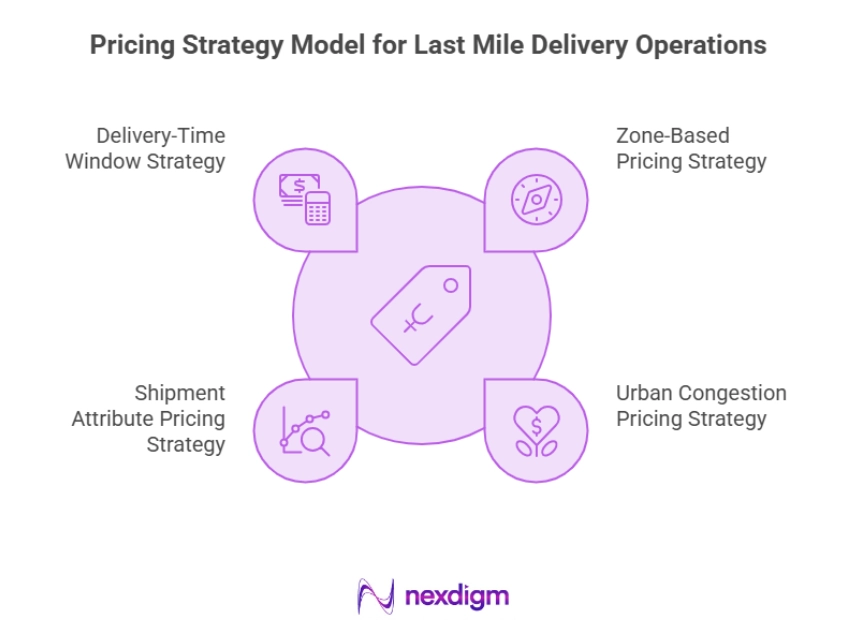
- Zone-Based Pricing Strategy: Nexdigm structures rates by geography, delivery density, traffic conditions, and service complexity, helping businesses price each zone accurately while protecting margins across diverse operating environments.
- Delivery-Time Window Strategy: Pricing reflects standard, scheduled, same-day, and narrow-window deliveries, helping businesses recover additional operating costs created by tighter service commitments and reduced routing flexibility.
- Urban Congestion Pricing Strategy: The model incorporates traffic intensity, restricted delivery zones, parking limitations, and access delays, enabling more accurate rates for complex urban routes and high-cost metropolitan markets.
- Shipment Attribute Pricing Strategy: Rates are aligned with parcel weight, dimensions, fragility, temperature requirements, and handling complexity, ensuring delivery charges accurately reflect resource consumption and operational risk.
Nexdigm’s Case
Nexdigm supported a logistics client by standardizing delivery processes and restructuring vendor contracts, reducing transit times by 12%, raising on-time deliveries and lowering freight spend by 14%, while improving pricing control, network reliability, and performance.
To take the next step, simply visit our Request a Consultation page and share your requirements with us.
Harsh Mittal
+91-8422857704