

Last-mile delivery represents the final stage of the logistics process, connecting distribution centres, fulfilment facilities and local delivery hubs with end customers. Although it covers a relatively short part of the overall transportation journey, it can have a considerable influence on delivery costs, customer experience and service reliability.
For businesses operating across multiple cities or serving large customer bases, selecting the right last-mile delivery provider is an important procurement decision. Vendors differ in geographical coverage, delivery fleet models, technology capabilities, workforce availability and their ability to manage fluctuating shipment volumes.
A structured assessment helps organisations determine which providers can support their delivery requirements while maintaining service quality and commercial efficiency.
Understanding the Last-Mile Delivery Supplier Landscape
Last-mile delivery providers operate through different network and service models.
- Dedicated fleet operators use owned or contracted vehicles to manage scheduled deliveries.
- Hyperlocal delivery providers focus on short-distance movements within cities, while e-commerce logistics companies manage high-volume parcel distribution through sorting centres, delivery hubs and local delivery personnel.
Some providers specialise in same-day and express deliveries, whereas others focus on scheduled, standard or bulk distribution.
The choice of supplier depends on the nature of the goods, customer locations, delivery frequency and required service levels.
Evaluating Network Density and Geographical Coverage
Network density is an important indicator of last-mile provider suitability. A vendor with a large national presence may still have limited delivery infrastructure in specific neighbourhoods, PIN codes or regional markets.
Procurement teams should examine the distribution of delivery hubs, serviceable locations, collection points and local delivery resources.
The assessment should distinguish between directly operated networks and third-party delivery arrangements. Subcontracting can extend geographical reach, but it may also introduce differences in service consistency, delivery visibility and accountability.
Businesses should compare provider coverage against their actual customer and order distribution. For example, an e-commerce company serving metropolitan markets may prioritise dense local delivery networks, while a consumer goods manufacturer may require broader coverage across smaller cities and semi-urban locations.
Network flexibility is also important during festive seasons, promotional campaigns and other periods of increased shipment demand.
Service Quality, Delivery Performance and Technology
Last-mile performance directly influences the customer experience. A shipment that reaches the local delivery hub on time may still experience delays because of route planning issues, unsuccessful delivery attempts or insufficient delivery personnel.
A vendor assessment should therefore examine the complete delivery process rather than focusing only on average transit times.
Important indicators include on-time delivery percentage, first-attempt delivery success rate, average delivery turnaround time, failed delivery and return-to-origin rates, shipment damage frequency and customer complaint resolution time.
Technology capabilities should also be assessed. A suitable platform should support real-time tracking, route allocation, proof of delivery, customer notifications and exception reporting.
Integration with e-commerce platforms, order management systems and transportation applications can improve coordination between sellers and delivery providers.
Some advanced providers also offer dynamic route optimisation, delivery density analysis and automated allocation of shipments to delivery personnel.
Scalability and Commercial Fit
Last-mile delivery costs are influenced by shipment density, delivery distance, parcel weight, failed delivery attempts and local operating conditions. A provider with a lower base rate may generate additional costs through remote-area surcharges, waiting charges, return handling and repeated delivery attempts.
Procurement teams should compare pricing across similar shipment profiles and geographical zones. Scalability should be evaluated through available delivery capacity, workforce flexibility, sorting infrastructure and the ability to support additional operating locations. Businesses should also examine service-level agreements, claims procedures, delivery liability, subcontracting arrangements and termination provisions.
The most suitable provider is not necessarily the one with the largest fleet. It is the provider whose network and operating model align with the organisation’s delivery density, customer locations and service expectations.
Nexdigm’s Last-Mile Delivery Supplier Evaluation Framework
An elaborate last mile delivery supplier evaluation consulting exercise should cover six stages:
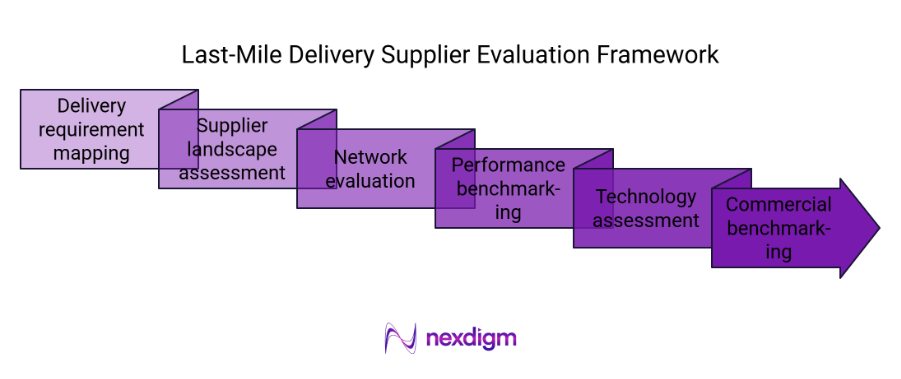
- Delivery requirement mapping: Identify order volumes, shipment profiles, customer locations and delivery timelines.
- Supplier landscape assessment: Map national, regional, hyperlocal and specialised delivery providers.
- Network evaluation: Compare delivery hubs, geographical coverage, service density and subcontractor arrangements.
- Performance benchmarking: Assess delivery reliability, first-attempt success, returns and complaint resolution.
- Technology assessment: Review tracking, route optimisation, proof of delivery and system integration.
- Commercial benchmarking: Compare shipment rates, surcharges, return handling and contractual service commitments.
Nexdigm can support organisations through last-mile logistics market research, supplier identification, geographical coverage analysis and commercial benchmarking. These assessments help procurement teams compare delivery providers and identify suppliers capable of supporting changing distribution requirements.
Nexdigm’s Case Study: Improving Last-Mile Supplier Allocation
Nexdigm assessed 12 last-mile delivery providers across 6 urban and regional markets, comparing network density, delivery success, technology and pricing. The research shortlisted 4 suppliers, identified a 15% variation in comparable delivery costs and established 7 service performance benchmarks.
To take the next step, simply visit our Request a Consultation page and share your requirements with us.
Harsh Mittal
+91-8422857704