

Life insurance premium competitiveness study helps insurers evaluate how rates, benefits, coverage terms, underwriting criteria, and customer value compare across markets experiencing stronger protection demand. Integrated with pricing analysis, it reveals product positioning weaknesses, and opportunities to refine premiums without undermining long-term profitability.
Insurers can use these insights to improve segmentation, strengthen value propositions, and respond faster to changing customer expectations. This approach enables sustainable portfolio growth, stronger policyholder acquisition and retention, and more competitive life insurance offerings across demographic and economic segments worldwide.
Recent study’s preliminary data show life insurance gross written premiums grew 11.5% nominally and 7.0% in real terms during 2025. This expansion reinforces pricing analysis and benchmarking for improving affordability, competitiveness, customer relevance, and sustainable portfolio growth across markets.
Strategic Pricing Analysis for Life Insurance Market Competitiveness
Strategic pricing analysis helps life insurers strengthen market competitiveness by aligning premiums, benefits, underwriting, and portfolio economics across evolving protection segments and diverse distribution channels worldwide effectively. Important strategies referred during the process are:
- Competitive Product Mapping Strategy: Compares term, whole-life, endowment, and protection products across competitors to identify premium gaps, benefit differences, underwriting advantages, and market positioning opportunities for targeted portfolio improvement.
- Customer Lifecycle Pricing Strategy: Uses demographic, income, health, and life-stage insights to create segment-specific premiums that improve affordability, relevance, conversion, retention, and protection uptake across priority customer groups effectively.
- Coverage Value Rebalancing Strategy: Rebalances coverage amounts, riders, exclusions, payment frequencies, and surrender features to strengthen perceived value while maintaining sustainable margins across life insurance categories.
- Distribution Economics Alignment Strategy: Assesses agent commissions, digital acquisition costs and conversion performance to align pricing with channel efficiency and improve profitable customer acquisition across distribution models.
Nexdigm’s Tailored Pricing Analysis Assistance for Life Insurance Providers
Nexdigm delivers life insurance pricing analysis through competitive benchmarking, customer segmentation, actuarial insights, underwriting assessment, and market intelligence. Nexdigm’s strategic engagement helps life insurers optimize premium structures, strengthen product positioning, improve policy affordability, and enhance portfolio profitability. By combining life insurance premium competitiveness study, pricing analysis, and customer value optimization, Nexdigm enables sustainable growth, higher policy retention, and stronger competitive advantage across evolving life insurance markets.
Nexdigm’s Integrated Framework for Life Insurance Pricing Analysis
Nexdigm’s integrated framework combines pricing analysis, market intelligence, actuarial evaluation, customer insights, and competitive benchmarking to optimize life insurance premiums, improve product positioning, and strengthen sustainable portfolio performance. Some important framework models referred by the experts are:
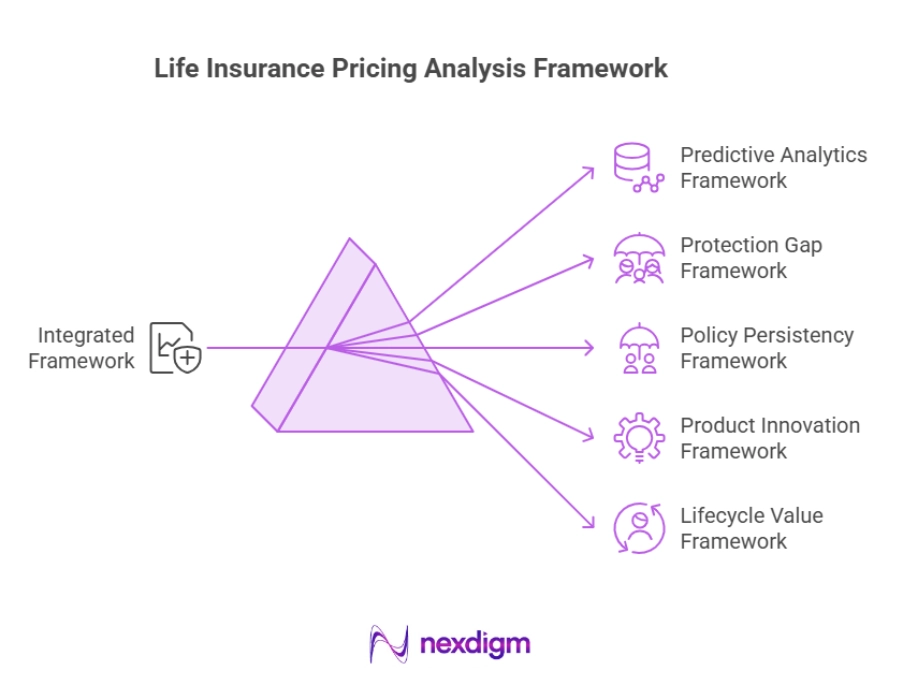
- Predictive Analytics Framework: Uses historical claims, mortality trends, customer behavior, and market signals to forecast pricing outcomes, enabling proactive premium optimization and stronger long-term portfolio competitiveness.
- Protection Gap Framework: Assesses customer income, financial obligations, life-stage needs, and existing coverage to develop competitively priced protection solutions that improve insurance accessibility and market penetration.
- Policy Persistency Framework: Analyzes renewal trends, lapse ratios, surrender behavior, and customer engagement to refine pricing decisions that improve policy continuation and maximize long-term customer lifetime value.
- Product Innovation Framework: Evaluates evolving customer expectations, digital insurance trends, flexible benefits, and optional riders to support innovative pricing models that strengthen product differentiation and market appeal.
- Lifecycle Value Framework: Maps pricing strategies across acquisition, policy servicing, renewal, and maturity stages to maximize customer value, improve retention, and enhance profitability throughout the policy lifecycle.
Nexdigm’s Case
Nexdigm partnered with a life insurance provider to benchmark premiums, optimize underwriting assumptions, and refine customer segmentation across protection products. The pricing analysis enhanced market competitiveness and portfolio performance. Outcomes included a 15% improvement in quote-to-policy conversion, 10% higher policy persistency, and an 8% increase in new business premium growth within twelve months.
To take the next step, simply visit our Request a Consultation page and share your requirements with us.
Harsh Mittal
+91-8422857704