

The rapid expansion of e-commerce, hyperlocal delivery services, and decentralized distribution networks has transformed the role of light commercial vehicles (LCVs) within the logistics ecosystem. Once primarily used for small-scale transportation and local trade activities, LCVs have become critical enablers of modern last-mile delivery operations.
A comprehensive Light commercial vehicle market opportunity analysis reveals that demand is increasingly concentrated in urban delivery networks, e-commerce logistics, cold-chain transportation, electric mobility solutions, and small business fleet expansion.
Understanding the LCV Market
The light commercial vehicle (LCV) market is evolving rapidly as businesses adapt to changing logistics requirements, faster delivery expectations, and growing urbanization. While overall demand continues to rise, growth is increasingly being driven by:
- E-commerce platforms
- Hyperlocal distribution
- Cold-chain logistics
- Sustainable mobility solutions
To identify where the strongest opportunities lie, it is important to examine the key segments that are shaping demand and influencing fleet investment decisions across the LCV ecosystem.
E-Commerce Delivery Fleets
E-commerce remains the single largest growth driver for LCV demand. As consumers increasingly expect same-day and next-day delivery services, logistics companies are expanding their delivery networks and investing heavily in vehicle fleets capable of supporting high-frequency urban operations. Key demand drivers include:
- Rising online shopping volumes
- Expanding fulfillment center networks
- Growth of marketplace platforms
- Increasing parcel shipments
- Faster delivery expectations
LCVs provide the ideal combination of payload capacity, maneuverability, and operational efficiency required for last-mile deliveries. Nexdigm believes that as e-commerce penetration rises, fleet expansion is expected to remain a major demand catalyst.
Urban Logistics and Hyperlocal Delivery
Cities are becoming the focal point of logistics activity. Businesses increasingly rely on localized inventory hubs and micro-fulfillment centers to shorten delivery times and improve customer satisfaction. LCVs are particularly suited for:
- Dense urban environments
- Frequent delivery routes
- Short-distance transportation
- Retail replenishment
- Hyperlocal order fulfillment
Urban logistics requires vehicles that can navigate congestion, access restricted areas, and support multiple delivery stops efficiently. This continues to drive investment in compact and versatile commercial vehicles.
Cold-Chain Transportation
The growth of online grocery, pharmaceutical, and healthcare logistics is generating significant demand for specialized LCVs. Temperature-controlled vehicles are increasingly required to transport:
- Fresh food products
- Dairy and frozen goods
- Pharmaceuticals
- Vaccines
- Healthcare supplies
Cold-chain logistics is becoming an essential component of modern supply chains, creating opportunities for customized LCV solutions equipped with refrigeration capabilities and advanced monitoring technologies.
Electric Light Commercial Vehicles
Electrification is rapidly transforming the LCV segment. Governments and corporations are actively pursuing sustainability goals, prompting increased adoption of electric delivery vehicles. Key drivers include:
- Emissions regulations
- Corporate ESG commitments
- Fuel cost savings
- Urban low-emission zones
- Financial incentives for EV adoption
Electric LCVs are particularly effective for predictable urban routes, making them attractive for e-commerce companies, logistics providers, and distribution businesses focused on long-term cost optimization.
SME and Small Fleet Expansion
Small and medium-sized enterprises represent a growing customer base for LCV manufacturers. Businesses operating in:
- Retail distribution
- Wholesale trade
- Local logistics
- Construction services
- Food delivery
The expanding SME sector creates recurring demand for affordable, fuel-efficient, and versatile vehicles capable of serving diverse operational requirements.
Quick Commerce and On-Demand Delivery Networks
The emergence of quick commerce has created a new category of transportation demand. Businesses offering deliveries within minutes rather than days require highly responsive fleet networks supported by strategically located warehousing infrastructure. LCVs support:
- Quick commerce operations
- Grocery delivery platforms
- Food distribution networks
- Urban fulfillment services
As delivery speed becomes a competitive differentiator, demand for agile transportation solutions is expected to increase significantly. While these segments offer significant growth potential, it is important to identify market opportunities related to fleet economics and investment decisions.
Where Are the Strongest Market Opportunities?
The answer is that last-mile growth is creating demand for agile, cost-efficient, and technology-enabled transportation solutions. The strongest opportunities are emerging across:
- E-commerce delivery fleets
- Urban logistics and hyperlocal distribution
- Cold-chain transportation
- Electric light commercial vehicles
- SME and small fleet operators
- Quick commerce and on-demand delivery networks
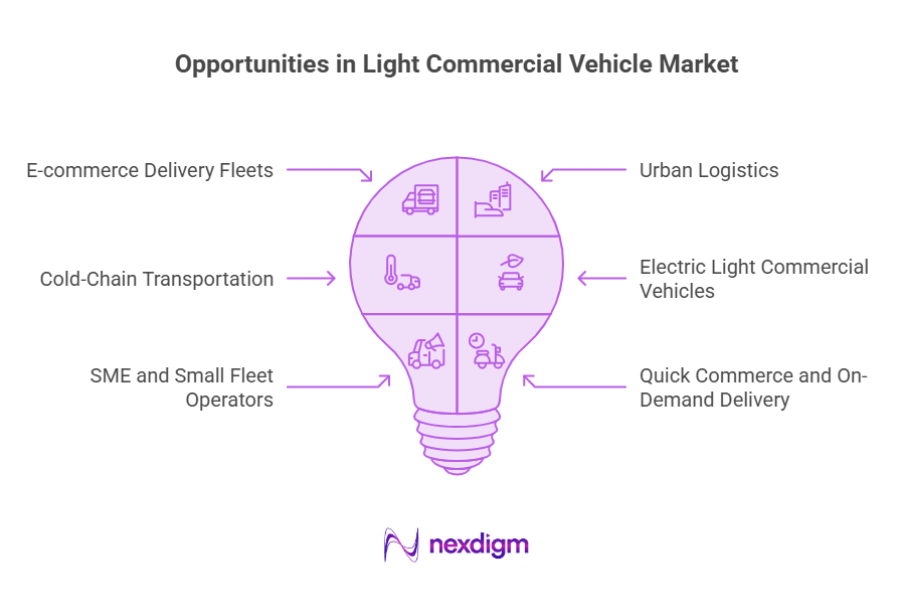
These segments are redefining purchasing priorities and creating new growth avenues for vehicle manufacturers and fleet operators. As these demand segments continue to evolve, businesses must identify where investment opportunities are. This is where Nexdigm can help organizations translate market insights into strategic business advantages.
Turning Last-Mile Growth into Nexdigm Advantage
While LCV demand continues to expand, identifying the right opportunities requires more than understanding vehicle sales trends. Organizations must assess market potential, fleet economics, investment feasibility, and competitive positioning. This is where Nexdigm can provide strategic value.
Market Assessment and Opportunity Identification
A growing market does not automatically translate into profitable investments. Nexdigm can support businesses through:
- Market sizing and segmentation
- Demand forecasting
- Opportunity prioritization
- Regional growth analysis
- Customer needs assessment
These insights help organizations focus resources on high-potential segments and avoid fragmented investment decisions.
Light Commercial Vehicle Market Opportunity Analysis
Understanding demand drivers and purchasing behavior is essential for long-term success. Nexdigm can assist organizations with:
- Fleet demand studies
- Customer segmentation analysis
- Industry attractiveness assessment
- Market growth forecasting
- Competitive demand mapping
A comprehensive Light commercial vehicle market opportunity analysis enables businesses to align product development, pricing, and go-to-market strategies with evolving customer requirements.
Fleet Economics and Business Case Development
Fleet buyers increasingly evaluate vehicles based on operational performance rather than purchase price alone. Nexdigm can help organizations assess:
- Total cost of ownership
- Fuel and energy cost implications
- Maintenance economics
- Asset utilization trends
- Return on investment scenarios
A strong economic value proposition is often the deciding factor for fleet operators when selecting vehicle solutions.
Nexdigm’s Case
Nexdigm assisted an automotive player in assessing LCV opportunities as India’s last-mile delivery market reached $7.9 billion in 2025, projected to grow at 14.4% CAGR in the coming years. The study mapped urban logistics, e-commerce, and fleet needs, identifying high-growth segments.
To take the next step, simply visit our Request a Consultation page and share your requirements with us.
Harsh Mittal
+91-8422857704