

Lithium battery procurement is becoming more strategic as demand expands while supply chains remain concentrated. The IEA estimates that global battery demand grew by more than 35% in 2025, surpassing 1.5 TWh, with lithium demand rising around 25% annually over the past two years.
The global lithium-ion battery market exceeded $150 billion in 2025, while EVs accounted for more than 70% of global lithium-ion battery deployment. At the same time, BloombergNEF reported that average lithium-ion battery pack prices fell 8% to $108/kWh in 2025.
These dynamics make lithium battery procurement research important for understanding supplier competitiveness, chemistry economics, capacity availability, and supply-chain exposure.
The Growing Need for Lithium Battery Procurement Analysis
Battery procurement decisions involve more than comparing cell prices. Chemistry, supplier scale, manufacturing location, raw-material exposure, capacity utilization, technology roadmaps, and logistics can all influence the effective cost and reliability of supply. The IEA reports that global lithium-ion manufacturing capacity exceeded 4 TWh at the end of 2025, with China accounting for more than 80% of global capacity. This concentration makes supplier and geographic assessment particularly important for procurement teams.
What Procurement Teams Should Evaluate
Procurement teams need to look beyond quoted cell prices when evaluating lithium battery suppliers. Chemistry, manufacturing scale, available capacity, production geography, raw-material exposure, technology maturity, customer concentration, and supply continuity can all influence sourcing outcomes. A supplier offering competitive pricing may still present challenges if capacity is constrained or supply is geographically concentrated. Evaluating these factors together creates a more balanced view of supplier competitiveness and procurement suitability.
Nexdigm’s View of Lithium Battery Procurement Priorities
For lithium battery procurement, the challenge is not simply identifying suppliers; it is understanding which factors could influence sourcing outcomes over time. Nexdigm can help procurement teams with:
- Tracking Market Economics: Monitoring battery pricing, chemistry trends, raw-material movements, production economics, and regional cost differences to understand changing procurement conditions.
- Reading Supplier Capacity: Assessing manufacturing footprints, utilization, expansion plans, customer commitments, and regional availability to distinguish announced capacity from realistically accessible supply.
- Identifying Supply Exposure: Examining geographic concentration, material dependencies, logistics routes, supplier relationships, and upstream exposure to highlight areas requiring diversification or contingency planning.
Together, these perspectives help procurement teams build a more practical understanding of supplier competitiveness and supply availability, supporting stronger sourcing and negotiation decisions.
Why Businesses and Suppliers Partner With Nexdigm
Businesses and suppliers can partner with Nexdigm to gain a clearer understanding of evolving battery markets, procurement expectations, and sourcing opportunities. Nexdigm’s combination of industry knowledge, market intelligence, supplier research, and commercial perspectives can help stakeholders identify opportunities, strengthen market positioning, understand customer requirements, and make better-informed strategic decisions as the lithium battery ecosystem continues to evolve.
How Experts of Nexdigm Structure Lithium Battery Procurement Research
Nexdigm’s lithium battery procurement research can bring supplier, market, cost, capacity, and supply-risk information into a structured decision framework. This helps procurement teams with:
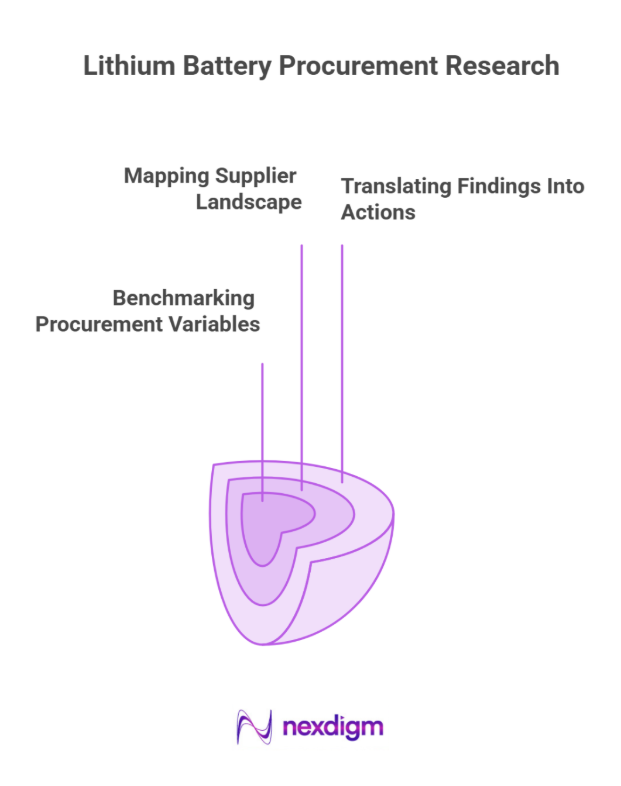
- Mapping the Supplier Landscape: Identifying relevant cell manufacturers by chemistry, geography, production scale, technology capabilities, customer base, and manufacturing footprint.
- Benchmarking Procurement Variables: Comparing supplier pricing, capacity, chemistry economics, production locations, material exposure, and commercial positioning to identify meaningful differences.
- Translating Findings Into Actions: Converting research insights into supplier negotiations, sourcing diversification, capacity planning, localization opportunities, and ongoing market monitoring.
This approach helps procurement teams use lithium battery procurement research not simply as market information, but as a practical input for sourcing strategy and supplier decisions.
Nexdigm’s Procurement Insights Supporting Battery Sourcing Decisions
Once supplier and market information has been analyzed, Nexdigm’s research insights help procurement teams in the following ways:
- Prioritizing Competitive Suppliers: Identifying suppliers offering a stronger combination of pricing, chemistry capability, capacity availability, and commercial attractiveness.
- Planning Around Capacity: Using supplier expansion plans, production locations, and utilization indicators to support volume allocation, regional sourcing, and future procurement planning.
- Strengthening Supply Resilience: Highlighting material dependencies, geographic concentration, and supplier exposure that may require alternative sourcing, localization, or contingency measures.
These insights help procurement teams move from understanding the lithium battery market to making more informed supplier and sourcing decisions.
Nexdigm’s Case
Nexdigm’s lithium battery procurement research identified 21% of suppliers with stronger procurement competitiveness, while 14% showed favorable capacity positioning and 11% demonstrated technology advantages. Based on these findings, the procurement team prioritized supplier negotiations, capacity planning, sourcing diversification, and alternative supplier evaluation.
To take the next step, simply visit our Request a Consultation page and share your requirements with us.
Harsh Mittal
+91-8422857704