

LNG gains market share when customers can make a credible economic and operational switch from an incumbent fuel. New liquefaction capacity can improve global availability, but it does not by itself persuade a power generator, industrial plant, truck operator or shipowner to change fuels. The customer needs compatible equipment, reliable supply and an acceptable delivered cost.
The IEA’s Gas 2025 report anticipated significant additions to global LNG supply and examined how greater price convergence could support additional gas consumption, particularly in price-sensitive Asian markets. It also identified industry and energy uses as important contributors to demand growth. The implication for adoption analysis is clear: additional LNG supply creates an opportunity for switching, but infrastructure and customer economics determine whether that opportunity becomes actual consumption.
Regional gas markets also remain less integrated than oil markets because pipeline connectivity, liquefaction capacity and receiving infrastructure constrain the ability to move gas between markets.
Every Switching Decision Has a Threshold
The incumbent fuel determines the economics of adoption.
For a coal-fired power plant, the relevant comparison includes heat rate, coal contract terms, gas turbine configuration, expected utilisation and the plant’s role in the electricity system. An industrial boiler may be technically easier to convert, but burner modification, gas pressure, downtime and connection costs still affect the payback.
Heavy transport presents a different problem. Diesel substitution requires suitable vehicles, LNG stations, storage and sufficiently predictable routes. Marine adoption depends on vessel orders, bunkering availability, port infrastructure and emissions requirements.
The comparison should therefore be made on delivered energy economics rather than commodity prices alone. LNG needs to be assessed after shipping, regasification, pipeline tariffs, taxes, currency effects, conversion costs and plant efficiency. The relevant question is the price at which the customer switches back to the incumbent fuel.
This creates an adoption threshold. A customer may switch during periods of low LNG prices without making a long-term commitment. A stronger market has customers whose economics remain workable across a reasonable range of LNG prices.
Infrastructure Decides How Far the Switch Can Travel
A technically attractive switching case can fail if the supply chain cannot reach the customer.
Map the route from liquefaction source through shipping, receiving terminal, regasification, pipeline or distribution network and finally to the end user. Assess actual utilisation alongside nameplate capacity. A terminal with substantial nominal capacity may have limited ability to support new demand if downstream pipelines are constrained.
The same principle applies to planned infrastructure. Projects should be separated by development stage, with permitting, financing and construction risk reflected in the forecast. Storage can improve supply resilience but adds cost. Alternative supply routes may reduce exposure to a single terminal or pipeline but can also weaken the economics.
Scenario testing should establish how adoption changes under low, base and high LNG prices. It should also account for currency movements, competing fuel prices and delayed infrastructure.
Durable Share Gains Look Different From Temporary Consumption
The strongest LNG adoption markets have evidence that customers will continue consuming gas after the immediate price incentive disappears.
Track conversions, contracted volumes, plant utilisation, fleet adoption, vessel orders and infrastructure commissioning alongside LNG prices. A power plant operating more frequently during a temporary supply shortage is not equivalent to an industrial cluster converting boilers and signing multi-year contracts.
For LNG market adoption assessment services, Nexdigm can combine switching economics, infrastructure readiness and customer commitments to identify where LNG can gain durable share and what commercial conditions are required to sustain that position.
LNG Adoption Viability Framework
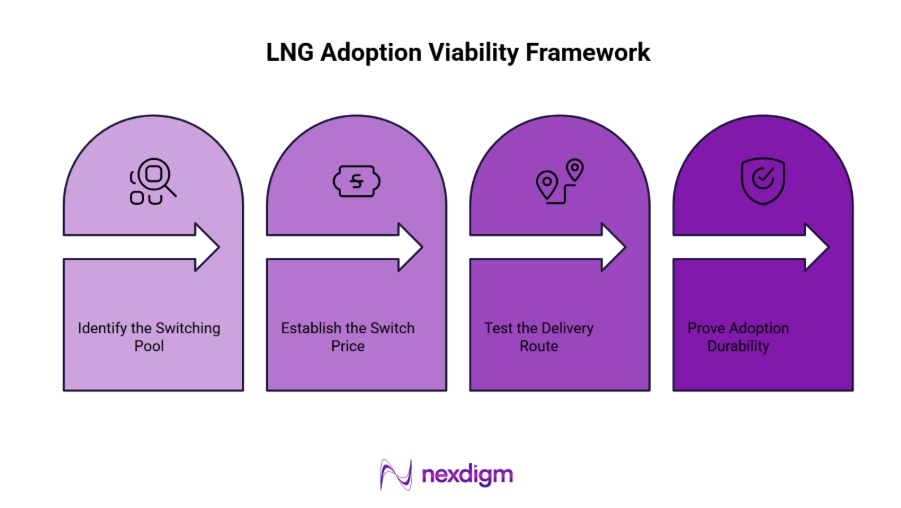
- Identify the Switching Pool
Determine which coal, oil or other fuel users can technically and economically convert to LNG, and quantify their addressable consumption. - Establish the Switch Price
Calculate delivered LNG cost against the incumbent fuel, including conversion efficiency, logistics, taxes, currency and operating costs. - Test the Delivery Route
Assess terminal, regasification, pipeline, storage and distribution capacity to determine whether the identified customers can actually be supplied. - Prove Adoption Durability
Test contracts, utilisation, infrastructure commitments and price sensitivity to distinguish temporary fuel switching from sustainable LNG share gains.
Nexdigm can apply these tests to prioritise customer clusters, infrastructure investments and procurement structures according to the strength of the underlying adoption case.
Nexdigm Case Study
Nexdigm assessed eight industrial clusters using incumbent-fuel costs, delivered LNG economics, pipeline access, boiler-conversion requirements and offtake potential. Three clusters supported fuel switching at base LNG prices, while others required unusually low spot prices. A staged supply agreement was recommended for the viable clusters to limit exposure to demand reversals.
To take the next step, simply visit our Request a Consultation page and share your requirements with us.
Harsh Mittal
+91-8422857704