

An LNG import market can look attractive because domestic gas supply is limited or a new regasification terminal is planned. But terminal capacity creates value only when buyers can afford the gas, infrastructure can deliver it to them, and demand is strong enough to support reliable utilization.
Recent market conditions show how quickly that equation can shift. The International Energy Agency estimates that global gas demand grew by around 1% in 2025, down from 2.8% in 2024. Higher spot prices and weaker industrial activity restrained demand, particularly in Asia.
The first half of 2026 brought further disruption. The IEA estimates that Asian gas demand fell by 0.5% year over year during that period. Chinese LNG imports declined by 12%, or about 3 billion cubic metres, as higher prices coincided with increased domestic production and pipeline deliveries. Import-market forecasts need to account for affordability and alternative supply, not just projected consumption.
Forecast Demand by Buyer and Use
Gas demand should be segmented by end use because buyers have different load profiles and price tolerance. Gas-fired power plants may need flexible volumes to balance renewables or meet peak demand. Industrial users may require steady supply for process heat or feedstock. City gas networks, commercial customers and transport users bring different connection needs and purchasing patterns.
For each segment, estimate current consumption, expected growth and the price at which demand would weaken. Test the effects of weather, power generation mix, industrial output, fuel switching and competing energy sources. A forecast that assumes every prospective buyer will use LNG at any price is unlikely to support a durable investment decision.
Measure Infrastructure Against Real Throughput
Across ASEAN, LNG import capacity exceeded 80 billion cubic metres per year in 2025, while imports remained just under 40 billion cubic metres. The IEA projects that imports could approach 80 billion cubic metres by 2030. More than 25 billion cubic metres per year of new regasification capacity is already under construction.
This growth may create future bottlenecks, but it also creates a risk of unused capacity. The IEA estimates utilization could reach 80% to 90% in several markets by 2030, potentially requiring more investment. Test that outlook against current terminal use, construction schedules, pipeline connections, storage, grid access and customer demand.
Separate operating facilities from projects that are planned, financed or under construction. Assess whether a new terminal will be ready when buyers need supply. For floating storage and regasification units, consider deployment flexibility and charter costs alongside speed to market.
Test Delivered Cost and Commercial Commitment
The relevant price is the cost of getting gas to the customer. Compare LNG procurement and shipping with regasification, storage and pipeline charges, then test the result against domestic gas, pipeline imports, coal, fuel oil, renewables and other alternatives.
Spot exposure can make demand fall when prices rise. Long-term contracts can improve supply assurance but may leave buyers with volume or price commitments they cannot absorb if demand underperforms. Assess who carries price, volume, foreign-exchange and underutilization risk.
Commercial viability also depends on the buyer. Identify anchor customers, credit quality, contract duration, take-or-pay terms and tariff recovery. A demand forecast becomes more useful when it distinguishes buyer interest from a signed commitment and identifies what would be required to convert interest into contracted throughput.
Framework: LNG Import-Market Readiness Test
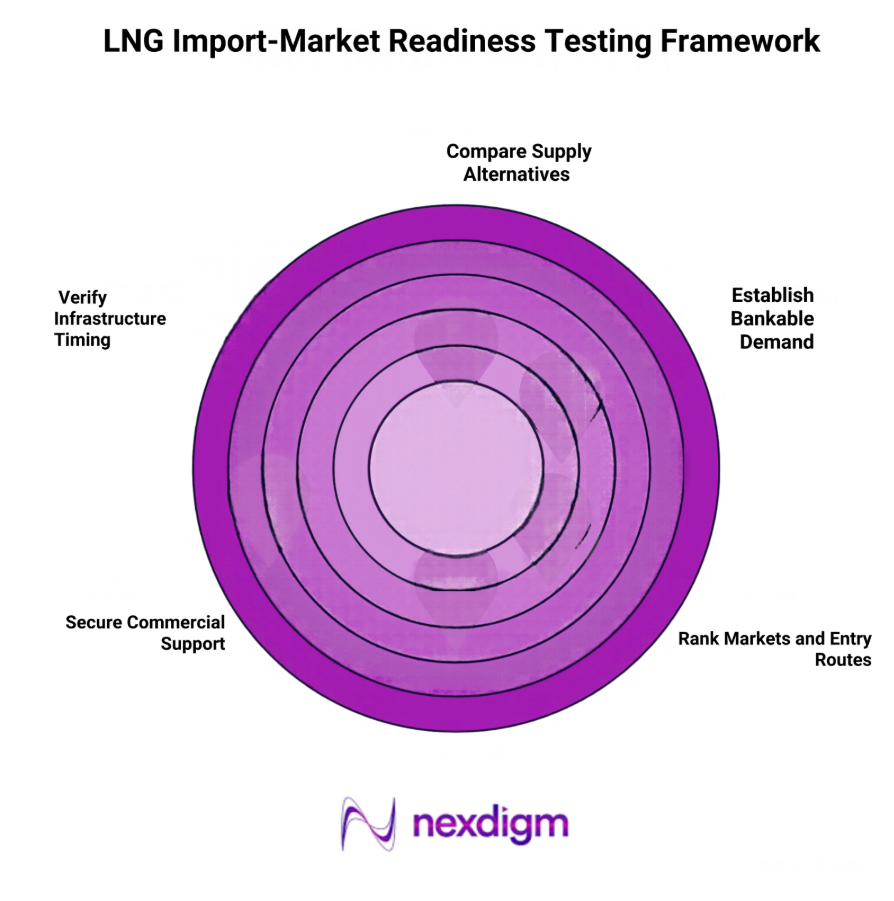
- Establish Bankable Demand
Forecast demand by power, industrial, city gas and other customer segments. Test volumes against prices, weather, generation plans and industrial output. - Compare Supply Alternatives
Assess LNG against domestic production, pipeline imports and competing fuels. Estimate the delivered price at which each customer segment would switch, reduce use or defer consumption. - Verify Infrastructure Timing
Review terminal capacity, utilization, pipelines, storage and grid access. Separate operational assets from projects at earlier stages and test whether infrastructure will be available when demand emerges. - Secure Commercial Support
Assess anchor buyers, creditworthiness, contract structure, tariff recovery and volume commitments. Identify who bears exposure to price changes, delays and unused capacity. - Rank Markets and Entry Routes
Prioritize markets by durable demand, delivered-cost competitiveness, infrastructure fit and contractability. Compare full-scale terminal investment with phased entry, floating terminals, third-party access and supply partnerships.
Nexdigm Case Study
Nexdigm modelled LNG import potential across five Southeast Asian markets, comparing buyer demand, terminal capacity, delivered cost and contract readiness. The scenario identified two markets where utilization could exceed 80% by 2030; one depended on a pipeline link under construction. We recommended securing anchor contracts before advancing terminal investment.
To take the next step, simply visit our Request a Consultation page and share your requirements with us.
Harsh Mittal
+91-8422857704