

LNG demand can grow quickly in one end use and remain price-sensitive in another. Gas-fired power plants may provide flexible supply during heat or low renewable output, but they can also sit idle when imported gas is more expensive than coal or renewables. Industrial boilers, fertilisers, city gas, commercial users and heavy transport each have different load profiles and ability to absorb price volatility. A credible outlook identifies the demand engine and tests whether customers will pay the delivered cost.
India Gas Market Report published in 2025 examines potential growth through 2030 from industrial activity, city gas, transport and greater power-sector utilisation, while treating infrastructure expansion as a necessary condition. India’s Ministry of Petroleum and Natural Gas also documents LNG imports, terminals and the national gas grid. The data support a market-specific view: the presence of terminals does not itself prove demand, and gas-based generation that operates at low load factors cannot anchor a terminal without competitive fuel pricing or a clear system role.
Map the Chain From Berth to Burner
Build sector demand from physical indicators. For power, use capacity, dispatch, peak load, renewable output and competing fuel costs. For industry, track production in chemicals, fertilisers, ceramics, glass, metals and refining, then estimate gas intensity. City gas requires pipeline access, customer connections and price competitiveness. LNG for trucks, ships or mining requires stations, vehicle conversion and predictable routes. Segment firm baseload from interruptible demand that disappears at high spot prices.
Then map import infrastructure: terminal capacity, utilisation, berth access, regasification, pipeline connection, storage, downstream distribution and seasonal constraints. Compare the delivered LNG cost with domestic production, pipeline imports, coal, fuel oil and power alternatives. Long-term contracts improve security but can expose buyers to take-or-pay obligations and indexation risk; spot purchases provide flexibility but create price and availability exposure. Currency depreciation can make imported fuel uneconomic even if the dollar benchmark is unchanged.
Demand Growth Needs a Durable Customer Base
The strongest LNG markets are not necessarily those with the largest announced gas projects. They are markets where new consumption can remain economically viable as supply expands. Industrial demand can provide relatively predictable baseload when gas is difficult to substitute in the production process. Power demand is more dependent on dispatch economics, while transport adoption depends on vehicle economics, fuelling infrastructure and route density.
This distinction matters when assessing terminal utilisation. A facility supported by contracted industrial demand has a different risk profile from one relying on occasional power-sector demand or spot-market trading. New liquefaction supply may improve availability, but lower international prices do not automatically translate into stronger local consumption if pipeline capacity, distribution or customer conversion remains limited.
For an LNG market feasibility study, Nexdigm can connect end-use economics with import infrastructure, customer commitments and competing fuels to determine where LNG demand can support a durable commercial proposition. The opportunity may ultimately sit in a terminal, pipeline, downstream conversion programme or flexible procurement model.
LNG Demand Opportunity Assessment Framework
An LNG market can be assessed through four commercial tests:
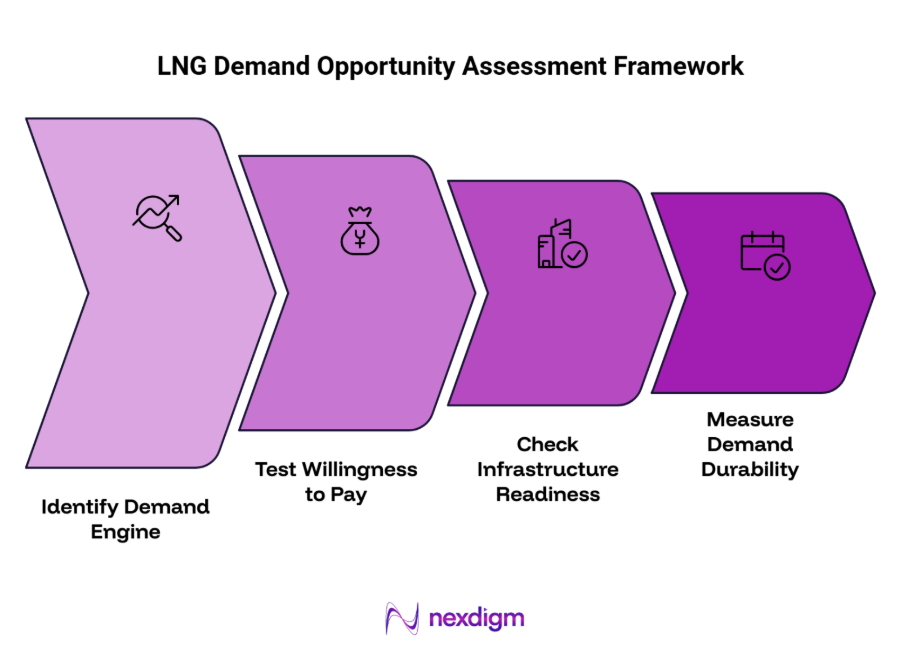
- Identify the Demand Engine
Determine whether incremental consumption is coming from power, industry, city gas, transport or another end use, and establish the physical indicators supporting that growth. - Test Willingness to Pay
Compare delivered LNG economics with domestic gas, coal, fuel oil, renewables and other alternatives to determine which customers can sustain demand at realistic prices. - Check Infrastructure Readiness
Assess terminals, regasification, pipelines, storage and downstream connections to establish whether forecast demand can actually be supplied. - Measure Demand Durability
Separate contracted and baseload demand from price-sensitive or seasonal consumption, then stress-test utilisation against higher LNG prices, delayed infrastructure and competing energy sources.
Nexdigm can use these tests to identify which markets can support sustained LNG consumption and what infrastructure or commercial structure is required to capture it.
Nexdigm Case Study
Nexdigm assessed an LNG import opportunity linking a coastal terminal with four industrial clusters and two gas-fired power plants. The team modelled monthly demand, pipeline constraints and fuel-switching economics, finding that contracted industrial loads supported moderate terminal utilisation while power demand remained seasonal. A phased pipeline and flexible LNG procurement model reduced exposure to take-or-pay risk.
To take the next step, simply visit our Request a Consultation page and share your requirements with us.
Harsh Mittal
+91-8422857704