

LNG trade is growing as more countries use imported gas to meet energy and industrial needs. Global LNG trade reached about 438 million tonnes in 2025, according to GECF, marking another year of expansion. The U.S. remained the world’s largest LNG exporter, shipping around 113 million tonnes, while Qatar and Australia were also major suppliers.
The U.S. LNG exports continued to grow in 2026, averaging 17.4 in the first half of the year, 23% higher than the same period in 2025. These shifts show why LNG trade analysis is useful for understanding where cargoes are moving, which markets are increasing imports, where export capacity is expanding, and how pricing and infrastructure influence trade decisions.
Cargo Flows Are Becoming More Dynamic
LNG cargoes can move between regions depending on demand, pricing, shipping availability, storage, and disruptions. In 2025, Europe increased LNG imports by 29 Mt to 130 Mt, while Asia remained the largest LNG-importing region at 273 Mt. This divergence shows how supply gaps and regional market conditions can redirect flexible cargoes.
Export Capacity Is Reshaping Supplier Competition
New liquefaction capacity is expanding the pool of LNG available to international buyers. In 2025, the U.S. became the first country to exceed 100 Mt of annual LNG exports, while Qatar and Australia remained major suppliers. As additional capacity enters the market, buyers can gain more sourcing options, but exporters also face greater competition for destination markets.
Nexdigm’s Expertise in Offering LNG Market Intelligence
Navigating LNG markets requires an understanding of how demand, supply, infrastructure, pricing, and trade flows interact across regions. Nexdigm combines these market dimensions to help businesses interpret evolving LNG trade dynamics, identify emerging opportunities, assess risks, and support strategic decision-making across the global gas value chain.
How Nexdigm Helps Identify LNG Market Opportunities
As LNG markets become more interconnected, interpreting trade movements requires a broader view of supply, demand, pricing, and infrastructure dynamics. Nexdigm helps businesses convert complex LNG trade data into strategic market intelligence through LNG Trade Analysis which involves:
- Import Demand Assessment: Evaluation of LNG import growth, buyer participation, and consumption trends to identify high-potential markets and emerging demand centers.
- Supply and Competitor Mapping: Tracking of exporter activity, capacity expansions, supplier concentration, and competitive positioning to understand evolving market dynamics.
- Trade Flow and Pricing Intelligence: Analysis of cargo movements, regional price differentials, infrastructure constraints, and trade routes to uncover sourcing and market-access opportunities.
Nexdigm enables businesses to move beyond LNG trade data and gain actionable insights that support sourcing, expansion, investment, and growth decisions.
Nexdigm’s LNG Trade Analysis Framework
Nexdigm evaluates LNG markets through interconnected analytical lenses that help businesses understand opportunities, risks, and competitive dynamics across the global gas value chain by conducting:
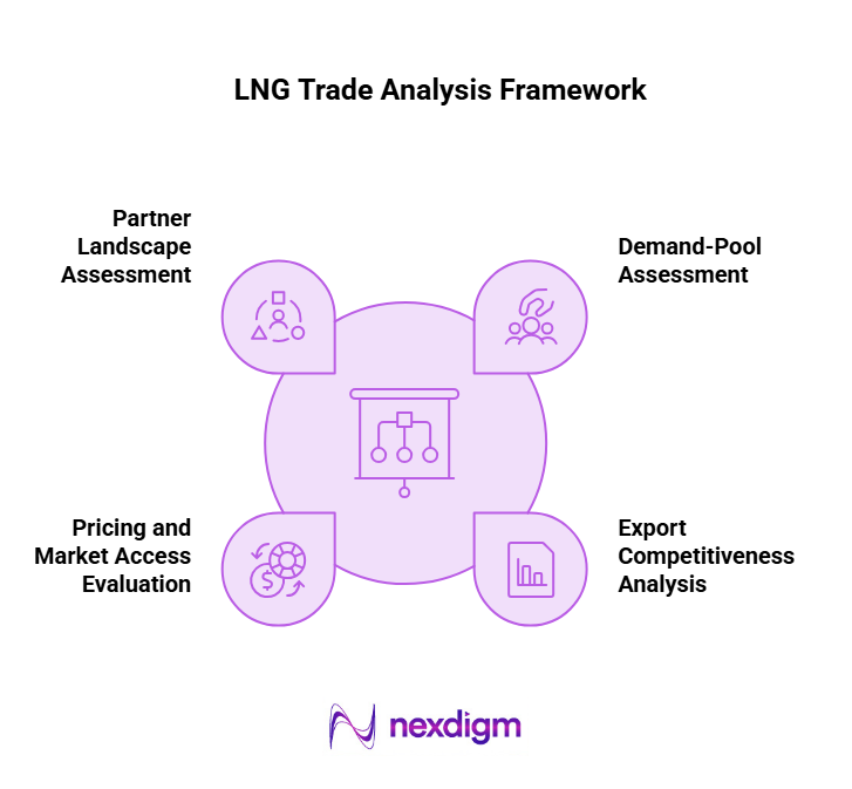
- Demand-Pool Assessment: Analysis of import growth, buyer participation, consumption patterns, and infrastructure developments to identify markets with expanding LNG requirements.
- Supply and Export Competitiveness Analysis: Assessment of exporter performance, liquefaction capacity additions, supplier concentration, and trade flows to understand evolving supply dynamics.
- Pricing and Market Access Evaluation: Examination of regional price trends, shipping routes, regasification capacity, and logistical constraints that influence LNG trade movements.
- Competitive and Partner Landscape Assessment: Identification of key suppliers, traders, buyers, and infrastructure participants to understand competitive positioning, partnership opportunities, and evolving market structures.
By combining these perspectives, Nexdigm helps businesses move beyond trade statistics to uncover actionable opportunities across sourcing, market expansion, and investment planning.
Business Advantages of Nexdigm’s LNG Trade Analysis
By transforming complex LNG trade data into actionable market intelligence, Nexdigm helps businesses make more informed sourcing, expansion, investment, and risk-management decisions by offering the following benefits:
- Improved Market Prioritization: Identify LNG markets with the strongest demand potential and commercial attractiveness.
- Enhanced Sourcing Decisions: Evaluate alternative suppliers and sourcing routes to strengthen supply security and flexibility.
- Greater Risk Visibility: Anticipate supply disruptions, capacity constraints, and market-access challenges before they impact operations.
- Stronger Competitive Positioning: Benchmark suppliers, buyers, and market participants to uncover strategic opportunities.
- More Confident Growth Decisions: Support expansion, investment, and partnership strategies with data-driven market intelligence.
Hence, through Nexdigm’s LNG trade analysis, organizations get to transform complex market signals into practical strategies that support their growth, resilience, and long-term competitive advantage.
Nexdigm’s Case
Nexdigm’s LNG trade assessments have helped energy-sector clients uncover growth opportunities, strengthen sourcing strategies, and improve market prioritization. In a recent anonymized engagement, trade-flow and demand analysis helped identify import markets representing over 20% higher growth potential, while supplier diversification assessment highlighted opportunities to reduce sourcing concentration by 30%+. These insights supported more confident expansion planning, risk mitigation, and commercial decision-making across the client’s LNG portfolio.
To take the next step, simply visit our Request a Consultation page and share your requirements with us.
Harsh Mittal
+91-8422857704