

Liquefied natural gas (LNG) markets can change direction rapidly when production interruptions, shipping constraints or regional price differences alter the economics of delivering cargoes. A shipment originally intended for Europe may become more attractive in Asia, while disruptions at export facilities can force buyers to compete for replacement supply.
For LNG producers, traders, importers and energy-intensive industries, understanding these shifts requires connecting cargo movements with price signals, contract flexibility, infrastructure availability and regional demand.
What Triggers LNG Trade Disruptions?
LNG supply can be disrupted at several stages, from gas production and liquefaction to shipping, regasification and final delivery. Geopolitical tensions may restrict access to maritime routes, while maintenance outages or infrastructure damage can reduce the volume available for export.
The International Energy Agency’s Gas Market Report, Q3-2026 describes how disruptions to LNG flows through the Strait of Hormuz in 2026 removed a major source of supply from international markets. The disruption affected prices, demand and cargo allocation, demonstrating how a regional event can influence buyers across continents.
Businesses should monitor four main indicators:
- Export Availability: Track production, liquefaction utilisation, terminal outages and loading schedules.
- Shipping Conditions: Monitor vessel movements, transit times, route restrictions and freight costs.
- Regional Demand: Assess consumption, storage levels, seasonal requirements and alternative fuel availability.
- Contract Flexibility: Identify destination clauses, delivery windows and the ability to redirect cargoes.
These indicators help distinguish a temporary shipping delay from a deeper shortage of available supply.
Follow Price Signals and Cargo Diversions
LNG cargoes are not always allocated to the same destination throughout their journey. Where contracts allow flexibility, traders can redirect shipments when price differences make another market more attractive.
The relevant comparison is not simply the headline spot price. Traders must consider transportation costs, liquefaction and regasification charges, contractual obligations, vessel availability and delivery timing. A market offering a higher price may still produce a weaker netback if reaching it requires a longer or more expensive voyage.
LNG trade disruptions and market rebalancing can be assessed by combining benchmark prices with cargo-level information, including loading origin, destination, arrival dates and route changes. This makes it easier to determine whether a price movement reflects a temporary shortage, a change in regional demand or a shift in available supply.
The IEA’s 2026 analysis documented how price differences between European TTF and Asian JKM benchmarks changed during the Middle East supply disruption, encouraging flexible cargoes to move towards Asian buyers. Such movements can relieve shortages in one region while tightening availability in another.
Assess The Effects Across Import Markets
Cargo diversions redistribute supply rather than necessarily creating new supply. When several buyers pursue the same flexible volumes, competition can raise spot prices and increase uncertainty for import-dependent businesses.
The consequences vary by market. Buyers with diversified contracts and storage capacity may be better positioned to manage interruptions. Buyers that depend heavily on spot purchases can face greater exposure to sudden price increases.
Energy-intensive manufacturers, utilities and fertiliser producers should therefore assess not only their direct suppliers but also the broader market conditions influencing replacement cargo availability.
The LNG Market Rebalancing Framework
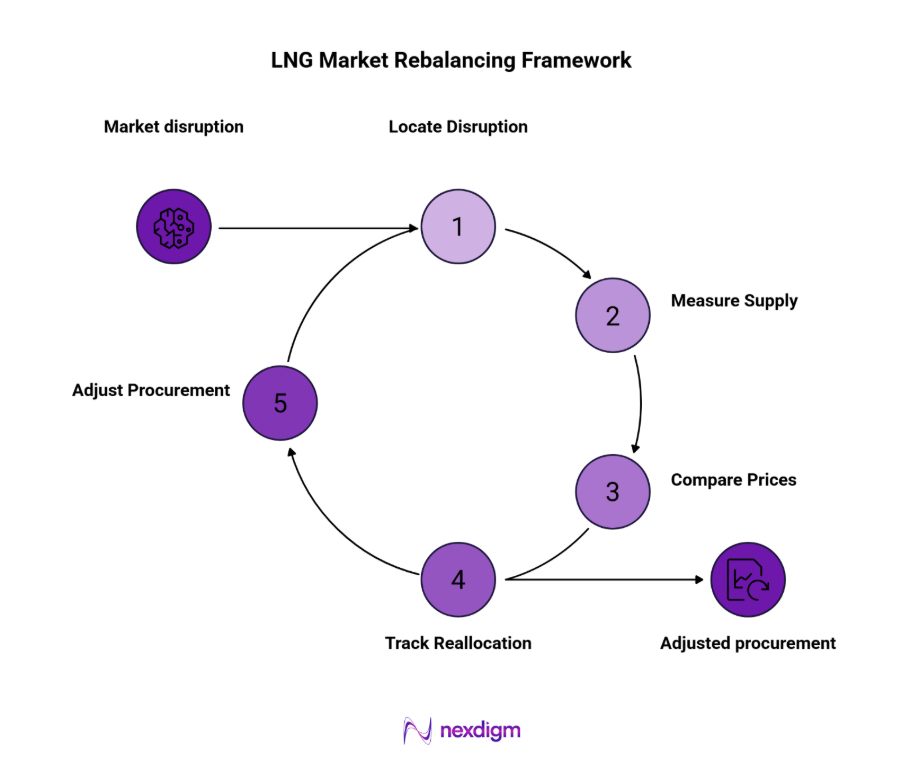
- Locate The Disruption: Identify affected production facilities, export terminals or shipping routes.
- Measure Available Supply: Estimate lost volumes and assess replacement capacity from alternative exporters.
- Compare Regional Prices: Evaluate benchmark spreads, freight costs and delivered netbacks.
- Track Cargo Reallocation: Monitor diversions, arrival schedules and changes in destination demand.
- Adjust Procurement: Review contract flexibility, alternative suppliers, storage and demand-management options.
Turning Market Volatility into Better Decisions
LNG market intelligence helps businesses distinguish between temporary price movements and structural changes in supply availability. By tracking infrastructure, shipping, contract terms and regional price differences together, companies can respond to diversions earlier and improve procurement resilience.
Case Study: Managing A Delayed LNG Delivery
An industrial buyer learns that a scheduled LNG delivery may be delayed by a shipping disruption. The procurement team reviews alternative suppliers, compares regional prices and checks contractual flexibility. It secures replacement volumes for critical demand while adjusting less urgent consumption to manage exposure to higher spot prices.
To take the next step, simply visit our Request a Consultation page and share your requirements with us.
Harsh Mittal
+91-8422857704