

Location decisions are becoming more data-driven as retailers and public-service organizations seek to place facilities closer to the populations they need to serve. In 2025, U.S. retail sales reached approximately US$5.6 trillion, according to the National Retail Federation, while e-commerce continued to account for a growing share of consumer activity.
Meanwhile, the U.S. Census Bureau reported that more than 80% of the population lived in urban areas in 2020, reinforcing the importance of understanding increasingly dense and differentiated local markets.
These shifts make location selection more complex. Hence, businesses must assess demand, accessibility, competition, infrastructure, catchments, and future development rather than relying on population size alone.
Location Quality Depends on More Than Footfall
A busy location may not necessarily be the most suitable site. Retailers need to consider whether surrounding customers match their target segments, whether competitors already dominate the area, and whether the location can generate sufficient sales relative to operating costs. For public services, the question is similarly broader: a facility should improve access for the intended population rather than simply occupy a geographically central position.
Local Growth Can Reshape Location Potential
Neighbourhoods and districts can change rapidly as new residential developments, transport infrastructure, commercial centres, employment hubs, and public facilities emerge. A location that appears marginal today may become strategically important as its surrounding catchment develops.
- Current-Market Signals: Existing population, demand, competition, accessibility, and infrastructure reveal the present attractiveness of a location.
- Future-Market Signals: Planned development, population growth, transport projects, and changing land use indicate how location potential may evolve.
Nexdigm’s Approach to Location Decision Strategy
Nexdigm approaches location strategy as a market-and-network decision, rather than simply a site-selection exercise. Its analysis can connect location intelligence for retail and public services, demographic intelligence, market research, geospatial analysis, infrastructure assessment, and location economics.
For retailers, this can help determine where new stores should be added, which catchments remain underserved, and how a proposed site fits within the existing network. For public-service organizations, the same approach can identify areas where additional facilities could improve population coverage and accessibility.
The emphasis is on understanding the relationship between people, demand, infrastructure, competitors, existing facilities, and future development before a location decision is made.
Why Location Intelligence Is Needed
Location decisions can no longer depend on population counts, historical performance, or site availability alone. A more integrated view helps organizations understand:
- Understand Local Demand: Combining demographic, behavioural, income, and market data helps identify whether a location has the right customer or population base for the proposed facility.
- Evaluate Accessibility and Competition: Analysing travel patterns, connectivity, nearby facilities, and competitors helps determine how easily a site can be reached and whether demand is already served.
- Identify Future Potential: Tracking infrastructure projects, residential growth, commercial development, and demographic changes helps assess whether a location can remain attractive as the surrounding market evolves.
A structured approach therefore helps organizations move from basic geographic selection to evidence-based location decisions, reducing the risk of investing in sites that appear attractive but lack sustainable demand or accessibility.
Nexdigm’s Structured Location Intelligence Framework
Nexdigm can structure location decisions through a sequential framework that moves from market definition to geographic analysis, site evaluation, scenario testing, and final prioritization. Steps for the framework include:
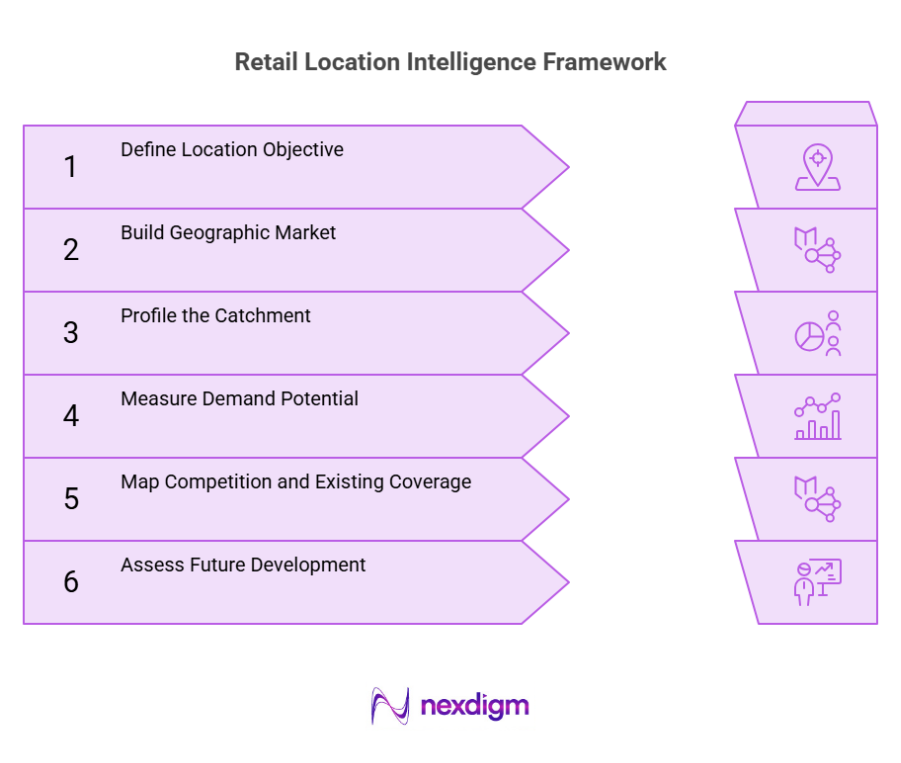
- Define the Location Objective: Establish the purpose of the facility, target population or customer, geographic scope, network objectives, and key site-selection criteria.
- Build the Geographic Market: Map relevant administrative boundaries, neighbourhoods, trade areas, existing facilities, transportation networks, commercial centres, residential clusters, and other geographic features.
- Profile the Catchment: Analyze population, households, income, age, employment, household composition, consumer characteristics, and other relevant demographic indicators. For public services, this can include the size and characteristics of the population requiring access to the service.
- Measure Demand Potential: Estimate potential demand using market size, category consumption, existing utilization, customer profiles, service requirements, and local growth indicators. This helps distinguish areas with large populations from areas with stronger addressable demand.
- Map Competition and Existing Coverage: Identify competing stores, service providers, public facilities, healthcare centres, schools, or other relevant organizations.
- Assess Future Development: Incorporate planned residential projects, commercial developments, transport infrastructure and other indicators of future growth. This provides a forward-looking view of location attractiveness rather than relying exclusively on current conditions.
The framework provides a consistent basis for comparing locations while allowing different weights to be assigned according to the organization’s strategic objectives.
Nexdigm’s Case
Nexdigm evaluated 15+ potential sites across five Indian states, assessing 30+ parameters including connectivity, infrastructure, labor, incentives, and expansion scope. The analysis narrowed the options to five priority sites, with Ahmedabad ranking highest. A detailed site assessment subsequently supported the client in selecting a suitable location for its proposed operations.
To take the next step, simply visit our Request a Consultation page and share your requirements with us.
Harsh Mittal
+91-8422857704