
Logistics costs often accumulate through a series of small inefficiencies rather than one obvious failure. A warehouse may release orders late, vehicles may return empty, inventory may sit between transport legs, or delivery schedules may repeatedly miss customer requirements. Individually, these issues can appear manageable.
Across a network, they can reduce capacity, increase working-capital needs and weaken service reliability.
Find Where Time and Money Accumulate
Start with a network map covering suppliers, warehouses, distribution centres, transport routes and delivery destinations. For each movement, capture cost, planned time, actual time, volume and service outcome.
Separate transport time from waiting time. A vehicle may complete its journey efficiently but lose hours waiting for loading, unloading, documentation or dock availability. Similarly, a distribution centre may report low transport costs while holding excess inventory to compensate for unreliable replenishment.
India’s September 2025 logistics-cost assessment, prepared by the National Council of Applied Economic Research for the Department for Promotion of Industry and Internal Trade, provides a structured national approach to measuring logistics costs using secondary data and nationwide surveys.
For individual businesses, the same principle applies, costs must be measured consistently across activities before performance can be compared.
Diagnose The Network Bottleneck
Effective logistics analysis connects shipment-level cost and delay records with capacity, utilisation, inventory and service performance. The objective is to identify the constraint that creates the greatest downstream impact, rather than simply target the largest visible expense.
Review five common sources of inefficiency:
- Transport utilisation: Low vehicle fill, empty returns and poorly consolidated loads increase cost per delivered unit.
- Warehouse flow: long picking times, dock queues and repeated handling delay dispatch and raise labour costs.
- Inventory placement: Stock held in the wrong locations creates avoidable transfers, urgent replenishment and missed deliveries.
- Schedule reliability: Variable transit times force larger buffers and make delivery promises harder to maintain.
- Handover failures: Poor coordination among carriers, warehouses, customs brokers and customers creates idle time and duplicated work.
A bottleneck is not always the most expensive activity in isolation. A warehouse delay that disrupts several outbound routes may have a greater network-wide effect than a high-cost lane that consistently meets its service target.
Prioritise Changes by Network Impact
The next step is to distinguish symptoms from root causes. If late deliveries increase, investigate whether the cause is route congestion, dispatch timing, insufficient capacity, poor forecasts or an unrealistic service schedule.
Then estimate the impact of each intervention.
- Load consolidation may reduce transport cost but increase delivery frequency intervals.
- Moving inventory closer to customers may improve responsiveness but raise storage costs.
- Automation can accelerate warehouse processing, but only if throughput constraints and process design justify the investment.
India’s National Logistics Policy and PM GatiShakti initiatives emphasise integrated infrastructure planning and improved coordination across logistics systems. At business level, the equivalent is to evaluate transport, warehousing and inventory as connected parts of the same network rather than optimise each department separately
Nexdigm’s Logistics Network Optimisation Framework
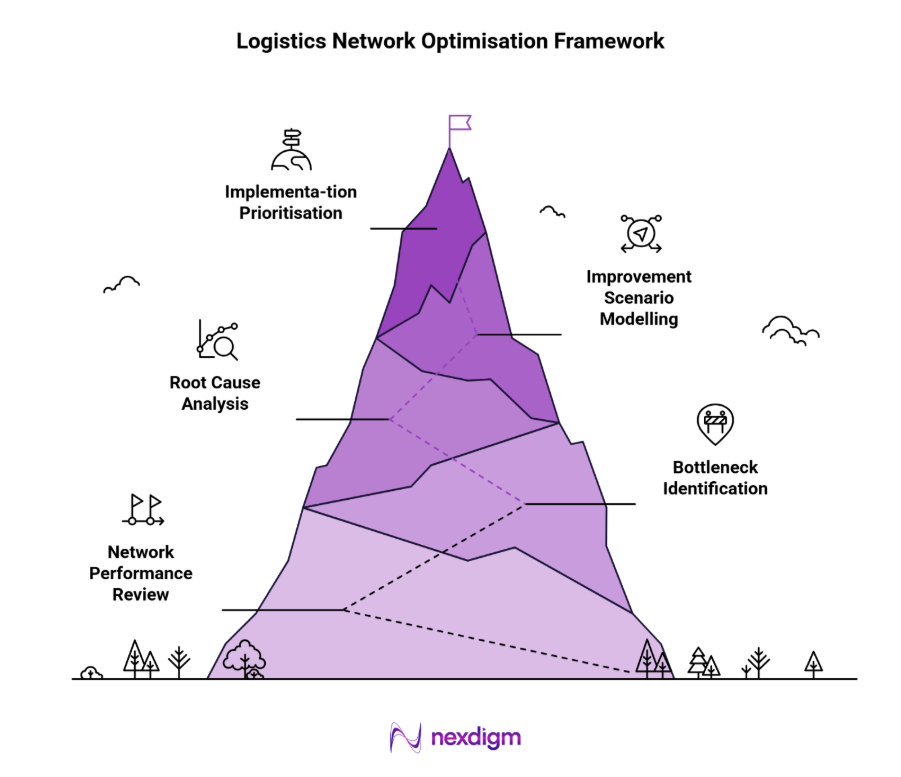
- Network Performance Review: Establish baseline costs, delivery times, utilisation and service levels.
- Bottleneck Identification: Locate recurring delays, capacity constraints and operational inefficiencies.
- Root Cause Analysis: Determine the operational factors driving excess costs and missed service targets.
- Improvement Scenario Modelling: Compare changes to routing, warehouse operations, inventory placement and capacity.
- Implementation Prioritisation: Rank initiatives by expected business impact, cost, feasibility and operational risk.
Nexdigm’s Case Study: Reducing Distribution Friction
A distributor reviewed six warehouses and 32 delivery routes. The analysis identified recurring dock delays at one facility and underutilised vehicles on several return journeys. Management revised dispatch windows, adjusted route consolidation and introduced weekly monitoring of cost per delivery and on-time performance.
To take the next step, simply visit our Request a Consultation page and share your requirements with us.
Harsh Mittal
+91-8422857704