

Logistics operations generate large volumes of information through transportation systems, warehouse applications, fleet devices, order management platforms and supplier networks. However, collecting operational data does not automatically provide useful insights. Businesses need analytics platforms that can combine information, identify patterns and support decisions involving transportation costs, inventory levels, delivery performance and capacity planning.
Logistics analytics solutions help organisations move from retrospective reporting towards more informed operational planning. Selecting the right vendor requires an assessment of analytical capabilities, data integration, scalability and the relevance of its applications to business requirements.
How Logistics Analytics Supports Supply Chain Decisions
Traditional logistics reporting primarily focuses on historical performance. Businesses review delivery times, transportation expenditure, warehouse productivity and inventory movements to understand what has already happened.
Analytics platforms extend this approach by helping organisations identify recurring patterns and anticipate potential operational problems.
For example, historical shipment data can reveal routes with consistently high delays. Inventory information can help identify locations experiencing repeated stock shortages, while carrier performance data can support more informed supplier allocation.
Logistics analytics platforms may support four broad analytical functions:
- Descriptive analytics: Explains historical performance through dashboards, reports and operational indicators.
- Diagnostic analytics: Identifies factors contributing to delays, cost variations and service failures.
- Predictive analytics: Uses historical information and statistical models to estimate future demand, delays and operational risks.
- Prescriptive analytics: Recommends potential actions based on constraints, business objectives and analytical outputs.
Procurement teams should distinguish between these capabilities when comparing vendors. A platform offering predictive dashboards is not necessarily capable of recommending operational decisions or automating them.
Evaluating Predictive Capability and Business Use Cases
Predictive capability should be assessed through actual business applications rather than general claims about artificial intelligence or machine learning.
For transportation operations, predictive models may estimate delivery delays using historical transit times, route information, weather conditions and traffic data.
In warehouse operations, analytics can help forecast order volumes, identify inventory movement patterns and anticipate capacity requirements.
Other applications include:
- Demand and inventory forecasting: Evaluating expected product demand and identifying potential stock shortages or excess inventory.
- Transportation cost analysis: Comparing freight expenditure across routes, carriers, shipment categories and delivery regions.
- Carrier performance prediction: Identifying providers with recurring delays, service inconsistencies or capacity constraints.
- Warehouse capacity planning: Forecasting storage requirements, picking volumes and labour utilisation.
- Disruption monitoring: Identifying potential supply chain interruptions using external and internal operational information.
The quality of these outputs depends on data availability, model accuracy and the frequency with which models are reviewed.
Data Integration and Platform Scalability
Data integration is often one of the most challenging parts of logistics analytics implementation.
A business may use separate applications for inventory management, transportation planning, warehouse operations and fleet tracking. If these systems use inconsistent identifiers, reporting structures or update frequencies, consolidating information becomes difficult.
Procurement teams should assess the vendor’s ability to integrate with ERP, WMS, TMS, fleet telematics and external data sources.
Important technical considerations include data ingestion, API connectivity, data transformation, historical data management and access controls.
Scalability should also be evaluated. The platform must be able to accommodate increasing transaction volumes, additional facilities, new business units and changing analytical requirements.
A proof of concept using the organisation’s own logistics data can help establish whether the platform produces useful insights and handles existing data quality challenges.
Commercial and Technical Considerations
Analytics platforms can use subscription-based, consumption-based or enterprise licensing models. The total investment may also include implementation, data preparation, integration, training and ongoing technical support.
Procurement teams should compare the cost of each platform against measurable operational objectives.
Useful indicators include forecast accuracy, reporting turnaround time, transportation cost per shipment, inventory turnover, delivery reliability and exception resolution time.
Vendor due diligence should also cover data security, model transparency, user permissions, data retention and the ability to export information when changing providers.
Logistics Analytics Platform Evaluation Framework
A structured logistics analytics platform supplier analysis should assess vendors across six dimensions:
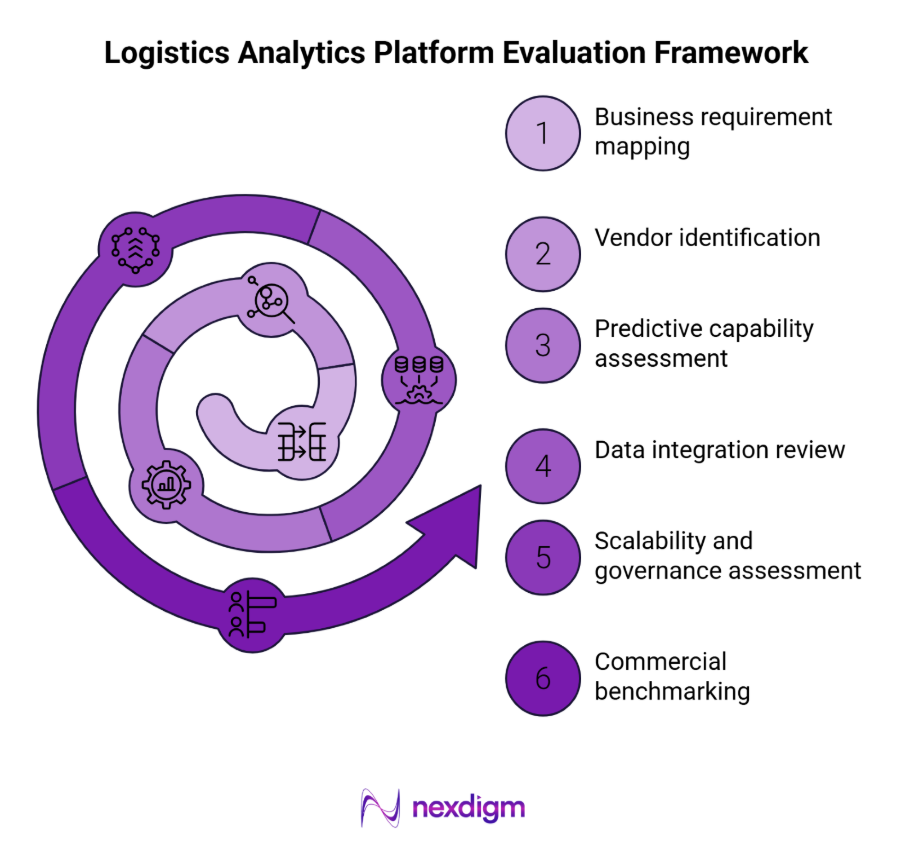
- Business requirement mapping: Identify analytical priorities across transportation, inventory, warehousing and distribution.
- Vendor identification: Map analytics providers according to their logistics capabilities and industry applications.
- Predictive capability assessment: Compare forecasting, anomaly detection, scenario modelling and optimisation functionality.
- Data integration review: Evaluate connectivity with ERP, WMS, TMS, telematics and external information sources.
- Scalability and governance assessment: Review transaction capacity, security, model monitoring and data management.
- Commercial benchmarking: Compare licensing, implementation, infrastructure, support and maintenance costs.
Nexdigm can support organisations through logistics analytics market research, technology vendor intelligence, platform benchmarking and procurement assessments. These services help businesses compare analytical capabilities and identify solutions that address specific supply chain decision-making requirements.
Nexdigm’s Case Study: Turning Logistics Data into Operational Insights
Nexdigm assessed 8 logistics analytics vendors across 4 business use cases, comparing predictive capabilities, integration and scalability. The assessment shortlisted 3 platforms, identified a 23% variation in implementation costs and established 7 performance measures for analytics technology selection.
To take the next step, simply visit our Request a Consultation page and share your requirements with us.
Harsh Mittal
+91-8422857704