

Logistics automation is often discussed as a single technology market, but the investment decision is rarely that simple. Autonomous mobile robots, automated storage systems, sortation equipment, guided vehicles, and computer vision address different operational problems and carry very different capital requirements.
For logistics operators, the opportunity lies in determining where automation can improve throughput, reduce labour dependency, or increase accuracy without creating an inflexible cost structure.
Automation Starts with the Workflow
The right technology depends on what is happening inside the facility.
Highly repetitive activities such as pallet movement, parcel sorting, and standardized picking are easier to automate than processes involving irregular products or unpredictable handling requirements. The assessment also needs to consider:
- Throughput: Higher-volume, multi-shift facilities generally have stronger economics for automation.
- SKU profile: Product dimensions, weights, and variability determine which systems can be deployed effectively.
- Process consistency: Repetitive workflows provide greater scope for robotics and automated material handling.
- Labour economics: High turnover, wage inflation, and labour shortages can strengthen the business case.
- Facility constraints: Available space, layout, lease duration, and existing infrastructure affect technology selection.
Automation should therefore follow the operating profile rather than the other way around.
Different Technologies Solve Different Problems
The technology choice has direct implications for capital requirements and flexibility.
AMRs can provide modular goods-to-person picking with relatively limited fixed infrastructure. AS/RS systems offer high-density storage but require substantial facility investment. Automated sortation is suited to high-volume parcel environments, while AGVs and automated forklifts are better aligned with repetitive pallet movements.
Computer vision and automated scanning can address another layer of the operation by measuring parcels, verifying labels, and identifying damage without requiring full physical automation.
For multi-client logistics operators in particular, flexibility can be as important as throughput. A system designed around one customer’s volume, or SKU profile may become difficult to justify when contracts change.
Peak Volume Can Distort the Business Case
Automation economics depend heavily on how a facility operates throughout the year. A system sized entirely around promotional or seasonal peaks can remain substantially underutilized during normal periods.
Operators therefore need to compare baseline and peak throughput before determining system capacity. Flexible manual processes or modular robotic capacity can sometimes be more economical than building fixed infrastructure for the highest-volume days.
The assessment should account for the full cost of ownership, including equipment, facility modifications, software integration, maintenance, specialist labour, and replacement components.
Integration Can Determine Whether Automation Works
Automation does not operate independently of the warehouse’s technology stack. ERP, WMS, WES, and WCS systems need to exchange information reliably for inventory and equipment movements to remain synchronized.
Legacy systems that rely on batch processing can create delays between physical movements and inventory updates. Proprietary platforms can also make future equipment changes more difficult.
For this reason, technology selection needs to consider API architecture, integration requirements, data latency, and the ability to operate different equipment within the same environment.
Where Does Automation Make Commercial Sense?
The opportunity varies significantly by facility and industry. E-commerce fulfilment centres may benefit from AMRs and high-speed sortation because of high picking volumes and compressed delivery windows. Industrial facilities may have stronger use cases for AGVs, pallet AS/RS, and vision inspection. Cold-chain and pharmaceutical facilities can justify specialized automation where operating environments make manual handling difficult.
This makes logistics automation market assessment a facility-level exercise as much as a technology evaluation. The objective is to identify where automation can generate sufficient operational and financial returns, and where process redesign remains the better option.
Nexdigm’s Approach to Evaluating Automation Opportunities
Nexdigm evaluates automation investments across operational, technological, and financial dimensions:
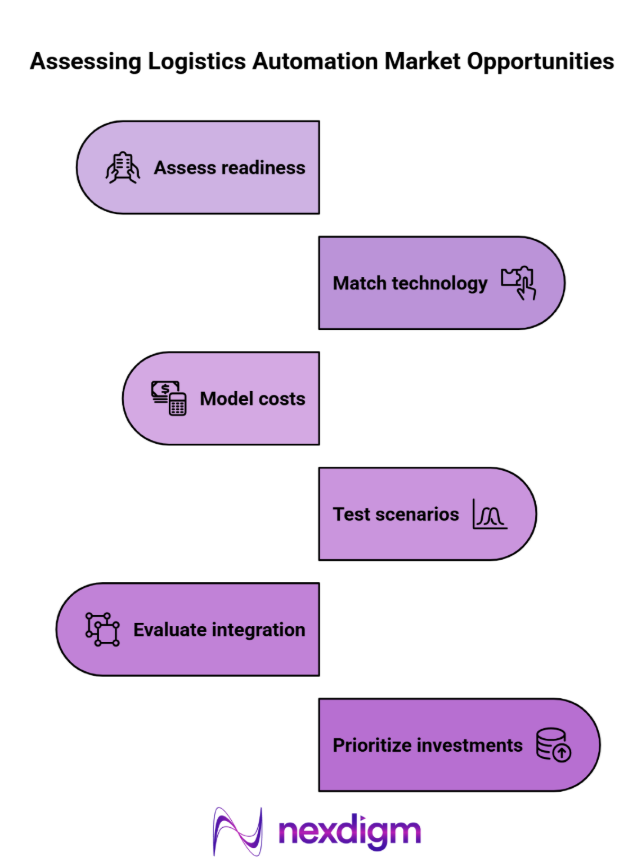
- Assess facility readiness: Examine workflows, layouts, SKU characteristics, labour requirements, and throughput patterns.
- Match technology to use case: Compare AMRs, AS/RS, sortation, AGVs, and vision systems against specific operational requirements.
- Model total cost of ownership: Account for CapEx, facility modifications, software, maintenance, and specialist labour.
- Test peak and baseline scenarios: Determine whether proposed systems remain economically viable across seasonal demand variations.
- Evaluate integration: Assess WMS, WES, WCS, ERP, API, and data requirements before technology selection.
- Prioritize investments: Identify facilities and processes where automation can deliver the strongest combination of productivity, flexibility, and payback.
How Nexdigm Cut a 3PL’s Automation Investment by 63%
A 3PL operating six warehouses faced 48% labour turnover and 2.8% picking errors. Nexdigm analysed 8.4 million pick events and found that fixed AS/RS was uneconomical across four facilities with short contracts and volatile volumes.
A targeted AMR, sortation, and process-modernization strategy reduced planned CapEx from $45 million to $16.5 million. Throughput increased 65%, picking errors fell to 0.18%, handling costs declined 28%, and capital payback was achieved in 26 months.
To take the next step, simply visit our Request a Consultation page and share your requirements with us.
Harsh Mittal
+91-8422857704