

Logistics markets can look crowded from a distance. Major operators have extensive networks, large customer portfolios and access to infrastructure that smaller providers cannot easily replicate. Yet market concentration does not mean every customer need is being served equally well.
The more interesting competitive question is where scale stops being an advantage. A large operator may be highly efficient on standardised, high-volume routes while remaining less attractive to a customer requiring specialised handling, regional coverage, unusual delivery windows or greater flexibility.
India’s 3PL market shows how quickly scale can accumulate. JLL reported more than 110 million sq. ft. of cumulative gross absorption by India’s 3PL sector between 2021 and H1 2026. The segment accounted for between 28% and 42% of annual absorption during the period, while average deal size increased from around 100,000 sq. ft. in 2021 to 125,000 sq. ft. in 2025.
That scale strengthens the position of established providers. It also makes broad, undifferentiated competition increasingly difficult.
The market leader does not necessarily own every valuable customer
Competitive analysis often starts with revenue, market share and geographic footprint. Those metrics are useful, but they can conceal where customers are dissatisfied or where service economics are unattractive to the largest providers.
Consider a manufacturer operating across several smaller industrial clusters. Its shipment volumes may be too dispersed to justify the attention of a large national provider, while a regional operator could build a more responsive network around those specific corridors.
The same pattern can appear in specialised logistics. Temperature-sensitive components, controlled products, urgent industrial parts and cross-border shipments may require capabilities that are not easily bundled into a standard service. Customers may be willing to pay for reliability or specialist handling even when a larger competitor can offer a lower headline price.
That is where competitive whitespace becomes commercially meaningful. It is not an empty market. It is a part of an existing market where the current proposition does not fully match customer requirements.
Where Nexdigm would look for the gap
A logistics competitive market assessment consulting exercise should therefore compare providers at the level where customers actually make decisions.
That means examining:
- which customer segments generate the bulk of each competitor’s revenue;
- which corridors receive the greatest network investment;
- where service coverage becomes thin;
- how pricing changes by shipment type and service level;
- which capabilities competitors emphasise and which they treat as exceptions;
- and where customers have limited alternatives despite the presence of several providers.
This can reveal a counterintuitive pattern. Two companies may both claim nationwide coverage while having very different practical coverage for a pharmaceutical distributor, an automotive supplier or a mid-sized exporter. Competitive position depends on the service required, not simply the number of cities shown on a network map.
Scale creates advantages. Specialisation creates another route in.
Large logistics operators benefit from density. More shipments across the same network can improve asset utilisation, route economics and purchasing power. They can also spread technology and infrastructure investments across a wider customer base.
New entrants rarely need to reproduce that entire system immediately. A more credible strategy is to build around a customer problem where existing scale does not translate cleanly into superior service.
The opportunity can emerge through several forms of differentiation:
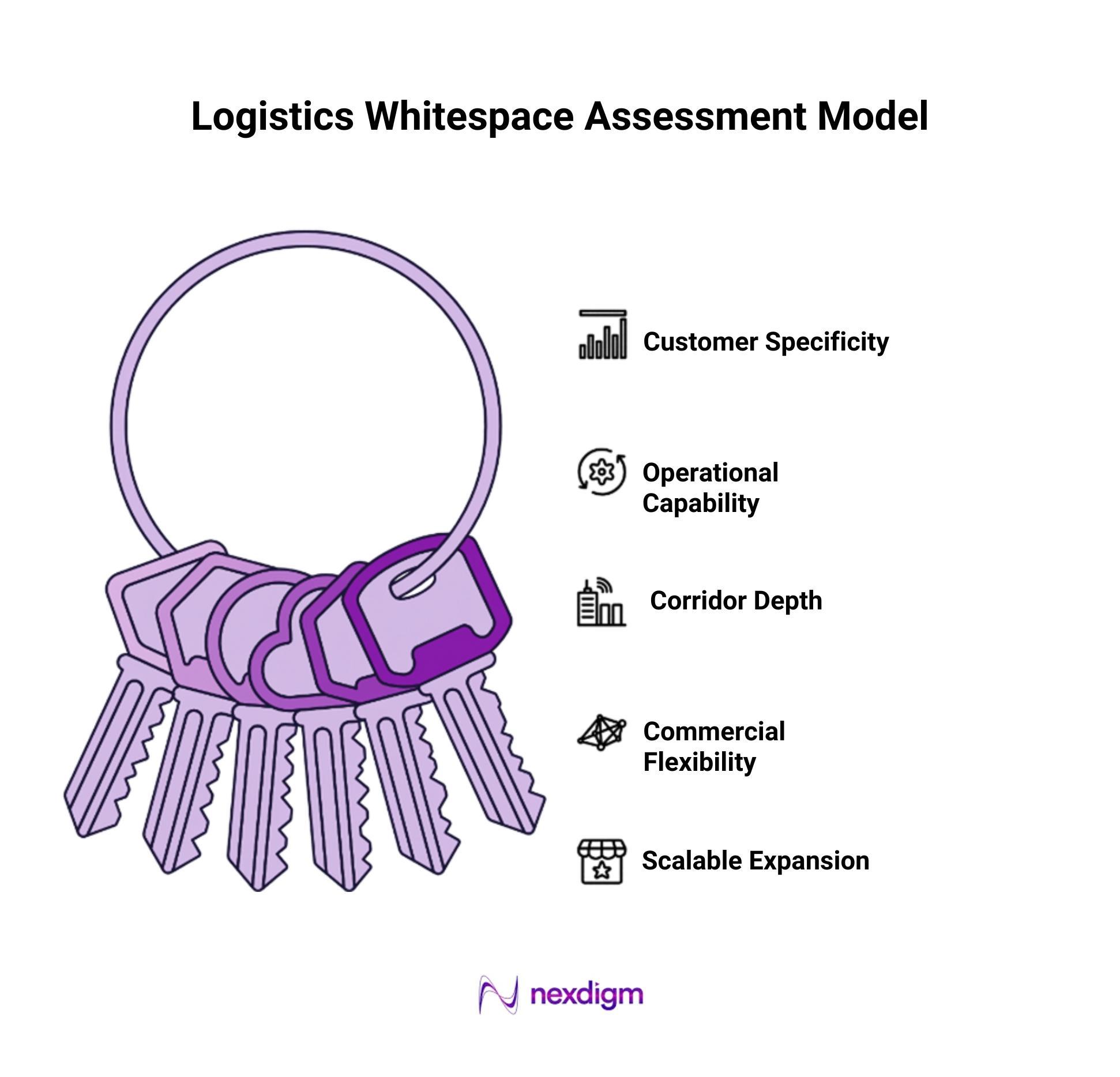
- Customer specificity: Focus on a segment whose requirements are poorly served by standardised logistics products.
- Corridor depth: Build exceptional service on a limited number of routes rather than claiming broad coverage too early.
- Operational capability: Develop specialist handling, compliance, visibility or time-critical delivery capabilities that are difficult to commoditise.
- Commercial flexibility: Structure contracts and service levels around customers whose shipment patterns do not fit standard pricing models.
- Scalable expansion: Use the initial niche as an anchor for adjacent customers and corridors instead of treating the niche as the entire business.
The test is whether the initial differentiation can generate enough density to become economically stronger as it scales. A niche is useful only when it can eventually support a network.
Illustrative Nexdigm Case: Finding an Underserved Customer Segment
A competitive assessment examined 31 logistics providers across enterprise, mid-market and specialised industrial accounts. Large operators controlled 74% of enterprise contracts, while mid-market industrial customers remained fragmented across regional providers. A focused proposition targeting four industrial clusters indicated approximately US$38 million in annual addressable revenue.
To take the next step, simply visit our Request a Consultation page and share your requirements with us.
Harsh Mittal
+91-8422857704