

Data analytics is transforming how organizations make real-time decisions across complex supply chains. By collecting and analyzing operational, inventory, and shipment data, companies gain actionable insights into performance, bottlenecks, and resource utilization. Competitive intelligence allows firms to benchmark
Logistics data analytics intelligence against industry peers, anticipate market trends, and identify best practices.
This combination of analytics and intelligence not only enhances efficiency, reduces costs, and improves service levels but also strengthens strategic decision-making and operational resilience across multi-tier logistics networks.
Organizations leveraging data analytics for real-time decision-making in logistics report 20–25% faster response times to operational disruptions and 15–18% improvements in on-time delivery rates. Analytics-driven insights reduce inventory holding costs by 10–15% and optimize route planning, lowering transportation expenses by 12–20%.
Companies integrating competitive intelligence alongside data analytics achieve better benchmarking, anticipate market trends, and enhance multi-tier logistics performance, resulting in measurable efficiency gains, cost savings, and improved supply chain responsiveness.
Strengthening Decision-Making Capabilities Across Complex Logistics Networks
Strengthening decision-making capabilities across complex logistics networks involves leveraging real-time data, analytics, and competitive intelligence to optimize operations, anticipate disruptions, improve supplier performance, reduce costs, and enhance overall supply chain efficiency:
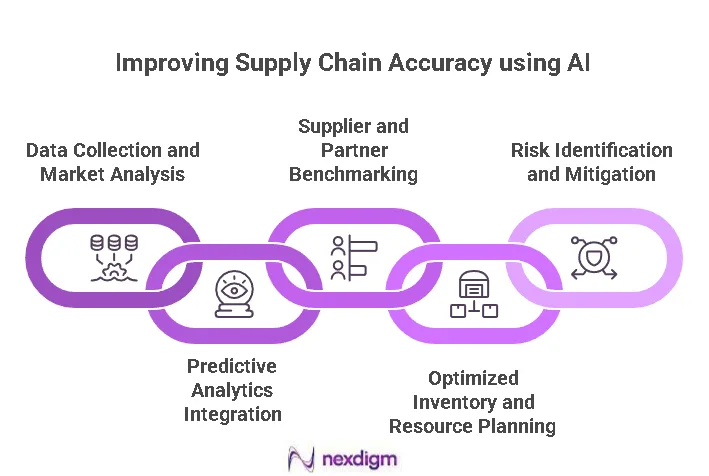
- Real-Time Data Integration – Consolidating inventory, shipment, and operational data across multi-tier networks to enable timely, informed logistics decisions.
- Predictive Analytics for Proactive Planning – Leveraging historical and real-time data to forecast disruptions, optimize routes, and improve resource allocation.
- Competitive Intelligence Insights – Analyzing market trends and competitor performance to benchmark operations and guide strategic decision-making.
- Risk Assessment and Mitigation – Identifying potential bottlenecks, delays, or failures and implementing proactive strategies for smooth logistics operations.
- Cost and Efficiency Optimization – Using data-driven insights to reduce transportation, handling, and inventory costs while improving operational efficiency.
Nexdigm Competitive Intelligence Integration for Logistics Decisions
Nexdigm Competitive Intelligence Integration for Logistics Decisions combines market, supplier, and competitor insights with real-time logistics data to enhance decision-making. By benchmarking performance against industry peers, identifying operational gaps, and analyzing trends, Nexdigm enables proactive route optimization, risk mitigation, and supplier management. This integration drives efficiency, reduces costs, improves responsiveness, and strengthens multi-tier supply chain competitiveness.
Nexdigm’s Insights in Real-Time Decision Making Across Complex Logistics Systems
Nexdigm’s insights in real-time decision making across complex logistics systems leverage data analytics, predictive modeling, and competitive intelligence to optimize operations, enhance efficiency, reduce costs, and improve multi-tier supply chain performance.
- Real-Time Data Consolidation – Integrating shipment, inventory, and operational data across multi-tier networks to provide actionable insights for immediate logistics decisions.
- Predictive Analytics for Proactive Planning – Using historical and real-time data to forecast delays, optimize routes, and anticipate operational bottlenecks.
- Risk Identification and Mitigation – Detecting potential disruptions, delays, or inefficiencies and implementing proactive strategies to maintain supply chain continuity.
- Continuous Monitoring and Improvement – Using dashboards and analytics to track KPIs, monitor trends, and refine logistics processes for sustained efficiency.
Nexdigm’s case:
Recently, Nexdigm partnered with a regional e‑commerce logistics provider to implement advanced data analytics and competitive intelligence for real‑time decision support. By consolidating multi‑tier shipment, inventory, and operations data into interactive dashboards, the client achieved a 22 % improvement in on‑time delivery performance, reduced logistics costs by 17 %, and increased inventory accuracy by 14 %. These insights enabled proactive routing adjustments, faster exception handling, and stronger supply chain responsiveness.
To take the next step, simply visit our Request a Consultation page and share your requirements with us.
Harsh Mittal
+91-8422857704