

A logistics distribution network analysis is essential for managing growing demand across regions by evaluating warehouse locations, transportation routes, and inventory flows. Integrating competitive intelligence allows companies to benchmark their distribution strategies against industry peers, identify efficiency gaps, and adopt best practices. Leveraging these insights helps optimize network design, improve delivery performance, enhance resource utilization, and maintain a competitive edge in dynamic, multi-regional logistics environments.
Analysis shows that logistics distribution network analysis can deliver substantial cost and service benefits. Optimized network design typically reduces total logistics costs by 15–30 % compared with unoptimized configurations by reshaping facility locations and flow patterns. Strategic warehouse location decisions alone can lower overall logistics expenses by 10–30 % while improving delivery times 15–40 % through reduced transit distances and better inventory placement.
Competitive Intelligence Integration for Future Trends in Distribution Network Design
Competitive intelligence integration for future distribution network design involves analyzing industry trends, competitor strategies, and market demands to proactively optimize warehouse placement, inventory flow, and transportation for scalable, efficient networks:
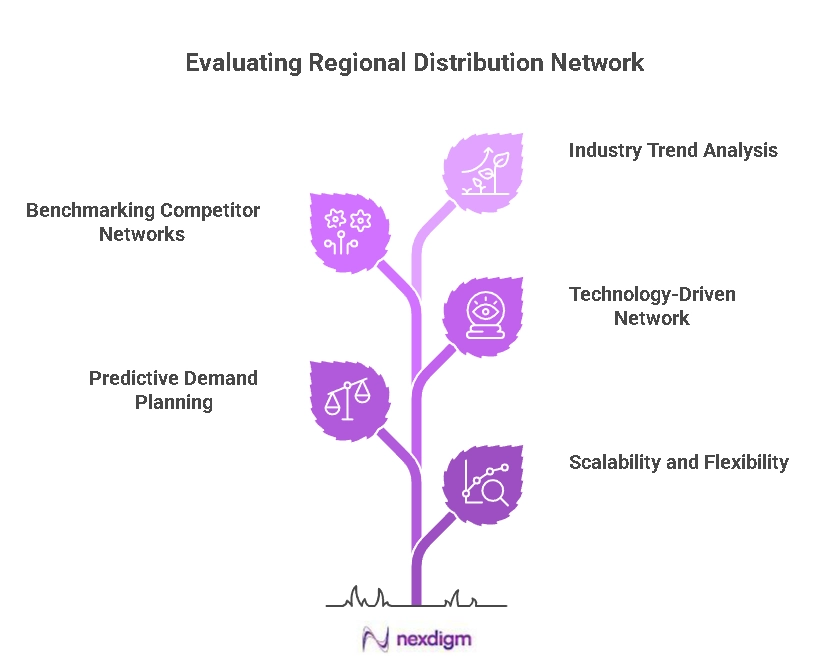
- Industry Trend Analysis – Monitor competitor strategies and market shifts to anticipate changes in demand and distribution requirements.
- Benchmarking Competitor Networks – Compare warehouse locations, route efficiency, and inventory management practices to identify best practices for network optimization.
- Predictive Demand Planning – Use competitive intelligence to forecast regional demand fluctuations and adjust inventory flows accordingly.
- Technology-Driven Network Design – Integrate AI, analytics, and simulation tools to model efficient distribution layouts informed by competitor insights.
- Scalability and Flexibility Assessment – Ensure network designs can adapt to evolving market trends and growing regional demand efficiently.
Nexdigm Expertise in Multi-Regional Network Benchmarking
Nexdigm’s Expertise in Multi-Regional Network Benchmarking enables logistics operators to evaluate distribution efficiency across regions by comparing warehouses, routes, and inventory flows against industry standards. By integrating competitive intelligence and advanced analytics, Nexdigm identifies performance gaps, recommends strategic improvements, and optimizes resource allocation. This approach enhances delivery reliability, reduces operational costs, and ensures scalable, high-performing distribution networks.
Nexdigm Technology Integration for Dynamic Distribution Network Management
Nexdigm’s Technology Integration for Dynamic Distribution Network Management leverages AI, analytics, and simulation tools to monitor performance, optimize routes, adjust inventory flows, and enhance scalability and efficiency across multi-regional logistics networks.
- AI-Driven Route Optimization – Use artificial intelligence to dynamically plan delivery routes, reducing transit times, fuel consumption, and improving overall network efficiency.
- Predictive Inventory Management – Leverage analytics to forecast demand and adjust inventory flows across regions, ensuring timely availability and reduced stockouts.
- Real-Time Performance Monitoring – Implement dashboards and KPIs to continuously track delivery efficiency, fleet utilization, and network bottlenecks.
- Simulation and Scenario Planning – Model alternative network configurations and delivery strategies to evaluate efficiency gains before implementation.
- Integration with IoT and Telematics – Connect vehicles, warehouses, and systems for real-time data collection and operational insights.
Nexdigm’s case:
In a multi‑regional logistics engagement, Nexdigm deployed technology integration for dynamic distribution network management, resulting in measurable performance gains. Real‑time monitoring and AI‑driven routing reduced average transit times by 17 %, while predictive inventory adjustments cut regional stockouts by 23 %. Overall network responsiveness improved, and logistics costs declined by 12 %, enabling the client to reliably handle increased demand across regions.
To take the next step, simply visit our Request a Consultation page and share your requirements with us.
Harsh Mittal
+91-8422857704