

Chemical market entry is not complete when a product reaches a customer. The logistics network must move materials safely, comply with handling and transportation requirements, maintain product integrity, and deliver at a commercially viable cost. For chemicals, delays, inappropriate storage, inefficient routes, or weak controls can quickly affect customer service and profitability.
The challenge is becoming more complex as chemical supply chains span multiple suppliers, production sites, ports, warehouses, distributors, and end-use industries. Recent study notes that chemical supply chains can experience 10–15% volatility, while logistics costs can vary by 12–18% across regions. Such variability makes network design and benchmarking important considerations before entering a new market.
For manufacturers, importers, distributors, and investors, logistics entry consulting for chemical market entry can help assess whether the proposed network is capable of supporting safe operations, regulatory requirements, reliable service, and sustainable cost economics.
Safety and Compliance Must Be Designed into the Network
Chemical logistics can involve hazardous materials, specialized packaging, controlled storage, documentation, trained personnel, and specific transportation requirements. These considerations can influence warehouse selection, carrier qualification, route planning, inventory positioning, and customer delivery models.
A network that minimizes freight cost but creates compliance or safety vulnerabilities may ultimately increase business risk. Market-entry planning therefore needs to evaluate operational controls alongside commercial economics.
Cost Efficiency Depends on the Entire Logistics Chain
Transportation is only one component of chemical logistics economics. Warehousing, handling, inventory carrying costs, packaging, loading and unloading, port operations, insurance, documentation, and emergency-response capabilities can all influence the delivered cost. Recent supply-chain benchmarking research highlights logistics performance, inventory management, sourcing efficiency, and cost structures as important areas for evaluating resilience and competitiveness.
Nexdigm’s Role in Evaluating Logistics Readiness for Chemical Market Entry
Successful chemical market entry depends on more than customer demand and product availability. Businesses must ensure that logistics networks can support safe handling, regulatory compliance, reliable deliveries, and cost-efficient operations.
Through its expertise in logistics entry consulting for chemical market entry, Nexdigm helps businesses assess logistics readiness by evaluating network infrastructure, transportation capabilities, storage requirements and operational risks. These insights help organizations build logistics networks that support both immediate market-entry objectives and long-term growth.
Why Businesses Partner with Nexdigm
Chemical logistics decisions can have significant implications for safety, compliance, service performance, and overall supply-chain economics. Businesses partner with Nexdigm to gain:
- Chemical Industry Expertise: Evaluate logistics requirements in the context of chemical-specific handling, storage, transportation, and compliance considerations.
- End-to-End Network Assessment: Analyze sourcing locations, transportation corridors, warehousing infrastructure, inventory positioning, and customer-delivery networks.
- Data-Driven Decision Support: Combine market insights, operational benchmarking, and supply-chain analysis to support informed expansion decisions.
By combining industry knowledge with logistics and supply-chain expertise, Nexdigm helps businesses build networks that support safe operations, reliable service levels, and sustainable growth in new and existing chemical markets.
Nexdigm’s Logistics Entry Framework for Chemical Market Entry
Safe, compliant, and cost-effective logistics are critical to successful chemical market entry. Leveraging expertise in logistics entry consulting for chemical market entry, Nexdigm helps businesses assess whether their logistics networks can support long-term commercial and operational objectives through the following steps:
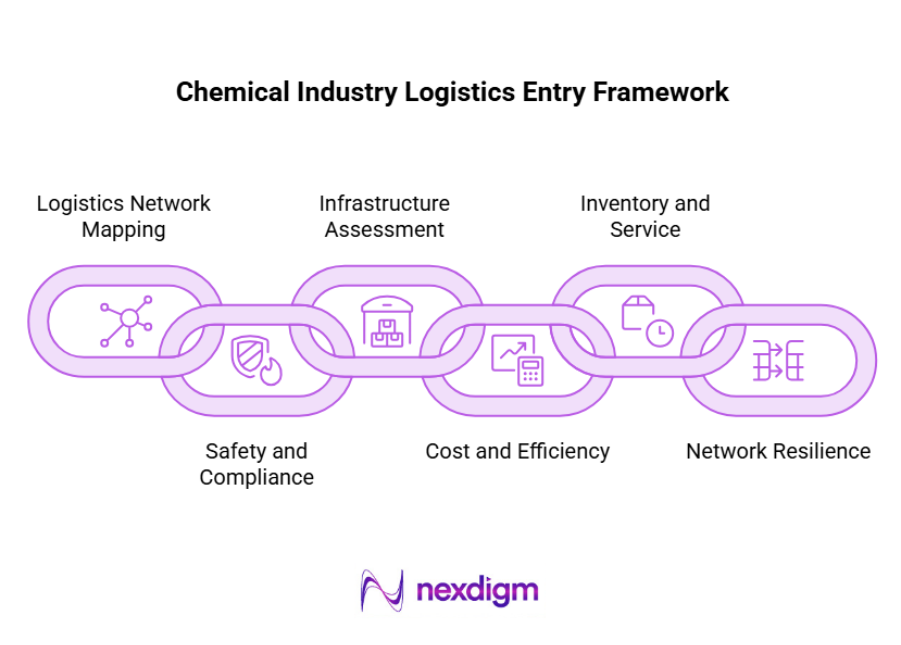
- Logistics Network Mapping: Assess suppliers, ports, warehouses, transportation corridors, distributors, and customer locations to understand end-to-end material movement.
- Safety and Compliance Evaluation: Review hazardous-material handling requirements, regulatory obligations, storage standards, documentation processes, and transportation compliance.
- Infrastructure and Capability Assessment: Evaluate warehousing facilities, storage capacity, handling systems, carrier capabilities, and logistics service providers supporting the network.
- Cost and Efficiency Analysis: Examine freight costs, warehousing expenses, inventory carrying costs, handling charges, and overall landed-cost economics.
- Inventory and Service-Level Planning: Assess inventory positioning, replenishment models, lead times, and delivery requirements to support customer expectations.
- Network Resilience Assessment: Identify operational bottlenecks, supply-chain vulnerabilities, compliance risks, and disruption scenarios that could affect continuity.
This framework helps businesses determine whether their logistics network can support safe operations, regulatory compliance, cost efficiency, and reliable customer service as they enter new chemical markets.
Business Impact of Nexdigm’s Logistics Entry Framework
A well-designed logistics network can create advantages that extend beyond operational efficiency. By evaluating logistics readiness before market entry, Nexdigm helps businesses align supply-chain capabilities with commercial objectives by:
- Improving Service Reliability: Optimizing inventory positioning, transportation routes, and delivery capabilities to support consistent customer service and product availability.
- Enhancing Cost Efficiency: Identifying opportunities to reduce logistics, warehousing, inventory, and handling costs across the network.
- Strengthening Compliance and Risk Management: Addressing safety, regulatory, and operational vulnerabilities before they affect market performance or business continuity.
- Offering Supply Chain Resilience: Improving preparedness for disruptions through better network design, infrastructure planning, and risk mitigation strategies.
With Nexdigm’s strategic assessment framework, chemical businesses can create networks that are safe, compliant, cost-effective, and capable of supporting long-term market success.
Nexdigm’s Case
Nexdigm supported a leading chemical company seeking greater resilience amid volatile market conditions. By applying supply-chain benchmarking and competitive intelligence, the engagement achieved a 13% reduction in logistics cost variability and an 18% improvement in inventory turnover, while strengthening overall supply-chain stability across global operations.
To take the next step, simply visit our Request a Consultation page and share your requirements with us.
Harsh Mittal
+91-8422857704