

Transport operators with heavily utilized assets require disciplined pricing decisions that balance market competitiveness, service reliability, and sustainable margins. A robust logistics fleet pricing competitiveness approach evaluates route economics, vehicle productivity, customer demand, capacity constraints, and competitor rate movements.
Through structured pricing analysis, operators can identify underpriced lanes, compare cost-to-serve variations, and refine rates by fleet type and service level. This enables management teams to protect profitability and maintain competitive positioning without sacrificing utilization or customer responsiveness across complex regional and national transport networks more effectively.
Recent industry benchmarks indicate that integrated pricing and capacity optimization can reduce transport procurement costs by about 21%, while a four-point utilization improvement may remove 12–15 vehicles from 200 daily routes, strengthening margins and impact of Pricing Analysis Services.
Pricing Analysis for Fleet Competitiveness and High Asset Utilization
Pricing analysis enables transport operators to balance competitive fleet rates with high asset utilization, improving profitability, market responsiveness, cost visibility, and informed commercial decisions across increasingly complex logistics networks. Some core benefits of the same are:
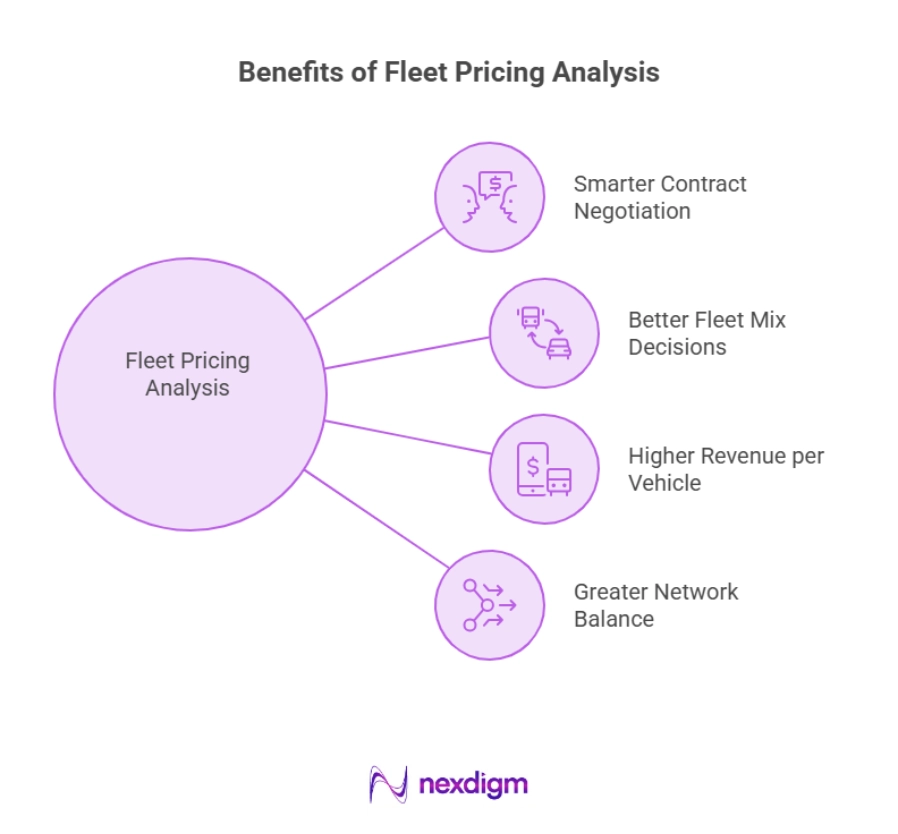
- Smarter Contract Negotiation: Detailed pricing analysis strengthens negotiations by providing evidence-based rate boundaries, helping operators secure sustainable contracts without relying on broad discounts or assumptions.
- Better Fleet Mix Decisions: Pricing analysis reveals which vehicle categories generate stronger returns, enabling operators to rebalance fleet composition, improve deployment efficiency, and reduce dependence on underperforming assets.
- Higher Revenue per Vehicle: Linking prices to vehicle productivity and route demand increases revenue potential per asset while discouraging low-value assignments that consume capacity without delivering sufficient returns.
- Greater Network Balance: Lane-level pricing encourages profitable freight flows across outbound and return routes, reducing empty mileage, balancing capacity, and supporting more efficient utilization throughout the transport network.
Nexdigm’s Strategic Assistance in Fleet Rate Optimization Pricing Analysis
Nexdigm’s strategic assistance in fleet rate optimization combines advanced pricing analysis, fleet pricing optimization, logistics cost analysis, and transportation pricing strategy to help operators improve commercial performance. By evaluating asset utilization, competitor benchmarks, route economics, and demand patterns, Nexdigm enables data-driven pricing decisions that strengthen profitability, enhance pricing competitiveness, and maximize returns across complex logistics networks.
Nexdigm’s Structured Pricing Analysis Blueprint for High-Utilization Fleets
Nexdigm’s strategic pricing blueprint helps high-utilization fleet operators align rates with asset productivity, route economics, demand intensity, and competitive benchmarks to improve margins, resilience, and commercial decision-making across networks consistently. Key blueprint elements/characteristics are:
- Establish Asset Economics Baseline: Map vehicle ownership, operating, maintenance, driver, fuel, and downtime costs to determine the minimum sustainable rate required for each fleet category and route served profitably.
- Quantify Utilization Value: Measure loaded miles, idle hours, turnaround time, capacity constraints, and backhaul potential to price scarce assets according to their true commercial contribution across operations accurately.
- Build Adaptive Rate Logic: Develop pricing rules that respond to utilization thresholds, demand surges, fuel movements, and capacity shortages while protecting margins and preserving transparency in customer negotiations consistently.
- Monitor and Refine Performance: Track realized yield, acceptance rates, revenue per vehicle, route contribution, and utilization changes to recalibrate prices, correct leakage, and sustain profitable fleet deployment decisions continuously.
Nexdigm’s Case
Nexdigm supported a leading fleet operator in redesigning its pricing blueprint by integrating route profitability, utilization metrics, and competitive benchmarking into its pricing analysis framework. The initiative delivered a 14% increase in revenue per vehicle, reduced pricing leakage and improved fleet utilization by 11%, strengthening margins and commercial agility across the network.
To take the next step, simply visit our Request a Consultation page and share your requirements with us.
Harsh Mittal
+91-8422857704