

Entering a new logistics market is often framed as a geographic expansion decision: choose a growing city, secure space, deploy capacity and begin selling. The harder question is whether the market can support a profitable network. Customer concentration, freight corridors, infrastructure, competitive capacity and cost-to-serve can make two apparently similar markets very different entry propositions.
The First Signal Comes from Customers
Market entry should begin with the shippers a provider can realistically win. Manufacturing clusters, retailers, distributors and other logistics-intensive businesses reveal where recurring freight demand exists and what services the market actually values.
Account-level analysis also distinguishes attractive volume from difficult volume. A large customer with predictable shipments and compatible service requirements may provide a stronger foundation than a broader pool of fragmented or highly seasonal demand. Freight volumes, shipment frequency, service requirements, logistics spend and existing provider relationships should be assessed before infrastructure is committed.
3PL demand remains substantial. 3PL providers accounted for around 30% of industrial and warehousing leasing across India’s top eight cities in H1 2026, making them the largest occupier segment.
Follow the Freight, Not the Map
Once priority customers are identified, their origin-destination flows reveal the network geography. Freight typically concentrates around manufacturing clusters, consumption centres, ports and major transport corridors rather than distributing evenly across a state or city.
This matters for network economics. A corridor with strong demand in one direction but limited return cargo can create poor asset utilization. Another corridor connecting complementary production and consumption centres may support more balanced flows and better utilization.
The entry analysis should therefore map shipment volumes, lane frequency, customer locations and competing providers at corridor level. A market becomes more attractive when several customers can be served through overlapping routes rather than requiring separate infrastructure for each account.
Infrastructure Can Change the Ranking
Transport infrastructure increasingly determines which markets can be served efficiently. India’s Eastern and Western Dedicated Freight Corridors are operational, while the government announced a 2,052-km Dankuni-Surat Dedicated Freight Corridor in the 2026 Union Budget. India has also approved 35 Multimodal Logistics Parks intended to connect production centres, consumption markets and EXIM gateways.
For an entrant, the relevant issue is whether access to that infrastructure changes transit times, vehicle utilization, service coverage or total cost for the target customer base.
A Growing Market Can Still Be a Difficult Entry
Demand growth does not automatically create attractive entry economics. In H1 2026, industrial and warehousing leasing across India’s top eight cities reached about 22 million sq. ft., while new Grade-A supply reached approximately 25 million sq. ft., up 27% year-on-year.
This creates different opportunities across markets. Established hubs may provide deeper customer pools but face stronger competition and higher occupancy costs. Emerging corridors may offer lower costs and more whitespace, but demand may be less mature. The entry decision has to balance addressable demand against incumbent capacity, warehouse availability, local operating costs and the effort required to acquire customers.
Build the First Network Around Proven Demand
The initial network should be sized around customers and corridors that have already been validated. Multi-client warehousing, outsourced line-haul capacity and cross-dock partnerships can provide flexibility while demand is being established. Permanent facilities or dedicated fleets can follow once volumes and utilization justify greater fixed investment.
This also allows the operating model to evolve with the market. A provider can begin with a focused corridor and expand into adjacent nodes as additional customers create sufficient density.
How Nexdigm Builds a Logistics Market-Entry Roadmap
Nexdigm’s logistics go-to-market strategy consulting approach can evaluate:
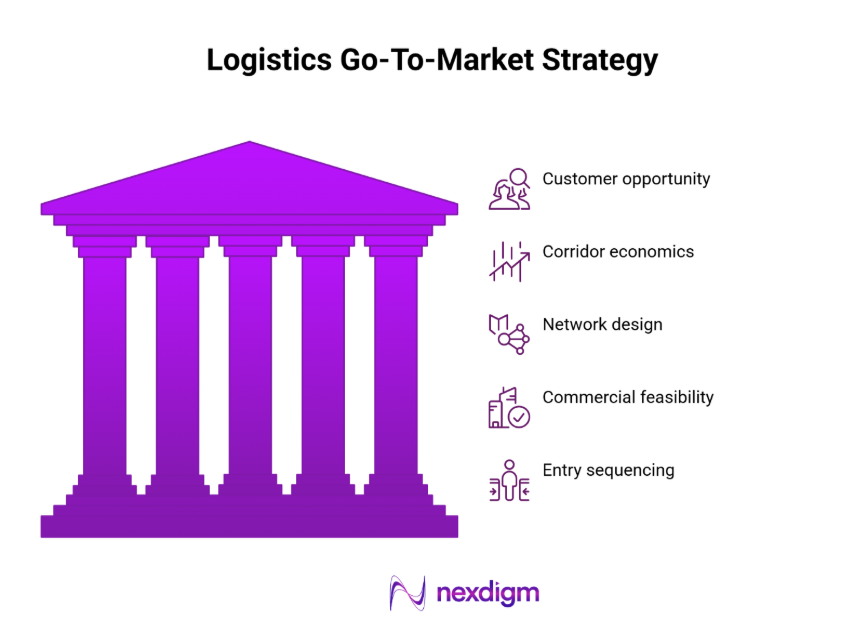
- Customer opportunity: Identify target shippers, freight volumes, logistics spend and service requirements.
- Corridor economics: Map origin-destination flows, shipment frequency and network balance.
- Network design: Determine the warehouse, cross-dock, fleet and partner footprint required for initial demand.
- Commercial feasibility: Model pricing, utilization, customer acquisition costs, working capital and break-even requirements.
- Entry sequencing: Rank markets according to demand, infrastructure, competitive whitespace and expected returns.
Nexdigm Case: Identifying Viable Hub Markets Before Investment
A logistics enterprise evaluating network expansion across high-growth trade markets assessed three potential commercial zones before committing to new infrastructure. Nexdigm examined industrial customer concentration, road connectivity, Grade-A warehouse availability and delivery-radius requirements.
The assessment shortlisted two viable regional hub locations. The resulting network architecture was projected to reduce regional distribution costs by 14%–16%, expand same-day and next-day delivery coverage by 35%, and reduce average customer transit times by 25%.
To take the next step, simply visit our Request a Consultation page and share your requirements with us.
Harsh Mittal
+91-8422857704