

Go-to-market strategies help logistics companies differentiate in competitive service markets by defining target customers, service positioning, pricing models, distribution channels, and value propositions. In logistics, differentiation depends on speed, reliability, technology visibility, cost efficiency, specialized handling, and customer support. For companies entering new regions, a strong market entry strategy must assess market demand, competitor intensity, customer needs, partner networks, compliance requirements, and service gaps.
A well-planned logistics go to market strategy supports faster customer acquisition, clearer positioning, stronger service credibility, and scalable growth across regional and international logistics markets.
The global logistics market was valued at about USD 4.11 trillion in 2025 and is projected to reach USD 8.50 trillion by 2033, growing at 10.1% annually. E-commerce logistics is also expected to grow strongly, increasing demand for differentiated services, faster delivery, and reliable market entry strategy.
Role of Go-to-Market Strategy in Differentiating Logistics Service Providers
Go-to-market strategy helps logistics service providers differentiate by defining target customers, service positioning, pricing, delivery strengths, technology value, and customer experience to compete effectively in new markets.
- Target Customer Segmentation: Identify priority customer groups, industry needs, shipment patterns, and service expectations before designing logistics market entry plans.
- Service Positioning: Define logistics strengths such as speed, reliability, technology visibility, cost efficiency, specialized handling, or regional coverage.
- Pricing Strategy: Develop competitive pricing models that balance customer value, service quality, operating costs, and market positioning.
- Technology Differentiation: Use tracking systems, dashboards, automation, and data visibility to improve customer trust and service transparency.
Nexdigm Pricing and Commercial Strategy for Logistics Service Differentiation
Nexdigm pricing and commercial strategy for logistics service differentiation helps businesses define competitive pricing models, margin structures, service bundles, and customer value propositions. This supports stronger market entry, improved profitability, clearer positioning, better customer acquisition, and sustainable growth in competitive logistics service markets.
Nexdigm Service Positioning Support for Competitive Logistics Differentiation
Nexdigm service positioning support for competitive logistics differentiation helps define target customers, service strengths, value proposition, delivery advantages, technology benefits, and market messaging for stronger competitive positioning:
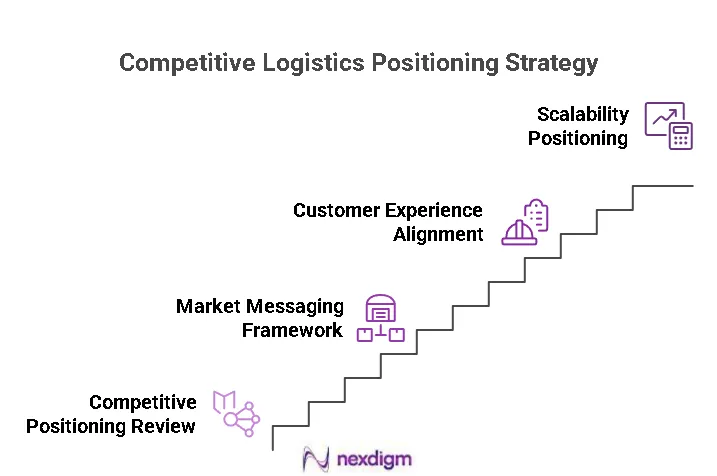
- Competitive Positioning Review: Nexdigm evaluates market alternatives, competitor offerings, pricing gaps, and service weaknesses to refine positioning strategy.
- Market Messaging Framework: Nexdigm helps build consistent messaging around reliability, efficiency, scalability, transparency, and customer service quality.
- Customer Experience Alignment: Nexdigm reviews communication, service support, issue resolution, and delivery updates to strengthen customer trust.
- Scalability Positioning: Nexdigm helps position logistics services as adaptable for higher volumes, new regions, and long-term customer growth.
Nexdigm’s case:
Nexdigm supported a logistics company strengthen service positioning for competitive differentiation before market entry. By assessing customer segments, competitor gaps, technology benefits, delivery reliability, and market messaging, Nexdigm helped improve qualified lead conversion by 24%, increase customer retention from 78% to 88%, and reduce pricing-related objections by 18%.
To take the next step, simply visit our Request a Consultation page and share your requirements with us.
Harsh Mittal
+91-8422857704