

Choosing the location of a new logistics hub has become more strategic as trade expands, supply chains diversify, and customers expect faster, more reliable movement of goods.
Global trade in goods and services reached approximately $35 trillion in 2025, a record high, with goods trade growing around 6.5% and services almost 9%.
Merchandise exports alone reached $26.3 trillion in 2025, increasing 7.2% year over year. Developing economies accounted for 46% of global exports, highlighting the growing importance of emerging logistics corridors.
These changes are creating new requirements for warehouses, freight consolidation, cross-docking, transportation, inventory positioning, and last-mile connectivity.
For logistics providers and infrastructure companies, the challenge is determining where the next logistics hub should be located and whether the market can support sustainable utilization.
A Logistics hub development opportunity analysis connects freight flows, connectivity, land availability, customer demand, infrastructure, and investment economics to identify the strongest locations.
The Growing Importance of a Logistics Hub
A modern logistics hub can combine multiple functions. It may include warehouses, cross-docking facilities, truck terminals, rail connections, container handling, fulfillment operations, cold storage, staging areas, and value-added services.
The best location depends on how these functions interact with surrounding freight and customer markets. A hub positioned close to customers but far from major freight corridors may improve last-mile performance but increase inbound transportation costs.
Identifying this balance is critical to ensuring that logistics hubs create sustainable value and support evolving supply chain requirements.
Role of Nexdigm in Selecting Location Hub
Selecting a logistics hub location requires more than comparing land prices. Nexdigm’s approach focuses on assessing a location’s ability to generate sustained freight demand and deliver long-term commercial value. This involves evaluation of the relationship between:
- Freight Flow Analysis: Evaluating the proximity to key freight origins and destinations to ensure strong cargo movement potential.
- Customer and Demand Mapping: Assessing customer density, consumption centers, and market accessibility to support sustainable demand.
- Transportation Connectivity: Analyzing access to major road, rail, port, airport, and multimodal transportation corridors.
- Industrial Ecosystem Assessment: Reviewing nearby manufacturing clusters, industrial activity, and supplier networks that drive logistics demand.
By connecting infrastructure, demand drivers, and market dynamics, Nexdigm can help distinguish locations that merely appear attractive from those capable of achieving strong utilization, sustainable growth, and lasting competitive advantage.
Nexdigm in Shaping a Strong Hub Location
At Nexdigm, successful logistics hubs are created at the intersection of demand, connectivity, infrastructure readiness, and future growth potential. The location assessment framework evaluates multiple factors to determine whether a site can support sustainable operations. Such as:
- Freight Flow Potential: Analysis of cargo volumes and growth trends across major trade and transportation corridors to identify locations with a strong and sustainable freight base.
- Market and Customer Demand: Assessment of the concentration of industrial, commercial, and consumer markets to determine the potential for distribution, fulfillment, and last-mile logistics activities.
- Connectivity and Access: Evaluation of proximity and access to highways, rail networks, ports, airports, and intermodal facilities to ensure efficient movement of goods across supply chains.
By evaluating these factors, Nexdigm help clients select locations with strong long-term logistics and commercial potential.
Nexdigm’s Logistics Hub Development Framework
The Logistics hub development opportunity analysis focuses on four areas: freight flows, connectivity, land and customer demand. The framework helps organizations evaluate potential hub locations based on both current logistics requirements and future market potential.
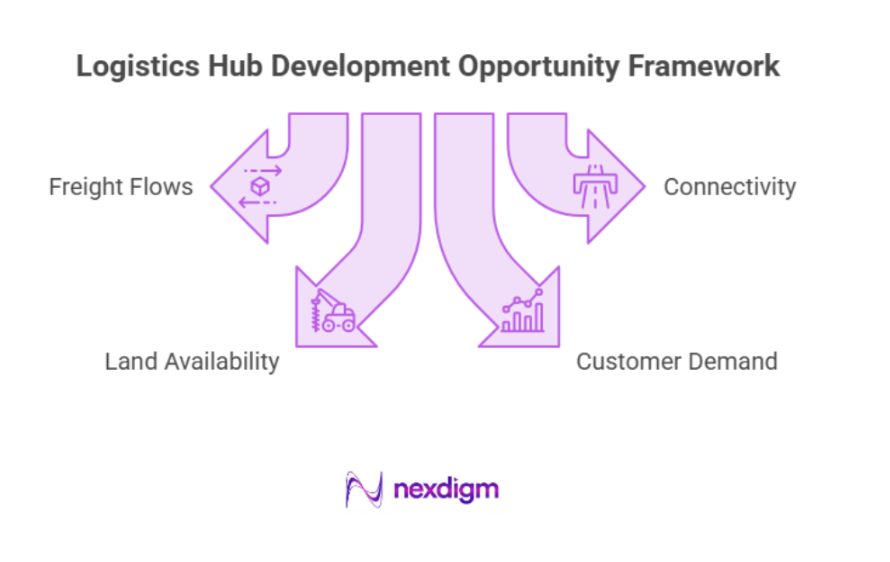
- Freight Flows: Nexdigm maps cargo origins, destinations, volumes, commodity types, trade corridors, and industrial activity to identify locations positioned around strong and growing freight movements.
- Connectivity: The assessment evaluates highway, rail, port, airport, and intermodal access to determine how efficiently a proposed hub can connect suppliers, customers, and major freight corridors.
- Land Availability: Nexdigm examines land availability, zoning, facility requirements, utilities, development constraints, and expansion potential to determine whether a location can support scalable hub development.
- Customer Demand: The framework evaluates population, businesses, retailers, manufacturers, e-commerce activity, delivery patterns, and geographic demand to determine the potential customer base surrounding each location.
The framework connects freight, connectivity, land and customer demand, helping developers and operators identify locations where a logistics hub can achieve sustainable utilization and growth.
Business Impact of Logistics Hub Development Framework
Nexdigm’s framework has a direct business impact because it turns location research into measurable decisions around cost, utilization, service levels, and investment returns. This involves:
- Freight Flow Optimization: Identifies locations near major cargo corridors, reducing unnecessary transportation distances, empty movements, and network inefficiencies.
- Better Site Selection: Combines freight, customer demand, connectivity, and land factors to reduce the risk of choosing a strategically weak hub location.
- Lower Logistics Costs: Evaluates transportation access, land economics, facility requirements, and network structure to identify locations capable of improving overall distribution economics.
By connecting these benefits, businesses can make more informed development and investment decisions.
Nexdigm’s Case
A logistics operator took Nexdigm’s support to evaluate site selection and network capacity. Within 10 months, hub utilization increased 24%, transportation costs declined 17%, freight handling efficiency improved and delivery lead times fell 20%, supporting stronger returns and scalable regional expansion.
To take the next step, simply visit our Request a Consultation page and share your requirements with us.
Harsh Mittal
+91-8422857704