

Import-export data can help logistics businesses anticipate where cargo demand is changing, which trade lanes are expanding and where network capacity may need to be adjusted. It does not reveal every operational requirement, but it provides an evidence base for deciding which products, routes and markets deserve closer investigation.
Start With Product-Level Trade Data
National trade totals can hide important differences between products and destinations. A rise in imports may be driven by a narrow group of goods that require specialised storage, frequent replenishment or temperature-controlled transport. Another increase may involve bulk commodities with very different handling and infrastructure needs.
The World Trade Organization provides merchandise trade statistics by economy, product group and time period, with data available in both value and volume terms for relevant series. Comparing these measures helps distinguish changes in physical movement from changes driven primarily by prices or product composition.
For logistics providers, the next step is to map these trade changes to the relevant ports, inland routes, warehouses and delivery markets.
Translate Trade Growth Into Logistics Demand
Effective logistics import export analysis connects product-level trade flows with shipment frequency, handling requirements, route connectivity and capacity availability. The aim is to estimate what changing trade patterns could mean for the logistics network, rather than assume that every increase in imports creates an equivalent increase in demand for every logistics service.
Important indicators include:
- Cargo Volume: Track quantities and shipment frequency by product and destination.
- Transport Mode: Identify whether flows are likely to require maritime, air, road or rail services.
- Handling Requirements: Distinguish general cargo from temperature-controlled, hazardous, oversized or time-sensitive shipments.
- Route Concentration: Assess reliance on particular ports, corridors and border crossings.
- Capacity Fit: Compare projected requirements with available transport, storage and handling capacity.
Trade statistics should be interpreted alongside operational records. Customs data may identify the reporting partner without revealing the original manufacturer, final delivery location or precise transport mode. Shipment records and customer information are needed to validate these details.
Identify Network Opportunities And Constraints
The World Bank’s 2025 Logistics Performance Indicators 2.0 use shipment-level tracking data to assess connectivity, speed and reliability across international logistics networks. The analysis highlights how delays can accumulate at ports, transshipment hubs and inland checkpoints. This demonstrates why trade growth alone is insufficient for identifying where additional logistics capacity will be useful.
For example, an increase in exports from a manufacturing region may create demand for consolidation facilities, container availability and more frequent outbound services. However, if the main port is congested or inland transport is unreliable, adding warehouse capacity alone may not resolve the underlying constraint.
Logistics providers should compare trade flows with service frequency, actual transit times, equipment availability, storage utilisation and customer delivery requirements. This helps distinguish a genuine capacity gap from a temporary peak or a change in shipping routes.
The Trade Data to Logistics Planning Framework
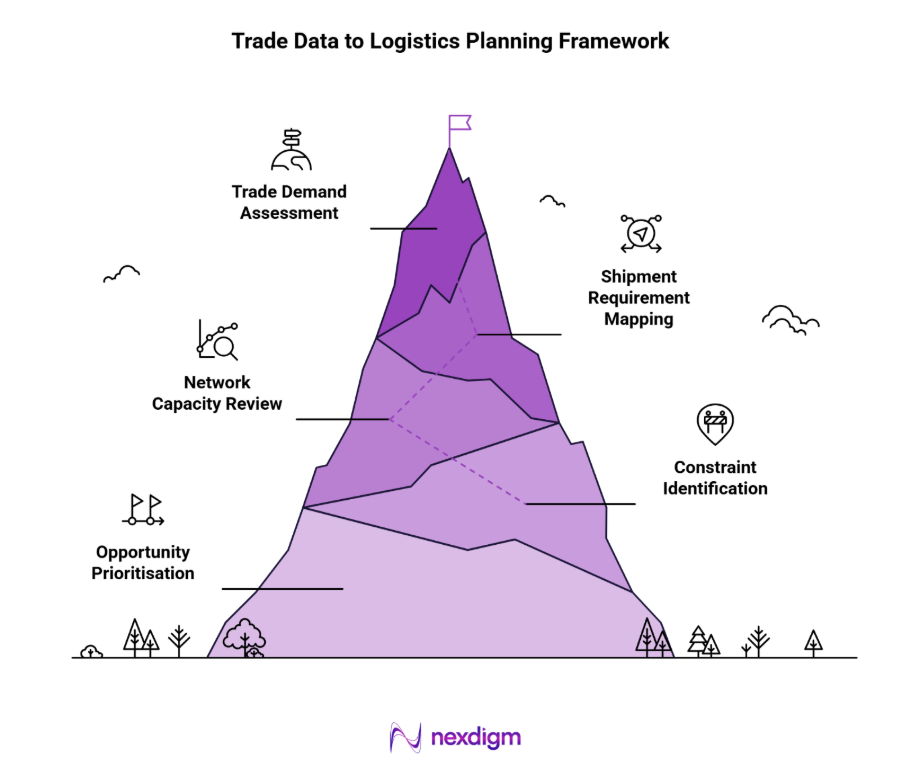
- Trade Demand Assessment: Identify products, destinations and sustained changes in import-export volumes.
- Shipment Requirement Mapping: Determine transport modes, handling needs, shipment frequency and delivery expectations.
- Network Capacity Review: Compare trade requirements with ports, routes, warehouses and available equipment.
- Constraint Identification: Locate bottlenecks in connectivity, clearance, storage or transport availability.
- Opportunity Prioritisation: Select services, routes or infrastructure changes based on demand evidence and commercial feasibility.
Case Study: Planning Capacity Around Trade Growth
A logistics provider reviewed product-level import data across five destination markets and compared it with warehouse utilisation and transport schedules. Two markets showed sustained growth in cargo requiring regular replenishment. The provider prioritised service planning for those destinations and reviewed inland capacity before committing to additional space.
To take the next step, simply visit our Request a Consultation page and share your requirements with us.
Harsh Mittal
+91-8422857704